A generic value proposition is invisible on LinkedIn. Decision-makers scroll fast, and if your headline doesn't immediately reflect their situation, you've lost them.
This guide walks B2B marketers through exactly how to build, structure, and test a LinkedIn-specific value proposition — from the ICP research that makes it relevant to the testing process that proves it works.
Key Takeaways
- A strong LinkedIn value proposition answers: "Why should I care, right now, on this platform?"
- Strong value propositions pair a specific ICP and pain point with a differentiated mechanism and measurable outcome
- LinkedIn's professional context demands business outcomes, not lifestyle benefits or vague category promises
- Test your value proposition through LinkedIn ad creative before scaling spend
What to Know Before You Build Your LinkedIn Value Proposition
Most LinkedIn value propositions fail before a single word gets written. The research phase — ICP definition and competitive positioning — is where messaging either earns relevance or quietly becomes background noise in someone's feed.
Understand Your Ideal Customer Profile First
Without a well-defined ICP, you cannot write a value proposition that feels relevant. LinkedIn's Campaign Manager offers 20+ audience attribute categories, including job function, seniority, industry, and company size — but targeting precision only matters if your message matches the mindset of the person you're reaching.
Your ICP research for LinkedIn should capture:
- Job title and seniority — who specifically is making or influencing the decision
- Industry and company size — the context shaping their priorities
- Key responsibilities and performance metrics — what they're accountable for
- The specific business problem they're trying to solve — not a category, but a situation
- What they consume on LinkedIn — content types, topics, and the voices they follow
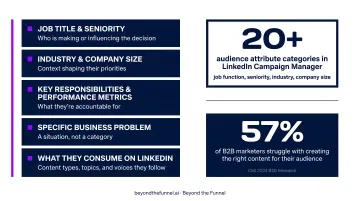
According to CMI's 2024 B2B research, 57% of B2B marketers struggle with creating the right content for their audience — which is really a symptom of weak audience definition upstream.
Conduct Competitive Research on LinkedIn Itself
Once you know who you're talking to, the next step is understanding what they're already hearing. Audit how competitors are positioning themselves — LinkedIn's Ad Library lets you search by company, keyword, and country to see active ad creative. Use it to identify:
- What category-level claims dominate your space (so you can avoid them)
- Which pain points competitors are addressing — and which they're ignoring
- Where positioning gaps exist that your value proposition can own
The Ad Library covers ads created after July 2025, so what you're seeing reflects what's actually running now. If every competitor in your space leads with "scale your pipeline faster," that's a gap — not a benchmark to match.
How to Create a Strong Value Proposition for LinkedIn
Creating a LinkedIn value proposition is a structured process, not a copywriting sprint. It moves from customer insight to a testable, specific statement your exact buyer will recognize as relevant.
Step 1: Define Your Target Buyer With Precision
Go beyond job title. Describe the specific situation your buyer is in right now.
Not "VP of Marketing" — but "a VP of Marketing at a SaaS company scaling past $5M ARR who is being asked to improve pipeline quality without increasing headcount."
That level of specificity signals to your LinkedIn audience that you understand their exact context. It's the difference between a message that makes someone think "this is for people like me" and one that gets scrolled past in three seconds.
Step 2: Name the Real Problem — Not the Category
There's a meaningful difference between a category description and a pain truth:
| Category Description | Pain Truth |
|---|---|
| "We help companies grow" | "Your LinkedIn ads are generating clicks but zero pipeline because your targeting is broad and your creative says nothing specific to anyone" |
| "We improve marketing performance" | "You're spending $15K/month on LinkedIn and your sales team still says the leads don't convert" |
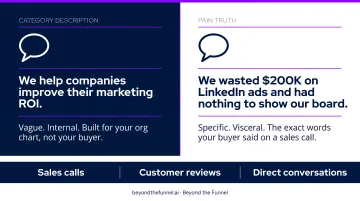
Use language from sales calls, customer reviews, and direct conversations — not internal jargon. The words your buyers use to describe their own problems are more powerful than the words your team uses internally.
Step 3: Define Your Differentiated Mechanism
A differentiated mechanism describes how you solve the problem in a way competitors cannot easily claim. It's not "we're experts" or "we use a proven process". Those phrases mean nothing.
Ask yourself: what is the specific method, framework, or approach that produces results for your clients?
For Beyond the Funnel, the differentiated mechanism is a testing framework developed across 1,000+ managed LinkedIn ad accounts. It validates audiences before scaling spend, refines ICP messaging through iterative creative testing, and connects awareness to conversion in a measurable full-funnel structure. That's specific. "We're LinkedIn experts" is not.
Your mechanism should be describable in one sentence and clearly distinct from how your competitors frame their approach.
Step 4: Anchor It to a Measurable or Tangible Outcome
"Drive growth" and "improve results" give buyers nothing to hold onto. State outcomes in terms they can visualize and compare against their current situation.
- Time saved per week (e.g., hours freed from manual reporting)
- Pipeline generated in a defined period, tied to specific campaigns
- Cost per lead reduced by X%, compared to a prior benchmark
- Conversion rate improved from X to Y across a defined funnel stage
Even directional specificity outperforms category language. "From guessing on LinkedIn to a repeatable growth system" is more compelling than "better LinkedIn performance" because it describes a transformation the buyer can picture.
Real results make this concrete. Evidation's former Head of Commercial Marketing credited Beyond the Funnel's strategy with taking their pipeline "from a few dozen to over 100 opportunities in one year." That's the kind of outcome language that earns attention.
Step 5: Compress It Into One or Two Clear Sentences
Use this framework as your starting point:
"We help [specific ICP] solve [specific pain] through [differentiated mechanism] so they can [measurable outcome]."
Test the statement with a simple question: can someone unfamiliar with your business understand it in under 10 seconds? If not, it needs more clarity — not more detail.
This compressed statement becomes the foundation for:
- LinkedIn ad headlines
- Profile summary and About section
- InMail and connection request copy
- Organic content hooks
Key Elements That Determine Whether Your LinkedIn Value Proposition Converts
Once written, your value proposition's performance depends on several specific variables. Understanding them helps you know what to test and what to fix when results underperform.
Clarity and Specificity
LinkedIn users scroll quickly. A headline that doesn't immediately reflect the buyer's situation won't earn a pause. "We drive business results" is invisible in a professional feed — it could describe anyone.
HockeyStack's analysis of 70+ B2B SaaS companies and $28M in LinkedIn ad spend found average CTRs of 0.82% in Q1 and 0.96% in Q3 — a narrow range where even small improvements in message relevance produce measurable results. When your headline speaks directly to a specific situation, the right buyers self-select.
Audience-Message Match
A value proposition that works for a CMO will likely miss a VP of Sales entirely. Their priorities, language, and definition of success are different — even within the same target company.
Forrester research confirms that B2B buyers overwhelmingly expect experiences personalized to their needs across both sales and marketing touchpoints. LinkedIn's targeting precision makes this achievable: you can reach CFOs of fintech companies with 500–5,000 employees separately from Marketing Directors at early-stage SaaS startups. But that precision is wasted if both audiences see the same message.
Segment-specific messaging doesn't mean rebuilding your value proposition from scratch. It means adapting the pain statement and outcome language for each audience while keeping the core mechanism consistent.
Social Proof and Credibility Signals
B2B buyers are risk-averse. The 2024 Edelman-LinkedIn B2B Thought Leadership Impact Report found that 73% of decision-makers say thought leadership is a more trustworthy basis for assessing capabilities than marketing materials — and 60% were willing to pay a premium to work with organizations that produce high-quality thought leadership.
Credibility signals that belong in your LinkedIn value proposition and creative:
- Specific client outcomes (pipeline numbers, conversion rates, time saved)
- Industry certifications or recognized expertise
- Named client results or logos where possible
- Data-backed claims from your own work
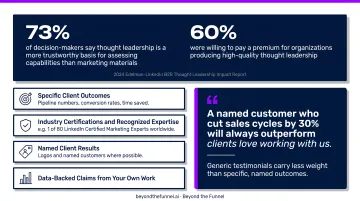
Generic testimonials carry less weight than specific, named outcomes. A named customer who cut sales cycles by 30% will always outperform "clients love working with us."
Testing and Iteration Through LinkedIn Ads
No value proposition should be declared final without real-world data. LinkedIn Campaign Manager includes a built-in A/B testing feature that lets you isolate one variable at a time and measure what resonates with your exact target buyer. The key variables worth testing:
- Headline framing and pain statement language
- Outcome claims (what you promise the buyer)
- Audience segment (CMO vs. VP of Sales vs. Founder)
- Creative format and visual approach
Beyond the Funnel's testing framework is built around this sequence: validate audiences and messaging before scaling spend, then build on each campaign cycle's learnings. That process stops brands from committing significant budget to the wrong message — and reveals which pain points and outcomes drive the highest-quality engagement from decision-makers.
Common Mistakes B2B Brands Make With Their LinkedIn Value Proposition
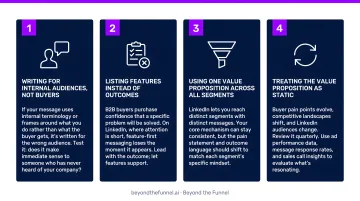
Most LinkedIn value proposition problems aren't about bad writing — they're about the wrong frame. Here are four patterns that consistently limit B2B performance on the platform.
Writing for internal audiences, not buyers. If your message uses internal terminology, references company history, or frames everything around what you do rather than what the buyer gets, it's written for the wrong audience. Run it through a simple test: does it make immediate sense to someone who has never heard of your company?
Listing features instead of outcomes. B2B buyers don't purchase features — they purchase confidence that a specific problem will be solved. On LinkedIn, where attention is short and buyers are evaluating multiple vendors simultaneously, feature-first messaging loses the moment it appears. Lead with the outcome and let features play a supporting role.
Using one value proposition across all audience segments. LinkedIn gives you the ability to reach distinct audience segments with distinct messages — a single universal value proposition leaves that leverage untouched. Your core mechanism can stay consistent, but the pain statement and outcome language should shift to match the specific mindset of each segment you're targeting.
Treating the value proposition as static. Buyer pain points evolve, competitive landscapes shift, and LinkedIn audiences change. A value proposition that converts today may underperform in six months. Review it quarterly. Use ad performance data, message response rates, and sales call insights to evaluate what's still resonating — and what needs to be updated.
Conclusion
A strong LinkedIn value proposition isn't the product of clever copywriting. It's the result of knowing your ICP precisely, naming the real pain honestly, describing your mechanism specifically, and anchoring it to an outcome your buyer can visualize.
The B2B brands seeing consistent LinkedIn performance treat their value proposition as a live asset — something they test against real audience data, refine based on what converts, and sharpen over time. The message is never finished; it's iterated.
If your current LinkedIn messaging isn't reflecting your ICP's real pain or your mechanism's real differentiation, that's where the work starts. Beyond the Funnel helps B2B brands pressure-test their positioning, validate audiences with real data, and build ad strategy around what actually moves buyers — not assumptions.
Frequently Asked Questions
What are the key elements of a value proposition for LinkedIn?
A strong LinkedIn value proposition includes four components: a specific ICP, a clearly named pain point, a differentiated mechanism for solving it, and a measurable or tangible outcome. Given LinkedIn's fast-scrolling professional context, clarity and brevity are non-negotiable. If it takes more than 10 seconds to understand, it needs editing.
What is the difference between a value proposition and a unique selling proposition on LinkedIn?
A USP describes what makes you different from competitors. A value proposition answers what that difference means for the buyer. On LinkedIn, the value proposition drives action because it speaks to buyer outcomes — not company attributes. Both matter, but the value proposition is what converts a scroll into a click.
Where should you place your value proposition on LinkedIn?
The three main placements are: your profile headline and About section (organic reach), ad headlines and primary text (paid campaigns), and connection request or InMail copy (outreach). Consistency across all three reinforces credibility and makes your positioning recognizable over time.
How do you test a value proposition for LinkedIn ads?
Run A/B tests using LinkedIn Sponsored Content with one isolated variable at a time: pain statements in headlines, outcome language in body copy, or audience segments. Measure click-through and conversion rates to identify which combination drives the highest-quality engagement from your target buyers.
What is the 5-3-2 rule on LinkedIn?
The 5-3-2 rule is a content-sharing guideline attributed to T.A. McCann: for every 10 posts, 5 should be curated content from others, 3 should be original content from you, and 2 should be personal or humanizing posts. It informs how consistently you reinforce your positioning through organic content.
What is the 3-2-1 rule on LinkedIn?
There isn't one universally agreed-upon definition — multiple versions exist, ranging from posting cadence guidance to content structure rules. One common interpretation refers to a posting and engagement habit: post 3 times per week, comment on 2 others' posts, send 1 direct message. Consistent presence amplifies your value proposition by keeping your expertise visible to your target audience over time.