Introduction
LinkedIn video watch time jumped 36% year-over-year, while video uploads climbed 34%, according to LinkedIn's own product data reported by Search Engine Journal. Video is quickly becoming the platform's default content type, not a nice-to-have.
Here's the problem: most B2B marketers are producing more video than ever, but a lot of it still gets scrolled past. Weak hooks, no captions, ads built for a funnel stage they don't actually serve. It's a lot of effort for very little pipeline impact.
This guide breaks down the creative, technical, and targeting practices that actually move the needle in 2026. It's built on lessons from Beyond the Funnel's work managing more than 1,000 LinkedIn ad accounts, and it skips the generic advice you've already read three times this year.
Key Takeaways
- Video is LinkedIn's fastest-growing content format, and B2B brands that ignore it risk losing pipeline.
- Your first 3-5 seconds decide whether someone watches or scrolls; so sound-off design is essential.
- Length, content type, and CTA all need to match the funnel stage you're actually targeting.
- One-off video ads don't scale, but ongoing A/B testing turns them into a repeatable channel.
Why LinkedIn Video Ads Matter for B2B in 2026
Video is outpacing every other content type on LinkedIn right now. That growth is happening at the same time LinkedIn's overall ad business is expanding fast, with ad revenue forecast to hit $8.2 billion in 2025, up 18.3% year-over-year, according to WARC's advertising forecast. More brands are competing for the same feed real estate.
That's the risk. The opportunity is who's watching.
The Audience Behind the Numbers
LinkedIn's user base skews heavily toward the people who actually sign purchase orders:
- 4 in 5 members influence business decisions at their company
- LinkedIn's audience carries 2x the buying power of the average web audience
- Millions of senior-level professionals, executives, and decision-makers are active daily
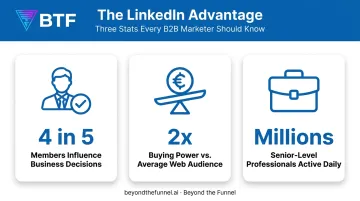
A well-made video ad on LinkedIn reaches people already primed to evaluate B2B solutions, not a general audience where only a fraction might be relevant.
That's the audience this guide is built for, and the practices behind it come from real experience, not theory. Beyond the Funnel's founder, Joshua Stout, is one of 80 LinkedIn Certified Marketing Experts worldwide and one of just 16 in the U.S. The recommendations here draw on patterns observed across more than 1,000 managed LinkedIn accounts, not a single case study dressed up as a trend.
Pre-Production Best Practices: Building Videos That Get Watched
Most video ads fail before a single frame gets shot. They fail in planning, when nobody accounts for how people actually scroll LinkedIn: fast, muted, and unforgiving.
Win the Hook Window
LinkedIn recommends capturing attention within the first 3-5 seconds, with your logo or core message appearing by the 10-second mark. Attention on a feed doesn't build slowly; it's captured immediately or lost.
Tactics that work:
- Open with a bold, specific stat relevant to your audience's pain point
- Ask a direct question your buyer is already asking themselves
- Use a visual surprise or unexpected pattern break in the first frame
Across the 1,000+ LinkedIn accounts we've managed at Beyond the Funnel, ads opening with a specific, relevant stat consistently earn more attention than generic brand intros.
Match Length to Objective
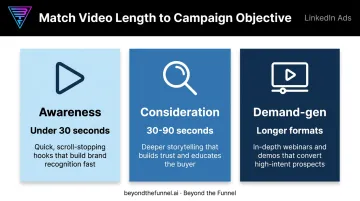
Don't default to one video length for every campaign. LinkedIn's own guidance ties shorter runtimes to better completion rates:
- Under 30 seconds for awareness campaigns, where completion matters most
- 30-90 seconds for consideration content that needs a bit more room to build a case
- Longer formats for demand-gen storytelling, webinar recaps, or detailed product walkthroughs
Design for Sound Off
Almost 80% of LinkedIn video ads are watched with the sound off, per LinkedIn's own Marketing Solutions guide. If your message only lands with audio, you're losing most of your audience before they hear a word.
Compensate with:
- Burned-in captions (not optional in 2026)
- Bold on-screen text carrying the key message
- Expressive visuals that communicate tone without narration
Specs and Production Basics
Current LinkedIn video ad specs to keep production teams from wasting a shoot:
| Element | Requirement |
|---|---|
| Orientation | 16:9, 1:1, 4:5, or 9:16 |
| File format | MP4 (H.264 or VP8) |
| File size | 75 KB to 500 MB |
| Duration | 3 seconds to 30 minutes (15-30 seconds recommended) |
| Captions | SRT file upload in Campaign Manager |
Beyond specs: steady shots, decent lighting, and clean audio still separate a credible B2B ad from one that reads as an afterthought. You don't need a studio, but you do need to avoid shaky handheld footage and echoey audio.
Crafting Video Content That Matches Each Funnel Stage
Most brands use video at every funnel stage, but they use the wrong video for the wrong stage. A product demo shown to a cold audience feels like a pitch nobody asked for, while a brand story shown to a warm, ready-to-buy prospect wastes their time.
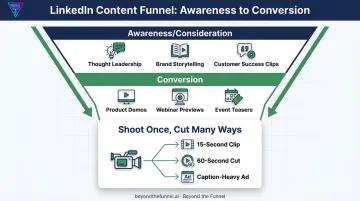
Awareness and Consideration Content
Early-funnel viewers aren't ready for a sales pitch. What works instead:
- Thought leadership clips that share a genuine point of view
- Brand storytelling that feels human, not scripted
- Customer success snippets that let the results speak
Authenticity consistently beats polish at this stage. Decision-makers scroll past anything that reads as a corporate banner ad. A recognizable founder, exec, or team member talking directly to camera earns more stops than a studio-produced brand spot, simply because it doesn't look like an ad.
As prospects move closer to a decision, that same preference for real people needs to translate into specifics they can act on.
Conversion-Focused Content
Further down the funnel, specificity wins:
- Quick product demos that answer "how does this actually work"
- Webinar previews that create urgency around a date
- Event teasers tied to a single, clear landing page
That same preference for real people over polished brand messaging carries through here. LinkedIn's Thought Leader Ads let you sponsor video posts from employees, executives, or approved creators instead of the brand page. Since decision-makers trust people more than logos, the format is worth testing at every funnel stage, not just awareness.
Whatever content type you choose, keep the ad copy and headline doing separate work from the video. Copy should reinforce the message with a clear, specific CTA, not just repeat what's already on screen.
One last practical note: shoot once, cut many ways. A single interview or demo can become a 15-second awareness clip, a 60-second consideration cut, and a caption-heavy conversion ad, without a second production day.
Targeting and Campaign Setup Best Practices
Great creative loses money fast if it's aimed at the wrong audience or bid the wrong way.
Before targeting even enters the picture, build enough creative variety: LinkedIn recommends 4-5 ad variations per campaign. Fewer than that limits optimization headroom, since the algorithm doesn't get enough signal to identify what's actually working.
Don't Over-Narrow Your Targeting
Start broad. LinkedIn's own guidance suggests location plus no more than two additional targeting criteria to start. Stacking five or six filters on day one usually shrinks your audience before you've collected any real data on who converts.
Refine from there using actual performance data, not assumptions about who "should" respond.
Match Bid Strategy to Objective
| Objective | Bid type | Why |
|---|---|---|
| Awareness / impressions | CPM | Pay for reach, not action |
| Lead generation / clicks | CPC | Pay only when someone acts |
| View-focused campaigns | CPV | Pay for qualified video views |
Automated bidding (maximum delivery or cost cap) works well when scale matters more than tight cost control. Manual bidding gives more precision but demands active monitoring.
Validate, Don't Assume
This is where a lot of B2B campaigns fail. Marketers guess which job titles or industries will engage, launch based on that guess, and never revisit it.
Beyond the Funnel's audience validation approach flips that script. Test broad segments early, then use real engagement and demographic data to confirm who's actually watching and converting. Scale only the segments that prove out.
Testing and Optimizing Video Ad Performance
A video ad that launches and never gets touched again is a one-time bet, not a growth channel.
Test One Variable at a Time
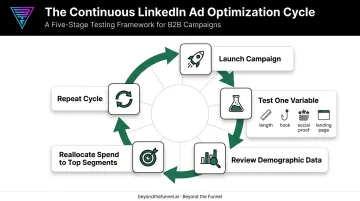
Structured A/B testing means isolating a single change per test:
- Video length: Does a shorter cut lift completion rate?
- Opening hook: Does a stat outperform a question?
- Social proof: Does a customer clip beat a founder talking-head?
- Landing page: Does a dedicated page outperform a generic one?
Changing multiple variables at once tells you almost nothing about what actually caused the result.
Use Demographic Reporting to Reallocate Spend
Campaign Manager reports on job title, seniority, industry, company size, and location for the people engaging with your video. Watch for which segments show the highest view and completion rates, then shift budget toward them rather than spreading spend evenly across an unproven audience.
Make Testing Continuous, Not a Launch Event
Accounts that scale keep testing after launch, while accounts that plateau usually stop once the campaign goes live. Beyond the Funnel's testing framework, built across more than 1,000 managed accounts, treats every campaign cycle as a chance to validate one more assumption rather than a "set it and check back in a quarter" exercise.
Frequently Asked Questions
What are the 5-3-2, 3-2-1, and 4-1-1 rules for LinkedIn content?
These are organic content-mix guidelines (ratios of curated, original, and promotional posts) rather than paid video rules. They're useful for planning your organic LinkedIn presence, but they don't dictate how you should structure a paid video ad campaign.
What types of videos perform best on LinkedIn?
Short educational clips, customer testimonials, and thought-leadership or behind-the-scenes content tend to perform well. Talking-head formats that feel personal generally outperform polished, corporate-style production.
How long should a LinkedIn video ad be?
Under 30 seconds works best for awareness campaigns focused on completion rate. Longer formats (30-90 seconds or more) can work for consideration or demand-gen if the video tells a complete story.
Should LinkedIn video ads have sound?
Sound should enhance the message, never carry it. Roughly 80% of viewers watch muted, so captions and on-screen text should always be the default.
How much does LinkedIn video advertising cost?
Cost depends on your bid type (CPM, CPC, or CPV) and how competitive your audience is. Budgets should align with your objective rather than a flat industry benchmark.
What's the biggest mistake B2B brands make with LinkedIn video ads?
Launching a single ad with a weak hook and no sound-off design, then never testing variations. Most underperforming accounts suffer from poor structure, regardless of how much budget is behind them.