Introduction
LinkedIn now counts more than 1 billion members in its search index, according to LinkedIn's own Sales Navigator page. That's the largest concentration of business decision-makers on any platform, period.
But scale doesn't equal results. Many B2B teams post content, send connection requests, and still watch qualified leads trickle in at a fraction of what the platform should deliver.
The gap usually comes down to strategy, targeting, and consistency.
This guide breaks down a step-by-step framework for generating leads on LinkedIn, the variables that drive real results, and the mistakes draining your pipeline before it ever fills up.
Key Takeaways
- Organic content, personalized outreach, and paid ads work best together—not in isolation
- Profile optimization and precise targeting form the foundation for everything else
- Consistent content mix drives visibility; sporadic promotional posting kills it
- Paid campaigns need testing before scaling—not guesswork
- Most underperformance traces back to generic messaging, not the platform itself
How to Generate Leads on LinkedIn: A Step-by-Step Framework
Step 1: Define Your Ideal Customer Profile and Target Audience
Before writing a single post or sending one connection request, know exactly who you're targeting.
Build filters around:
- Firmographics: industry, company size, revenue range
- Job titles and seniority: decision-makers vs. influencers vs. end users
- Behavior patterns: what content they engage with, groups they follow
LinkedIn's native targeting works for basic campaigns. Sales Navigator's advanced filters go deeper, letting you save custom lead lists and track when prospects change roles. Map each persona to specific pain points so later messaging feels relevant, not generic.
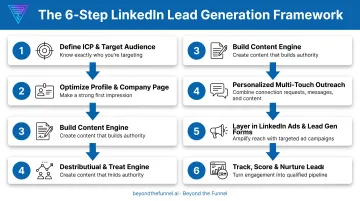
Step 2: Optimize Your Profile and Company Page
A weak profile undermines everything downstream. Before someone accepts your connection request or clicks your ad, they check your profile.
Update these essentials:
- Professional photo that looks current and approachable
- Keyword-driven headline describing who you help, not just your job title
- Banner image communicating your value proposition at a glance
- About section framed around client problems solved, not a resume
A complete, active profile also feeds your Social Selling Index, LinkedIn's metric for professional brand strength, network quality, and engagement. Microsoft's breakdown of the four SSI pillars covers how well you establish your brand, find the right people, share insights, and build relationships.
A stronger presence here builds trust before the first message even lands.
Step 3: Build a Consistent, Value-First Content Engine
Purely promotional feeds get scrolled past. Mix formats instead:
- How-to posts that teach something specific
- Short storytelling posts tied to a client win or lesson learned
- Polls that spark quick engagement
- Original commentary on industry trends
Posting-cadence frameworks help here (more on the 5-3-2 and 3-2-1 rules in the FAQ below). The goal is balancing curated content, original thought leadership, and personal posts so your audience doesn't feel marketed to every time you show up in their feed.
Step 4: Run Personalized, Multi-Touch Outreach
Generic pitches get ignored, or worse, reported. Combine connection requests, thoughtful comments on prospects' posts, and InMail using real personalization: name, role, and something specific from their recent activity.
LinkedIn does enforce invitation limits to protect account health. The official LinkedIn Help page confirms limits apply to Basic and Premium accounts, though it doesn't publish an exact weekly number. Once you hit the cap, the restriction typically lasts about a week and can't be lifted early.
Sales Navigator users get 50 monthly InMail credits for reaching prospects outside their network. Respect these limits. Volume without personalization just burns credibility faster.
Step 5: Layer in LinkedIn Ads and Lead Gen Forms to Scale
Organic and outreach efforts have a ceiling. Paid campaigns break through it.
Sponsored Content, Message Ads, and native Lead Gen Forms pre-fill fields like name, title, company, and location directly from a member's profile. That reduces friction and typically improves form completion since prospects aren't stuck typing on mobile.
The variable that actually separates results here is testing:
- Audience segments
- Creative angles and formats
- Offer types (demo, guide, webinar, free trial)
Beyond the Funnel's founder, Joshua Stout, is one of 80 LinkedIn Certified Marketing Experts worldwide. His agency's model centers on validating audiences with real data before committing budget, then scaling only what's proven. That testing framework, refined across more than 1,000 managed LinkedIn ad accounts, is often what keeps campaigns compounding instead of plateauing.
Step 6: Track, Score, and Nurture Leads
A lead that never gets followed up on isn't a lead. It's a wasted click.
Set up basic lead scoring or persona-matching so your sales team knows which form-fills or InMail replies deserve immediate attention. Connect LinkedIn campaign data to your CRM for full-funnel visibility. Without that connection, you're guessing at ROI instead of measuring it.
When Does LinkedIn Lead Generation Make Sense?
LinkedIn lead gen works best for B2B companies targeting specific job titles or industries, especially when sales cycles run long and deal values run high. Think SaaS, finance, technology, and healthcare—sectors where Beyond the Funnel focuses its client work.
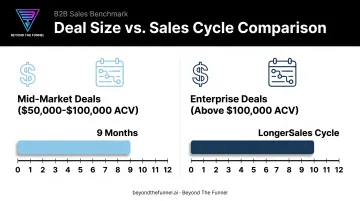
That fit shows up in the data. Norwest's 2024 B2B Sales & Marketing Benchmark Report, based on a survey of 195 sales and marketing leaders at VC- and PE-backed companies, found that mid-market deals averaging $50,000 to $100,000 in annual contract value carried an average 9-month sales cycle. That timeline is nearly as long as enterprise deals above $100K—exactly the kind of considered, multi-stakeholder purchase where LinkedIn's targeting precision pays off.
It becomes far less efficient for:
- Low-cost B2C products
- Hyper-local businesses whose buyers aren't concentrated on the platform
- Short, impulse-driven sales motions that don't need multi-touch nurturing
Even in strong-fit scenarios, LinkedIn alone rarely outperforms a combined approach. Pairing it with email nurturing, webinars, or search PPC for high-intent queries typically drives better full-funnel results than any single channel carrying the whole load.
Key Strategies That Separate High-Performing LinkedIn Lead Gen From the Rest
High performers rarely win on LinkedIn with one clever tactic. They stack the practices below until pipeline becomes predictable instead of sporadic.
Audience Targeting Precision
Narrow, validated targeting reduces wasted spend and wasted outreach. Assumption-based targeting—guessing who fits your ICP without testing—tends to produce low reply and conversion rates. Validated audiences, confirmed through real engagement data, consistently outperform guesswork.
Content-to-Outreach Ratio and Posting Consistency
Irregular or overly promotional posting erodes visibility. Structured posting-mix frameworks sustain engagement and inbound interest because they train the algorithm and your audience to expect consistent value rather than sporadic pitches.
Personalization Depth in Outreach and InMail
Generic templated messages get ignored or flagged. LinkedIn's Sales Navigator materials describe InMail as a tool for sending personalized messages to prospects outside your network, not mass blasts.
Depth of personalization matters more than message volume. Strong touches reference:
- A recent role change
- A shared connection
- A prospect's latest post or company news
Creative and Offer Testing in Paid Campaigns
Ad creative, offer type, and form length materially affect cost-per-lead and lead quality. One-off campaigns rarely repeat their success by accident. Continuous A/B testing of audiences and creative turns a single good result into a repeatable growth engine, the same principle behind Beyond the Funnel's testing framework across 1,000+ managed accounts.
Lead Follow-Up Speed and CRM Integration
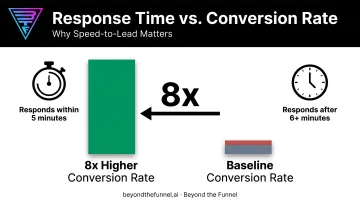
Response time decides whether leads convert or go cold. InsideSales' Lead Response Management research found inbound lead conversion rates are 8 times higher when a rep responds within 5 minutes versus waiting 6 minutes or longer. Instant routing through CRM integration directly improves close rates on form-fills and InMail replies.
Common Mistakes That Kill LinkedIn Lead Generation Results
Three habits sabotage most LinkedIn programs:
Broadcasting instead of engaging. Posting content without responding to comments, messages, or discussions turns a two-way platform into a one-way megaphone. Engagement signals matter to both your audience and LinkedIn's algorithm.
Scaling generic outreach. Sending unpersonalized connection requests or InMails at volume lowers reply rates and risks account restrictions. LinkedIn's invitation limits exist because mass, low-quality outreach hurts the platform experience.
Launching ads without validation. Running paid campaigns without a tested audience or clear testing plan wastes spend and produces low-quality leads. Validation separates campaigns that scale from ones that stall.
Conclusion
LinkedIn lead generation works when organic content, personalized outreach, and tested paid campaigns work together—not as isolated tactics.
When results stall, the cause is usually weak targeting, inconsistent content, or ad spend deployed before it's validated. Rarely is the platform itself the problem.
Brands that want predictable, data-backed LinkedIn growth can partner with Beyond the Funnel—led by a LinkedIn Certified Marketing Expert—to build and scale a full-funnel program grounded in testing, not guesswork. Schedule a strategy conversation to see where your current approach stands.
Frequently Asked Questions
What is the most effective LinkedIn lead generation strategy?
An optimized profile, value-first content, personalized outreach, and tested LinkedIn Ads with Lead Gen Forms outperform any single tactic. Continuous audience and creative testing is what locks in results for your brand.
What are the 5-3-2 and 3-2-1 posting rules on LinkedIn for lead generation?
The 5-3-2 rule suggests 5 curated posts, 3 original posts, and 2 personal posts per 10 pieces of content. The 3-2-1 rule, a weekly version, uses 3 industry posts, 2 personal-insight posts, and 1 personal story. Both keep you visible without turning every post into a pitch.
How long does it take to see results from LinkedIn lead generation?
Organic strategies typically take weeks to months to build trust and visibility. Paid campaigns can generate leads faster, but they still need a testing window, often around 15 days per LinkedIn's own guidance, before you optimize based on results.
Is LinkedIn Sales Navigator worth it for lead generation?
For teams doing consistent outbound prospecting, yes. Its 50+ filters, saved lead lists, and real-time alerts on role changes typically justify the cost for active outbound programs.
How many connection requests or messages should I send per week on LinkedIn?
LinkedIn enforces invitation limits to protect platform integrity, though it doesn't publish an exact weekly number. Personalization matters more than raw volume, and hitting the cap can trigger a week-long restriction.
Do I need LinkedIn Ads to generate B2B leads, or is organic enough?
Organic content and engagement can generate leads on their own. Ads, especially Lead Gen Forms, accelerate volume and precision targeting. The strongest programs combine both rather than relying on one alone.