Introduction
Most people who call themselves thought leaders on LinkedIn aren't. Their headlines say it, their bios claim it, but their content disappears into the feed without moving anyone's thinking.
Real thought leadership is earned. Decision-makers actively seek your perspective before they act. Your analysis shapes how your industry thinks — not just how many people engaged with your last post.
LinkedIn is where that recognition is built. According to the 2024 Edelman-LinkedIn B2B Thought Leadership Impact Report, 75% of decision-makers and C-suite executives said thought leadership led them to research a product or service they weren't previously considering. That's not a soft brand metric — that's pipeline influence before a single sales call happens.
This guide covers what genuine LinkedIn thought leadership actually requires: the right positioning, consistent content, community engagement, and the long-term discipline that turns visibility into real influence.
Key Takeaways
- Thought leadership is earned through consistent, well-reasoned ideas — not self-promotion.
- A fully optimized LinkedIn profile signals authority before anyone reads your content.
- Owning a specific niche beats trying to speak to everyone.
- Clear stances and genuine engagement compound into real influence over time.
- Combining organic content with LinkedIn advertising builds authority faster than either approach alone.
What LinkedIn Thought Leadership Really Means (and Why Most Get It Wrong)
Thought leadership isn't a badge. It's recognition — the kind that comes when others consistently seek out your perspective to inform their own decisions. The moment you put "thought leader" in your headline without substantiation, you've already undermined the claim.
Here's a sharper test: Would anyone stake their career, budget, or reputation on what you're saying? If the answer is no, you have content — but not yet thought leadership.
The Standard You're Working Toward
The 2024 Edelman-LinkedIn report puts the business case:
- 73% of B2B decision-makers trust thought leadership more than marketing materials for assessing capabilities
- 86% are more likely to invite high-quality thought leadership producers into the RFP process
- 60% said it made them willing to pay a premium to work with an organization
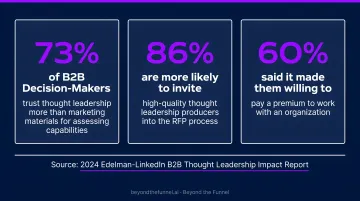
These aren't engagement metrics. They're purchase signals.
The Curse of Knowledge
Experienced practitioners make one consistent mistake: they assume their audience already understands their credibility and context. Every single post needs to re-establish who you are, the experience behind your perspective, and why this specific insight matters now. Skipping that step is how brilliant ideas get scrolled past.
Who Actually Qualifies
Genuine B2B thought leaders are founders, executives, practitioners, and subject matter experts with real-world results behind them. Client portfolios, measurable outcomes, industry recognition, hard-won failures — that's the evidence that makes a perspective worth trusting.
Joshua Stout, founder of Beyond the Funnel, holds the LinkedIn Certified Marketing Expert designation (1 of 80 worldwide, 1 of 16 in the U.S.) and is recognized in the top 3% globally by Marquis Who's Who — exactly the kind of verifiable proof that earns a seat at the table.
Thought leadership is also a long game. Demand Gen Report's 2024 buyer research found 80% of B2B buyers initiate first contact only when they're 70% through the buying journey, across an average cycle of 11.3 months. By the time a buyer reaches out, most of their decision is already made — which means your visibility during that silent research phase is what determines whether you're even in the conversation.
Optimize Your LinkedIn Profile for Thought Leadership
Your profile is your credibility hub. Before your content earns attention, your profile must signal that you're worth listening to.
Three elements that do the heaviest lifting:
- Headline — Communicate your specific expertise, not just your job title. "Founder | B2B LinkedIn Advertising Expert" outperforms "Founder at [Company Name]" every time.
- About section — Tell your story, establish your niche, and make it clear what you know that others don't.
- Banner image — A visual that reinforces your positioning. It's prime real estate that most people waste.
Optimizing Key Profile Sections for Authority
Each section of your profile plays a specific role in building credibility with first-time visitors:
- Featured Section: Your portfolio of proof. Highlight impactful original content, speaking engagements, case studies, and media appearances — it answers "why should I listen to you?" before anyone scrolls further.
- Experience and Skills: Specificity wins. "Grew pipeline from 30 to 100+ qualified opportunities in 12 months" builds far more authority than "managed LinkedIn campaigns."
- Recommendations and Recognition: Certifications, awards, and peer endorsements signal that others vouch for your expertise. Joshua Stout's LinkedIn Certified Marketing Expert status and Marquis Who's Who recognition both appear prominently in his profile — reinforcing credibility at every touchpoint.
What to avoid:
- Salesy language or self-labels like "thought leader" without substantiation
- Inconsistency between stated values and posted content
- Anything that presents an unprofessional image
- Downplaying achievements out of misplaced humility — your audience makes trust decisions based on everything they can see
Discover and Own Your LinkedIn Niche
Broad, generic content appeals to no one in particular. Focused expertise on a defined topic builds a loyal, relevant audience that actually needs what you know — and keeps coming back for more.
Finding your sweet spot requires three things to intersect:
- Your area of deepest expertise
- Timely, relevant industry trends
- Your target audience's most pressing pain points
Researching Your Competitive Space
Search relevant hashtags and industry keywords on LinkedIn. Study what the most-followed voices in your space cover regularly. Then look for what's missing: the question nobody's asking directly, the angle that's underrepresented, or the position that runs against the grain of accepted advice.
Taking a data-backed contrarian stance earns far more attention than content that confirms what everyone already believes. A post that challenges a widely held assumption in your industry — backed by real numbers or firsthand experience — will consistently outperform a generic tips list.
A few moves worth making during your research:
- Track which topics generate genuine debate in the comments (not just likes)
- Note the questions your prospects ask repeatedly that no one addresses directly
- Identify where established voices oversimplify or skip nuance
- Find the intersection between your expertise and an underserved audience concern
Turning Your Niche Into a Key Message
Your niche needs to become a simple, repeatable articulation of your point of view — a key message that anchors all your content. It should reflect:
- Your specific expertise
- Your audience's primary goals
- The unique lens you bring to the industry
When someone follows you for two weeks, they should be able to describe exactly what you stand for.
Create LinkedIn Content That Builds Real Authority
Sharing others' work or posting generic observations won't build authority — your audience needs your voice, your analysis, and positions you're willing to defend. That's what separates a thought leader from a content aggregator.
The 2025 Edelman-LinkedIn report offers clear guidance on what hidden decision-makers actually want from thought leadership content:
- 86% wanted fresh perspectives that challenge assumptions
- 65% preferred a more human, less formal tone
- 57% favored quick takeaways over deep, academic-style content
Those three data points tell you exactly what to build toward. Here's how to put them into practice.
Content Formats and Posting Strategy
The formats that work:
| Format | Best For |
|---|---|
| Short-form text posts | Opinion pieces, hooks, perspective-driven takes |
| LinkedIn articles / newsletters | Deep analysis, evergreen authority, subscriber relationships |
| Native video | Humanizing your expertise, accessible delivery |
| Document / carousel posts | Structured data-rich insights that earn saves and shares |
A mix of formats serves different segments of your audience and different moments in the algorithm's attention cycle.
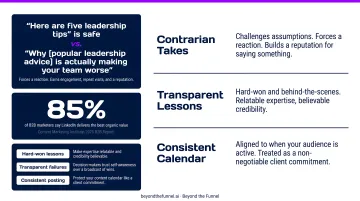
The difference between forgettable content and thought leadership is a position. "Here are five leadership tips" is safe. "Why [popular leadership advice] is actually making your team worse" forces a reaction — readers either nod, push back, or reconsider their assumptions. That reaction earns engagement, repeat visits, and a reputation for actually saying something.
Hard-won lessons, transparent failures, behind-the-scenes perspective — these make your expertise relatable and your credibility believable. Decision-makers trust people who demonstrate self-awareness over those who only broadcast wins.
According to Content Marketing Institute's 2025 B2B report, 85% of B2B marketers said LinkedIn delivered the best organic value among all social platforms — but that value accrues only for those who post consistently. Build a content calendar aligned to when your target audience is most active. Protect it like a client commitment.
Build Community Through Engagement and Strategic Amplification
Thought leadership is a conversation, not a broadcast. Actively engaging with other thought leaders in your space — commenting with substantive insights, asking questions that deepen discussion, sharing content with your own framing — builds reciprocal visibility and positions you as a peer rather than a megaphone.
Being visible in the comment sections of prominent voices in your niche exposes you to their audiences. Done well, a single thoughtful comment can drive more relevant profile visits than an average post.
Practical amplification steps:
- Respond promptly to every comment on your posts — early engagement matters for algorithmic distribution
- Send personalized connection requests after meaningful interactions
- Use LinkedIn newsletters to build a direct subscriber relationship that exists outside the algorithm's control
Once your organic content is consistently resonating, it's worth asking whether the right people are actually seeing it. That's where paid amplification enters.
When Organic Meets Paid
Pairing strong organic thought leadership with LinkedIn's Thought Leader Ads extends your reach to precisely targeted B2B audiences — without starting from scratch on credibility.
This is a core part of the full-funnel LinkedIn strategy at Beyond the Funnel: organic content builds authentic credibility, while paid amplification ensures that credibility is seen by the right people at scale. Organic content earns trust; paid distribution makes sure decision-makers actually encounter it when it matters.
The 2025 Edelman-LinkedIn research found 95% of hidden decision-makers said strong thought leadership made them more receptive to sales and marketing outreach. That receptivity doesn't happen without sustained exposure — and paid amplification closes the gap between content quality and audience reach.
Track Progress and Stay Consistent for the Long Game
Follower count is a lagging indicator. The signals that actually matter are:
- Inbound connection requests from your target audience
- Comments demonstrating your content changed someone's thinking
- Invitations to speak, collaborate, or contribute to industry publications
- Content being shared into networks you didn't reach organically
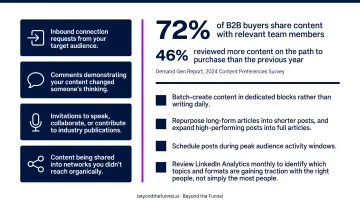
That last signal matters more than most people track. Demand Gen Report's 2024 Content Preferences survey found 72% of B2B buyers share content with relevant team members and 46% reviewed more content on the path to purchase than the previous year. Your content moves through buying committees you may never directly reach — consistency keeps it in circulation.
Practical tactics for sustainable output:
- Batch-create content in dedicated blocks rather than writing daily
- Repurpose long-form articles into shorter posts, and expand high-performing posts into full articles
- Schedule posts during peak audience activity windows
- Review LinkedIn Analytics monthly to identify which topics and formats are gaining traction with the right people, not simply the most people
Frequently Asked Questions
How long does it take to become a thought leader on LinkedIn?
Meaningful recognition typically builds over 6 to 12 months of consistent, high-quality posting. The timeline depends on posting frequency, niche specificity, and the depth of expertise being shared — consistency and relevance compound over time in ways that one-off viral posts simply don't.
How often should I post on LinkedIn to build thought leadership?
Most practitioners recommend 3 to 5 times per week for consistent visibility, but quality and consistency matter more than volume. Two well-reasoned, original posts a week will build more authority than five recycled takes with nothing new to say.
What types of content perform best for B2B thought leadership on LinkedIn?
Short-form opinion posts with strong hooks consistently drive reach, document and carousel posts work well for structured insights, and LinkedIn newsletters build deeper engagement over time. The ideal mix depends on your audience's preferences and your own content strengths.
Do I need a large following to be considered a thought leader on LinkedIn?
No. Follower count is a lagging indicator, not a prerequisite. A small, highly engaged, industry-relevant audience carries more weight than a large disengaged one — real thought leadership is measured by quality of influence, not quantity of followers.
Can a company page build thought leadership, or does it need to be a personal profile?
Personal profiles significantly outperform company pages for thought leadership because people trust and engage with people — not logos. A company page supports brand credibility, but individual voices are where authority is built on LinkedIn.
What's the difference between a LinkedIn Top Voice and a thought leader?
LinkedIn Top Voice is a platform-bestowed designation recognizing consistent, high-quality contributions to specific topics. Thought leadership is a broader, earned reputation — the badge is recognition of a pattern of contribution, not proof of genuine influence. You can hold one without the other.