TL;DR
- LinkedIn offers three bidding strategies: Maximum Delivery (fully automated), Cost Cap (semi-automated with a target cost), and Manual Bidding (full advertiser control).
- LinkedIn's ad auction rewards both bid amount and ad relevance — a higher-quality ad can win placements over a higher bid.
- Manual Bidding is the recommended starting point for most B2B campaigns, especially when conversion data is limited.
- Cost Cap needs at least 100 conversions in the prior 30 days to perform reliably — without that history, it consistently underdelivers.
- Maximum Delivery works best for scaling proven campaigns, not for cost-sensitive launches starting from scratch.
What Is LinkedIn Ads Bidding?
LinkedIn ads bidding is the process by which advertisers compete in a real-time auction for the right to show their ad to a specific LinkedIn member. Your "bid" is the maximum amount you're willing to pay for a defined key result — a click, an impression, a lead form submission, or a video view.
Unlike a fixed-price placement, LinkedIn's auction-based system means cost is never guaranteed. It fluctuates based on competition, audience size, and ad quality.
One distinction that confuses many advertisers: bid type and charge type are not the same thing.
- Bid type (also called optimization target) controls how LinkedIn's algorithm prioritizes and delivers your ads
- Charge type determines what triggers a billing event — CPC, CPM, CPV, or CPS
According to LinkedIn's Marketing API documentation, the optimizationTargetType field governs the bidding model, while the costType field determines billing. These are configured separately in Campaign Manager.
Bidding is tied directly to campaign objectives. The objective you select determines which charge types and bidding strategies are available — not every combination is supported. That's what makes the full system worth understanding before you set a single dollar amount.
How LinkedIn's Ad Auction Works
The Second-Price Auction Model
LinkedIn uses what practitioners describe as a second-price auction: advertisers submit bids, the highest-ranked ad wins the placement, and the winner pays just above the second-highest bid (not their full maximum bid). This means you frequently pay less than your stated bid, which is worth keeping in mind when evaluating cost data.
The Four Factors That Determine Auction Outcomes
Practitioner sources consistently describe four sequential factors in LinkedIn's auction ranking:
- Targeting match — which ads are eligible to compete for a given member based on targeting criteria
- Bid amount and budget pacing — how your bid compares to competing advertisers
- Ad relevance score — LinkedIn's predicted probability that a member will take the desired action (pCTR for clicks, pLTR for leads, pVTR for video views)
- Final ad ranking — a combined score of bid value and relevance that determines placement
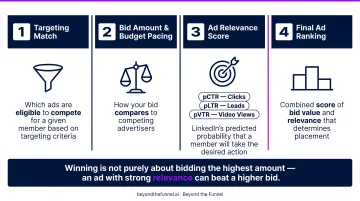
The critical implication: winning is not purely about bidding the highest amount. An ad with strong relevance can beat a higher bid. Creative quality, audience-message fit, and targeting precision all directly affect your actual cost per result — not just your bid.
Campaign Quality Score
Practitioners reference a Campaign Quality Score (CQS) — a 1–10 signal reflecting how a campaign performs in auctions relative to competitors targeting the same audience. It functions as LinkedIn's proxy for ad relevance. A low CQS typically indicates the algorithm predicts low engagement from your target audience, which raises effective costs.
Treat CQS as a directional signal, not an absolute optimization target. It tells you whether your creative and targeting are resonating. Conversion data remains your primary performance metric.
The Learning Phase
When a new campaign launches using Maximum Delivery, LinkedIn enters a data-gathering period. Results fluctuate while the algorithm learns which auctions to enter and which audiences respond. This is normal — but it's also why aggressive budget scaling early in a campaign often backfires, and why a controlled manual start frequently performs better during this window.
The 3 LinkedIn Ads Bidding Strategies Explained
Think of the three strategies as a spectrum: from full automation to full advertiser control. LinkedIn defaults new campaigns to Maximum Delivery — something worth evaluating consciously rather than accepting without question.
Maximum Delivery (Automated)
Maximum Delivery hands full control to LinkedIn's machine learning. The algorithm sets bids automatically, with one goal: spend the entire daily or lifetime budget while generating as many key results as possible. You set no bid. Per LinkedIn's official API documentation, Maximum Delivery campaigns are charged by CPM (impressions).
When it makes sense:
- Scaling a proven campaign with strong creative and established conversion history
- Brand awareness campaigns where cost-per-lead isn't the primary metric
- Very small, niche audiences where other strategies fail to deliver at all
Maximum Delivery prioritizes delivery over cost efficiency. The algorithm will bid whatever it takes to spend the budget — which means volume is maximized, but cost control is not.
Cost Cap
Cost Cap is semi-automated. You set a maximum average cost per key result, and LinkedIn's algorithm adjusts bids auction by auction, prioritizing lower-cost opportunities first.
One important nuance: the cost cap is an average target, not a hard ceiling. Some individual results will cost more, some less. The algorithm aims to keep the average within your stated cap over time.
The conversion history requirement matters. Practitioners widely cite approximately 100 conversions in the prior 30 days as the point where the Cost Cap algorithm has enough data to optimize reliably. WordStream's 2025 LinkedIn bidding guide notes that below this threshold, delivery issues and cost instability are common — the algorithm simply can't identify with confidence which auctions are worth entering. This is a practitioner benchmark, not an official LinkedIn eligibility rule, but it holds up consistently across experienced accounts.
Manual Bidding
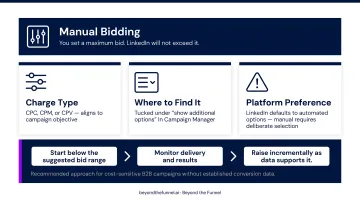
Manual Bidding gives you complete control. You set a maximum bid; LinkedIn will not exceed it. Charge type aligns to your objective — CPC, CPM, or CPV depending on campaign configuration.
One practical note: LinkedIn tucks Manual Bidding under a "show additional options" dropdown in Campaign Manager. The platform clearly prefers automated options. That preference isn't necessarily wrong for all advertisers — but for cost-sensitive B2B campaigns without established conversion data, manual control frequently outperforms automated defaults.
The practitioner-recommended approach: start below the suggested bid range to find cheaper inventory, monitor delivery and results, then raise incrementally as performance data supports it.
How to Choose the Right LinkedIn Bidding Strategy
The decision comes down to two variables: campaign stage and primary goal.
A simple decision path:
Start with Manual → validate performance → test Cost Cap or Maximum Delivery as data accumulates
New Campaigns or Limited Conversion History → Manual Bidding
LinkedIn's machine learning for both Cost Cap and Maximum Delivery requires historical data to optimize effectively. Without it, automated strategies frequently overspend on low-quality impressions or underdeliver entirely.
Manual Bidding removes that dependency. You control the ceiling, gather real performance data, and build the foundation automated strategies need to function properly. Start below the suggested bid range to identify the cheapest available inventory before committing to higher spend — a straightforward way to manage costs early.
Established Campaigns with Conversion Data → Cost Cap
Cost Cap becomes viable once you have:
- A defined target cost per lead
- Approximately 100+ conversions in the prior 30 days
- Confidence that campaign creative drives consistent engagement
Using Cost Cap prematurely — before that conversion history exists — often leads to poor budget delivery. The algorithm can't identify which auctions to enter, so it either overpays or fails to spend at all.
Proven Campaigns Prioritizing Volume → Maximum Delivery
Maximum Delivery makes sense when:
- Full budget utilization is the priority
- Creative has demonstrated strong CTR — HockeyStack's 2025 analysis of $28M in LinkedIn ad spend found B2B SaaS campaigns averaging 0.82%–0.96% CTR, with top performers exceeding 1.0%
- The algorithm has conversion history to optimize against
If cost per result is the primary concern, Maximum Delivery is the wrong tool. It's built to spend budgets, not minimize CPL.
Ad Relevance Reduces Bidding Costs Across All Strategies
Ads with higher relevance scores win more auctions at lower effective costs. Three factors drive that advantage:
- Creative quality — compelling formats and copy that earn attention over interruptive ads
- Precise audience targeting — reaching the right segments rather than broad, unvalidated lists
- Message-to-audience fit — matching the offer to where buyers are in the funnel
Each of these lowers your cost of competing in the auction, regardless of which bid strategy you're running.
This is why Beyond the Funnel's full-funnel framework starts upstream: audience validation confirms which segments genuinely respond, and creative testing identifies what resonates before conversion-stage budget is committed. That early work directly reduces the cost of every auction entered downstream.
Common LinkedIn Bidding Mistakes to Avoid
Before adjusting your bidding strategy, it's worth recognizing where most advertisers go wrong. These three mistakes account for a disproportionate share of wasted LinkedIn ad spend.
Mistake 1: Blindly Trusting LinkedIn's Suggested Bid Ranges
LinkedIn's suggested ranges are calibrated to help advertisers be competitive and spend their full budget — not to find the lowest cost per result. Starting at or above the suggested range, particularly with manual or cost cap strategies, often inflates CPCs and CPMs unnecessarily.
A better approach:
- Start below the suggested range
- Monitor delivery over the first few days
- Increase bids only when performance data justifies it
Mistake 2: Switching to Maximum Delivery Too Early
Many advertisers switch to automated bidding before their campaigns have the data to support it. Without a proven CTR baseline and conversion history, Maximum Delivery typically results in high CPMs and inflated cost per lead — the algorithm bids aggressively with limited signal about what's actually working.
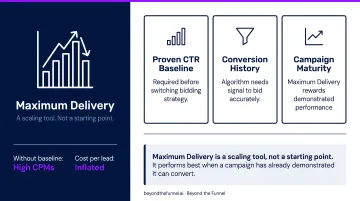
Maximum Delivery is a scaling tool, not a starting point. It performs best when a campaign has already demonstrated it can convert.
Mistake 3: Confusing Bidding Strategy with Campaign Objective
Some advertisers choose Maximum Delivery thinking it optimizes for their conversion goal — it doesn't. It optimizes for budget delivery.
What LinkedIn optimizes toward is set by your campaign objective and optimization goal. The bidding strategy controls how aggressively and with what constraints LinkedIn pursues that goal. These are separate levers, and mixing them up leads to campaigns that hit budget targets but miss business goals.
Frequently Asked Questions
Is manual bidding better than cost cap on LinkedIn?
For most new or mid-stage campaigns, manual bidding offers better cost control because it doesn't rely on conversion history the way cost cap does. Cost cap can outperform manual bidding at scale when strong conversion data exists, but without it, expect poor delivery and unpredictable costs.
How does the LinkedIn ad auction work?
LinkedIn uses a second-price auction where ads compete based on a combination of bid amount and predicted relevance score. The highest-ranked ad wins the placement and pays just above the second-highest bid, meaning stronger creative and tighter targeting can reduce your effective cost without raising your bid.
Why are LinkedIn's suggested bid ranges so high?
Suggested bid ranges are designed to keep advertisers competitive in the most contested auctions and ensure full budget delivery. They are not designed to minimize cost per result. Treat them as an upper-bound reference, not a target, especially for manual and cost cap strategies.
When should I switch from manual bidding to maximum delivery?
Switch to Maximum Delivery once campaigns show consistently above-average CTR and have enough conversion history for LinkedIn's algorithm to optimize against. Switching too early typically increases costs without improving results.
Does my ad's quality affect how much I pay in the LinkedIn auction?
Yes. LinkedIn's auction factors in a predicted relevance score: an estimate of how likely a member is to engage with your ad. Ads with higher relevance scores can win placements over higher bids, so better creative and tighter audience targeting directly lower your effective CPM or CPC.
How many conversions do I need before using cost cap bidding on LinkedIn?
While LinkedIn doesn't publish an official threshold, most practitioners cite 100 conversions in the prior 30 days as the point where the cost cap algorithm has enough data to optimize reliably. Below that level, expect delivery instability and inconsistent costs.