Run a Lead Gen Form against a cold, never-heard-of-you audience, and you'll pay a premium for leads that never respond to sales. Run a passive brand video against people who already know your product, and you're wasting impressions on prospects who are ready to convert right now.
This guide maps every LinkedIn campaign type to its ideal funnel stage, so you can stop guessing and start spending with intent.
Key Takeaways
- Match every campaign to a funnel stage—Awareness, Consideration, or Conversion—before you pick a format
- Pick formats by buyer intent, not popularity: video for cold, documents for warm, lead gen forms for hot leads
- Let budget, sales cycle length, audience size, and creative capacity decide which formats you can actually run
- Full-funnel LinkedIn strategies consistently outperform single-stage, "set it and forget it" campaigns
- Continuous testing turns one-off campaign wins into predictable, scalable growth
What Are LinkedIn Campaign Types?
LinkedIn campaign types are objective-based campaigns built in Campaign Manager, each tied to a specific marketing goal: awareness, consideration, or conversion.
Each objective unlocks a specific set of ad formats you can build and launch: Single Image, Video, Carousel, Document, Message, Conversation, Lead Gen Forms, and more. Your objective choice determines which formats are available.
The Three Campaign Objective Categories
LinkedIn's own advertising platform groups every campaign under three umbrellas.
- Awareness: Optimized for reach and impressions. Top-of-funnel formats include Single Image, Video, Text, and Follower Ads.
- Consideration: Built for mid-funnel website visits, engagement, or video views—typically with Carousel, Document, and Event Ads.
- Conversion: Drives leads, website conversions, or job applicants through Lead Gen Forms, Conversation Ads, and Message Ads.
Each objective locks you into a compatible set of formats. Select "Website Conversions" when your real goal is brand recognition, and you're stuck choosing between formats built to push for a click, not leave a lasting impression.
LinkedIn Campaign Types by Funnel Stage: A Decision Guide
Mismatched format-to-stage pairing is the single biggest reason LinkedIn budgets underperform. Marketers chase the format with the best-looking benchmarks, not the one their buyer is actually ready for.
Here's the quick-reference version before we break down each stage:
| Funnel Stage | Goal | Best Formats | Key KPIs |
|---|---|---|---|
| Awareness | Reach cold ICP audience | Single Image, Video, Thought Leader, Connected TV | Impressions, reach, CTR, video view-through rate |
| Consideration | Educate and build trust | Document, Carousel, Event, Article/Newsletter | Engagement rate, downloads, registrations |
| Conversion | Capture high-intent leads | Lead Gen Forms, Conversation Ads, Message Ads | Cost per lead, form completion rate, MQL-to-SQL rate |
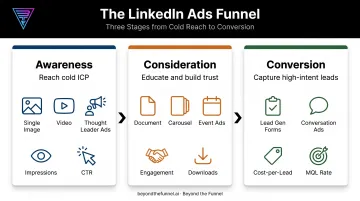
Top-of-Funnel (Awareness Stage) Campaigns
The goal here is reaching the widest relevant ICP audience and building recognition before they're sales-ready. Nobody converts off a cold impression, so don't ask them to.
Best formats for this stage:
- Single Image Ads - simple, cheap to produce, and effective for testing messaging at scale
- Video Ads - build recall and trust faster than static content, with no CTA pressure attached
- Thought Leader Ads - promote posts from executives, which feel native rather than promotional
- Connected TV Ads - extend reach into passive viewing moments outside the feed
These formats work because they demand low commitment and deliver high reach. A cold prospect isn't ready to fill out a form. They're ready to notice you exist.
KPIs to track: impressions, reach, CTR, and video view-through rate.
Middle-of-Funnel (Consideration Stage) Campaigns
The goal shifts here. You're no longer chasing visibility - you're educating a warmed audience and building trust with proof points.
Best formats for this stage:
- Document Ads - let prospects flip through a whitepaper or case study without leaving LinkedIn
- Carousel Ads - walk through a multi-step story or a product's feature set
- Event Ads - drive webinar registrations where prospects can ask direct questions
- Article/Newsletter Ads - promote long-form content that builds authority over time
These formats let prospects self-educate on their own timeline, which matters because B2B buyers rarely convert after a single touch.
KPIs to track: engagement rate, downloads, and registrations.
A common mid-funnel play: retarget website visitors who didn't convert with a Document Ad built around a relevant case study. It's a low-friction way to move someone from "aware" to "interested" without asking for a form fill yet.
Bottom-of-Funnel (Conversion Stage) Campaigns
At this stage, the goal is capturing high-intent leads and driving measurable pipeline from an audience that already knows your brand.
Best formats for this stage:
- Lead Gen Forms - pre-fill contact details from a prospect's LinkedIn profile, reducing friction to near zero
- Conversation Ads - deliver a 1:1, choose-your-own-path message inside a prospect's inbox
- Message Ads - send a direct, single-CTA message for time-sensitive offers like demo bookings
KPIs to track: cost per lead, form completion rate, and MQL-to-SQL conversion rate.
Sequential retargeting bridges the gap between stages: someone who watched an awareness-stage video ad later receives a Conversation Ad inviting them to book a call. That connects a passive impression to an active conversion step, so your top-of-funnel spend doesn't just sit unused.
Key Factors to Consider When Choosing Your LinkedIn Campaign Type
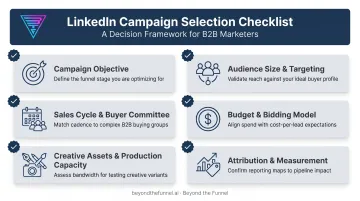
Funnel-stage theory only matters once it's connected to real budget and creative decisions. These are the variables that determine what's actually feasible.
Goal, Audience, and Sales Cycle Fit
Campaign objective. Your stated business goal, not the flashiest ad format, should dictate format selection. Choosing Conversation Ads for a cold audience, or Single Image Ads for a bottom-funnel push, inflates cost-per-result because the format is fighting the funnel stage instead of matching it.
Audience size and targeting. Narrow ABM-style audiences (think a list of 500 named accounts) need different formats than broad awareness plays. Conversation and Message Ads work well against small, high-value lists, but formats billed per send get expensive fast when the audience is too thin to generate volume.
Sales cycle and buyer committee. Long B2B sales cycles rarely convert off one ad. A six-month cycle involving a CFO, an IT director, and an end user usually needs a multi-touch sequence spanning awareness, consideration, and conversion campaigns, not a single Lead Gen Form launched in isolation.
Budget, Creative, and Measurement Reality
Budget and bidding model. CPC, CPM, and cost-per-send pricing vary by format, and LinkedIn's own advertising page confirms costs are auction-determined with no fixed rate. Practical implications:
- Small budgets stretch further on CPM-based awareness formats
- Cost-per-send formats (Message, Conversation Ads) need audience volume to stay efficient
- Test budgets should scale with each format's minimum viable audience size
Creative assets and production capacity. Video and Document Ads demand more production time than a Single Image Ad. Teams with limited design or video resources should start simple, prove the concept works, then scale creative investment once a format shows results.
Attribution and measurement. Conversion tracking through the LinkedIn Insight Tag and UTM parameters needs to be live before you scale conversion-stage spend. Without it, you can't tell whether a Lead Gen Form is producing real SQLs or just cheap form fills that go nowhere.
How Beyond the Funnel Can Help You Execute a Full-Funnel LinkedIn Strategy
Beyond the Funnel helps B2B brands match the right campaign type to the right funnel stage through data and creative testing.
Founder Joshua Stout is one of just 16 LinkedIn Certified Marketing Experts in the U.S. (80 worldwide). He has managed and optimized more than 1,000 LinkedIn ad accounts across SaaS, finance, technology, and healthcare.
That experience shows up in results. Michael Arbini, former Head of Commercial Marketing at Evidation, credits Josh with growing the company's LinkedIn pipeline from a few dozen opportunities to more than 100 in a single year. That lift came from mapping and executing a full-funnel strategy instead of running isolated lead-gen campaigns.
Beyond the Funnel's approach includes:
- Tests audience segments with real campaign data before scaling spend
- Shapes messaging and visuals from what audiences actually engage with
- Connects awareness, consideration, and conversion into one measurable system
- Delivers weekly metrics, optimization reviews, and clear next steps
This is the exact funnel-stage discipline covered above: test each format where it belongs, then scale what proves out.
Conclusion
Match your LinkedIn ad format to where your buyer sits in the funnel. A cold prospect needs a video, not a lead form. A warm one needs proof, not another impression. Engagement benchmarks matter far less than stage fit.
Campaign-type selection isn't a one-time decision, either. Buyer behavior shifts, competitors change their creative, and formats that worked last quarter can stall. Review performance by funnel stage regularly, not just by overall account totals.
Brands that treat LinkedIn as an ongoing experiment consistently outgrow those running one static campaign and hoping it holds. They test formats, retire weak ones, and build sequences across the funnel. Start with the stage your buyer is in today, then expand from there.
Frequently Asked Questions
What are the different types of LinkedIn campaigns?
LinkedIn campaigns fall into three objective categories: Awareness, Consideration, and Conversion. Awareness uses formats like Video and Single Image Ads, Consideration uses Document and Carousel Ads, and Conversion uses Lead Gen Forms and Conversation Ads.
How do I choose the right LinkedIn ad format for each funnel stage?
Match the format to buyer intent. Use reach-focused formats like Video or Single Image Ads for cold audiences, education-focused formats like Document Ads for warm audiences, and low-friction formats like Lead Gen Forms for ready-to-convert leads.
What is the difference between LinkedIn Campaign Manager's Classic and Accelerate modes?
Classic gives you manual control over targeting, bidding, and creative. Accelerate uses LinkedIn's AI to automate targeting, creative, bidding, and placement. LinkedIn reports up to 42% better cost per action versus Classic in tests from October 2023 to September 2024.
Which LinkedIn ad format is best for lead generation?
Lead Gen Forms paired with Single Image or Video Ads typically perform well because they pre-fill a prospect's contact details from their LinkedIn profile, removing the friction of an external landing page.
How much do LinkedIn ads cost for B2B campaigns?
Costs are auction-based and vary by industry, audience competitiveness, and format. One 2024 Databox benchmark found a median CPM of $30.19 across 127 contributors, though your actual cost depends heavily on how specific your targeting is.
Can I use multiple campaign types in a single LinkedIn funnel strategy?
Yes, and it's the recommended approach. Combining formats across stages, such as Video Ads for awareness, Document Ads for consideration, and Lead Gen Forms for conversion, builds a connected funnel instead of isolated campaigns.