Introduction
LinkedIn isn't just another channel in the B2B marketing mix anymore. It's the primary battleground for buyer attention, and the money backs it up. WARC forecasts LinkedIn's global ad revenue will hit $9.7 billion in 2026, up from $8.2 billion in 2025.
That growth tracks a real shift in how the platform works. AI-driven algorithm changes, a video-first feed, and smarter ad tools now decide what wins attention and what gets ignored.
Brands still running static image ads and hoping for the best are watching competitors pull ahead with predictable, repeatable pipeline growth. This guide breaks down the LinkedIn marketing trends shaping 2026, why they're happening now, and exactly how B2B brands need to adapt.
Key Takeaways
- Video and AI-powered ad tools now determine who gets seen by decision-makers on LinkedIn
- The algorithm rewards authentic conversation and dwell time over likes and reshares
- Full-funnel, account-based advertising has replaced one-off campaign tactics as the B2B norm
- Executive thought leadership and employee advocacy are core growth levers, not side projects
- Brands that test, measure, and adapt fast will outpace competitors still running last year’s playbooks
Key LinkedIn Marketing Trends to Watch in 2026
Trend 1: Short-Form Video Takes Over the Feed
LinkedIn has become a video platform. The "Videos For You" tab now spans mobile and desktop, full-screen playback mimics TikTok-style discovery, and LinkedIn's direct CapCut integration lets creators publish edited video straight to their feed.
The numbers back up the shift. LinkedIn video watch time grew 36% year-over-year, and video creation is climbing at 2x the rate of any other original post format on the platform.
Why it matters: video wins on reach and discoverability even when raw engagement sits slightly behind other formats. Socialinsider's 2026 benchmark study, which analyzed 1.3 million posts across 16,645 business pages, found:
- Multi-image posts: 6.60% average engagement
- Native documents: 6.10% average engagement
- Video: 5.60% average engagement
Video trails slightly on raw engagement rate but wins on reach and discoverability, especially as LinkedIn starts surfacing video in search carousels.
Trend 2: AI-Powered Ad Tools Become the New Standard
LinkedIn's Campaign Manager has turned into a predictive engine. Three tools now define how sophisticated advertisers plan:
- Accelerate: uses AI and platform-wide signals to predict ideal audiences and auto-optimize bidding and placements
- Media Planner: forecasts expected reach, spend, and likely ROI before a campaign ever launches
- Campaign Performance Digest: generates plain-text breakdowns of what's working and what isn't, on request
Picture a marketer with a $15,000 quarterly budget testing three audience segments in Media Planner before committing a dollar. They compare projected reach and cost curves for each scenario, then allocate spend to the combination with the strongest forecasted efficiency instead of splitting budget evenly and hoping.
Adoption is accelerating for a simple reason: budgets are tighter, and marketers need to justify spend with data before launch, not after.
Trend 3: Personal Brand and Employee Advocacy Outperform Corporate Pages
LinkedIn's algorithm has gotten better at spotting generic, AI-flavored corporate posts, and it's pushing them down in favor of content that sounds like an actual person wrote it. Thought Leader Ads make this official: brands can now sponsor an executive's or employee's organic post without stripping away their voice or reposting it through the company page.
One healthcare CEO campaign using this format saw follower growth jump 6x, adding over 20,000 followers at roughly $10 per follower, alongside a 45% lift in engagement rate. That's a case result, not a universal guarantee, but it illustrates the gap between human-led and brand-led content.
B2B buyers trust people, not logos. A founder's post about a hard-won lesson will almost always outperform a polished company announcement covering the same ground.
Trend 4: Full-Funnel, Account-Based LinkedIn Advertising
Single-format campaigns are losing ground to layered strategies that combine Sponsored Content, Sponsored Messaging, and Matched Audiences retargeting into one connected system. Awareness ads warm up a buying group, messaging ads nurture engaged prospects, and retargeting closes the loop with people who've already shown interest.
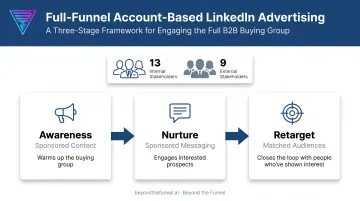
This shift tracks with how B2B buying actually works now. Forrester reports that a typical 2026 business buying decision involves 13 internal stakeholders and 9 external influencers. Single-touch campaigns simply can't reach that many people across a deal.
This is the challenge Beyond the Funnel built its framework to solve. Led by one of only 16 LinkedIn Certified Marketing Experts in the U.S., the agency validates audiences and creative with real performance data before scaling spend, rather than launching multi-format campaigns on assumption.
Evidation's Head of Commercial Marketing, Michael Arbini, credited founder Joshua Stout with mapping a full LinkedIn strategy that took their pipeline from a few dozen opportunities to over 100 in a single year, shifting from unpredictable wins to a repeatable growth engine.
Trend 5: Conversation-Driven Content Beats Passive Engagement
LinkedIn is starting to behave less like a broadcast feed and more like a professional Reddit. The algorithm now weighs meaningful back-and-forth comments and dwell time far more heavily than likes or shares. LinkedIn itself reported comments grew 24% in 2025, though some of that lift likely includes bot activity, so treat it as directional rather than pure organic signal.
Post formats that reliably spark real conversation include:
- Direct questions that invite a genuine answer, not a rhetorical one
- Personal stories with a specific, relatable stumble or lesson
- Short, line-broken text that reads more like a text message than a press release
- Contrarian takes on common industry assumptions
If your content isn't generating comments, it's probably not generating reach either.
What's Driving These LinkedIn Marketing Trends
These shifts aren't random. They're the product of technology, buyer psychology, and budget math converging at once.
- Technology: AI detection flags generic phrasing, and predictive ad tools raise the bar for efficient targeting
- Buyer expectations: Decision-makers research deeply before sales conversations and expect expertise, not a pitch
- Cost pressure: HubSpot benchmark data puts LinkedIn CPL at $110 vs. $70.11 for Google Ads and $84 across B2B—so ROI proof comes before scale
- Competition: LinkedIn ad revenue heading toward $9.7B in 2026 means more brands fighting for the same professional attention
The easy wins are gone. Winning now takes sharper targeting, stronger creative, and proof before you scale.
How These Trends Are Impacting B2B Companies
These trends are already reshaping day-to-day work for marketing, finance, and hiring teams.
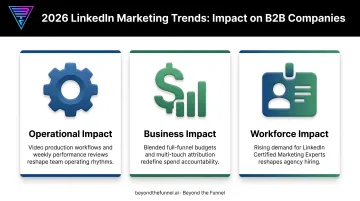
Operational Impact
Video production and AI-assisted analytics can no longer live on the sidelines as "nice-to-have" projects. Marketing teams need:
- Repeatable workflows for shooting and editing short video
- Weekly performance digest reviews instead of quarterly check-ins
Business Impact
Budgets are moving from single-format line items to blended, full-funnel allocations. Attribution models have to keep pace. A lead that converts after seeing three ad formats across two months needs multi-touch tracking, not last-click reporting.
Workforce Impact
Navigating Accelerate, Media Planner, and constantly shifting algorithm rules takes specialized skill. More companies are turning to LinkedIn Certified Marketing Experts, in-house or through agencies. Generalist social media hires increasingly struggle to keep pace with platform-specific complexity.
Future Signals for LinkedIn Marketing Beyond 2026
These indicators aren't fully mainstream yet, but they're worth tracking over the next one to three years:
- Creator monetization expansion — BrandLink (formerly Wire) already shows 130% higher video completion and up to 18% greater lead likelihood than standard video ads
- AI-identified buyer groups — automated stakeholder mapping will help marketers reach multiple decision-makers in one deal, not guess who else is in the room
- Video in search results — LinkedIn is testing video carousels in topic search, so video becomes discoverability content—not just feed content
Brands that act on these signals early—especially treating video as a search asset—will hold a clear head start once they go mainstream.
Conclusion
A winning 2026 LinkedIn strategy blends AI-powered ad tools that forecast before you spend, authentic content that sounds human, and full-funnel account-based targeting built around how buying groups actually operate.
Brands that adapt early will out-position competitors still running single-format, set-it-and-forget-it campaigns. Evidation’s jump from a few dozen opportunities to over 100 in a single year is what that shift looks like in practice.
Working with a LinkedIn Certified Marketing Expert at Beyond the Funnel helps B2B brands turn these trends into a predictable, revenue-driving LinkedIn program—not another experimental line item.
Frequently Asked Questions
What is the best strategy for LinkedIn marketing?
The best strategy blends organic thought leadership, employee advocacy, and full-funnel paid campaigns, validated through ongoing testing. Relying on a single tactic, whether it's just organic posting or just ads, leaves growth to chance.
What are the 3-2-1, 3-3-3, and 95-5 rules for LinkedIn marketing?
The 3-2-1 rule mixes three educational, two conversational, and one promotional post. Skip the Instagram-born 3-3-3 hashtag rule on LinkedIn. The 95-5 rule: only about 5% of B2B buyers are in-market, so prioritize awareness over hard sells.
How much does LinkedIn marketing cost in 2026?
Organic marketing costs only the time to create content consistently. Paid campaigns typically run $2–$3 CPC and $5–$8 CPM, varying by industry, audience, and objective. Managed agency retainers for full-funnel campaigns often start around $1,000–$2,000 per month plus ad spend.
How often should businesses post on LinkedIn for the best results?
Company pages perform best posting several times per week, while executives see strong results posting just two to three times weekly. Consistency and quality matter far more than raw volume.
What's the difference between organic and paid LinkedIn marketing?
Organic marketing builds long-term authority and trust through free content and genuine engagement. Paid marketing guarantees targeted reach for immediate goals like lead generation. Most effective 2026 strategies use both together.
How do I measure the ROI of my LinkedIn marketing strategy?
Track engagement rate, cost per lead, and lead gen form completion rate as core KPIs. Map each metric back to a specific business goal, whether that's pipeline volume, brand awareness, or hiring, rather than tracking vanity metrics in isolation.