Introduction
Picture this: your targeting is dialed in—VP-level titles, right industries, right company sizes. The campaign launches, impressions roll in, and then the number that matters most sits at a flat 0.3% CTR.
That's below where most B2B advertisers land. Recent benchmarking of 70+ B2B SaaS companies and $28M in LinkedIn ad spend found average CTRs ranging from 0.82% in Q1 to 1.05% by September.
The targeting wasn't the problem; the copy never earned the click.
Most B2B marketers know how to build a tight LinkedIn audience. Far fewer know how to write copy that stops a scroll and moves a decision-maker to act.
This guide covers the character limits, proven frameworks, and best practices that turn LinkedIn impressions into real pipeline.
Key Takeaways
- Character limits are strict: ~150 characters for intro text, ~70 for headlines.
- Funnel stage dictates tone and CTA: cold audiences need education, not "Request Demo."
- AIDA, PAS, and BAB frameworks: replace guesswork with structure for cold-start copy.
- Test 4-5 ad variations per campaign: prevents fatigue and protects performance.
What Is LinkedIn Ad Copy & Why It Matters for B2B Marketers
LinkedIn ad copy is everything a viewer reads before they decide to click: the headline, the introductory text, the description line, and the call-to-action. It shows up across Sponsored Content, Message Ads, Text Ads, Conversation Ads, and Document Ads, and it's the only variable in your campaign that a human actually reads before converting.
Targeting gets you in front of the right person. Copy decides what happens next.
That distinction matters more on LinkedIn than almost anywhere else online. Users are in a work mindset when they scroll their feed, which means generic, vague, or overly promotional copy gets ignored faster than it would on a consumer platform.
This is also why LinkedIn dominates B2B advertising in the first place. 87% of B2B marketing leaders at companies earning over $100M report a paid relationship with LinkedIn, more than double the share of any other platform, according to Forrester's 2024 B2B Brand And Communications Survey.
Here's the catch most marketers miss: not everyone seeing your ad is ready to buy right now.
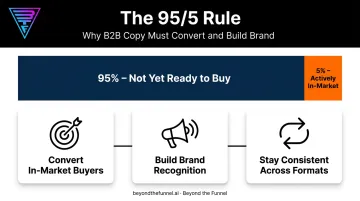
Ehrenberg-Bass Institute research on B2B buying cycles found that for categories purchased roughly every five years, only about 5% of buyers are actively in-market during any given quarter. The other 95% aren't ready today, but they're forming brand memory for later.
That means your copy carries several responsibilities at once:
- Convert the small in-market segment with clear, direct value propositions
- Build recognition with everyone else so your brand comes to mind when they finally are ready
- Stay consistent across formats so both groups recognize the same core message
Copy that only chases immediate clicks ignores the second job entirely, and that's usually where budgets get wasted.
LinkedIn Ad Copy Requirements: Character Limits & Specs by Format
Before you write a single word, know the boundaries. LinkedIn doesn't warn you when copy gets cut off. It just truncates, and readers rarely bother clicking "See more" to finish your sentence.
Text Limits That Actually Matter
- Intro text: Stay near 150 characters. The technical max is 200, but there's no expansion option, so cut-off text is gone for good.
- Description/CTA line: Aim for 70-100 characters. This sits beneath your headline on Single Image Ads and adds context without repeating it.
- CTA button text: Choose from LinkedIn's preset options (Learn More, Download, Register, Sign Up), typically capped around 20-25 characters.
LinkedIn's advertising policy also restricts certain content patterns. Ads can't use excessive emojis, unusual capitalization, or unrelated hashtags, and violations trigger rejection before your ad ever runs, per LinkedIn's advertising policy.
Technical caps allow up to 10 emojis on Single Image, Message, and Conversation ad formats. Using anywhere near that many usually hurts credibility more than it helps.
Format-Specific Character & Size Quick Reference
| Format | Intro Text | Headline | File Size |
|---|---|---|---|
| Single Image Ad | 150 chars (3,000 max) | 70 chars (200 max) | 5MB, JPG/PNG/GIF |
| Carousel Ad | 150 chars (255 max) | 45 chars per card | 10MB per card |
| Message Ad | 60-char subject, 1,500-char body | No headline field | 2MB banner |
| Conversation Ad | 8,000-char message layers | No headline field | 2MB banner, 5MB image |
| Document Ad | 150 chars (3,000 max) | 70 chars (200 max) | 100MB, 300 pages |
Image specs matter just as much as character counts. Horizontal Single Image Ads recommend 1200x628px, while square creative recommends 1200x1200px. Whichever you choose changes how much room your copy has next to the visual, so plan text and creative together rather than squeezing copy in as an afterthought.
Proven Copywriting Frameworks for LinkedIn Ads
Staring at a blank intro-text field with 150 characters to work with is intimidating. Frameworks remove the guesswork.
AIDA (Attention, Interest, Desire, Action) maps directly to funnel stage. Attention and Interest work for cold, top-of-funnel audiences. Desire and Action fit warmer segments who already know your category.
PAS (Problem, Agitation, Solution) opens with a specific pain point, twists the knife slightly, then introduces the fix:
"Your sales team spends 6 hours a week manually pulling reports. That's 300+ hours a year lost to spreadsheets instead of selling. [Product] automates it in one click."
BAB (Before, After, Bridge) works well for audiences unfamiliar with your category altogether:
"Before: chasing leads across five disconnected tools. After: one dashboard showing exactly who's ready to buy. [Product] is the bridge."
Two more patterns worth testing: a stat-lead hook opens with a quantified detail, like "73% of pipeline stalls at this one stage," to signal you understand the problem. A question or contrarian hook challenges an assumption, such as "Your CRM data is lying to you," to interrupt the scroll.
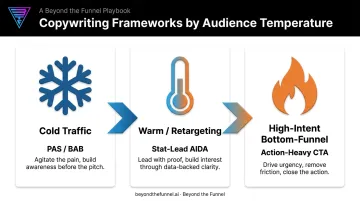
Matching framework to audience temperature:
- Cold traffic → PAS or BAB (educate first, sell second)
- Warm/retargeting audiences → Stat-lead or direct AIDA (they already know the category)
- High-intent, bottom-funnel → Action-heavy copy with proof points, not education
Best Practices for Writing High-Converting LinkedIn Ad Copy
Frameworks give you structure. These practices determine whether that structure actually converts.
Nail the first 150 characters. That's the only guaranteed real estate before truncation. Answer "what's in it for me" immediately — skip the brand-name opener and generic mission statement.
Write for one persona and one pain point per ad. Trying to speak to a VP of Sales and a Director of Marketing in the same 150 characters dilutes both messages. Pick one.
Match CTA and tone to funnel stage. A cold audience that's never engaged with your brand isn't ready for "Request Demo." That CTA belongs with warm, high-intent audiences. Cold traffic responds better to "Learn More" or "Download."
Lead with benefits, not features. Decision-makers don't buy specs; they buy outcomes. Instead of "40+ integrations," try "Connect your entire stack without a single manual export." Specific stats and customer quotes carry more weight than adjectives ever will.
Test 4-5 variations per campaign. Rotate messaging angles, not just images. Refresh underperforming creative regularly: LinkedIn ad fatigue is silent, and CTR drops before you notice frequency climbing.
Common LinkedIn Ad Copy Mistakes to Avoid
- Corporate speak. "Leveraging synergistic solutions" reads like it was written for a committee, not a person scrolling on their phone.
- Feature-first copy. Listing capabilities instead of describing what the reader's Tuesday actually looks like after using your product.
- Ignoring truncation. A punchline that lands at character 180 never gets read if your headline cuts off at 70.
How Beyond the Funnel Turns LinkedIn Ad Copy Into Predictable Pipeline
Great copy still fails if it's tested against the wrong audience or scaled before it's proven. That's the gap Beyond the Funnel closes.
Rather than guessing which messaging will resonate, the agency's testing framework validates audience segments and refines positioning with real performance data before spend increases. Copy and targeting move together, not in isolation.
Founder Joshua Stout built this approach across more than 1,000 managed LinkedIn ad accounts, spanning SaaS, finance, technology, and healthcare brands. He's one of only 80 LinkedIn Certified Marketing Experts worldwide — and 1 of 16 in the U.S.
That experience shows up in client results. Evidation's former Head of Commercial Marketing, Michael Arbini, credited Josh with helping the team grow pipeline from a few dozen opportunities to over 100 qualified opportunities in a single year. That growth came through a full LinkedIn strategy spanning awareness through conversion.
Beyond the Funnel's approach rests on three pillars:
- Audience validation using real engagement data, not assumptions
- Creative testing across formats, including Single Image, Document, Video, Thought Leader, and Text Ads
- Transparent reporting that shows performance, learnings, and next steps

If your targeting is solid but your copy isn't converting, that's usually a signal worth investigating before spend climbs any further. Beyond the Funnel's team can help pinpoint exactly where the gap is.
Frequently Asked Questions
What are the requirements for LinkedIn ad copy?
LinkedIn ad copy must stay within character limits to avoid truncation, and it must follow platform formatting rules. Excessive emojis, unusual capitalization, or unrelated hashtags can trigger ad rejection.
What is the ideal character length for LinkedIn ad copy?
Shorter is safer. Keep intro text around 150 characters and headlines under 70 characters, even though LinkedIn's technical maximums are higher.
Which CTA works best for LinkedIn ads?
It depends on funnel stage. Softer CTAs like "Learn More" or "Download" work best for cold audiences, while direct CTAs like "Request Demo" should be reserved for warm, high-intent segments.
How often should I refresh my LinkedIn ad copy?
Refresh underperforming creative every 4-6 weeks and rotate 4-5 ad variations per campaign. Ad fatigue often shows up as a quiet CTR decline before it's obvious.
What's the difference between writing for cold vs. warm audiences?
Cold audiences need educational, low-friction copy that leads with a pain point. Warm audiences can handle comparative, proof-forward messaging and direct conversion CTAs.
Can I use emojis or exclamation points in LinkedIn ad copy?
LinkedIn technically allows up to 10 emojis on several formats, but excessive punctuation, emojis, or unusual capitalization can trigger ad rejection under LinkedIn's advertising policy.