The stakes are higher than they look. Gartner research shows B2B buying groups now range from 5 to 11 stakeholders, each spending only a fraction of their journey talking to sales. Being "first to mind" before that group even enters a vendor conversation is what separates brands that win deals from those that never get considered.
This guide covers the exact steps to build LinkedIn brand awareness organically and through paid campaigns, how to configure Campaign Manager for awareness objectives, which metrics actually matter, and the most common mistakes that destroy results.
Key Takeaways
- LinkedIn's professional audience is uniquely powerful for B2B, but results require deliberate targeting — not broad posting
- Effective brand awareness combines organic thought leadership with paid amplification running continuously, not in bursts
- The brand awareness objective in Campaign Manager optimizes for reach, not clicks — knowing when to use it matters
- Measure impressions, engagement rate, profile views, follower quality, and post demographics — leads are the wrong scorecard here
- Most failures trace back to one of three fixable causes: the wrong audience, the wrong content format, or the wrong measurement framework
How to Build Brand Awareness on LinkedIn: A Step-by-Step Approach
Step 1: Define Objectives and Validate Your Audience
Before spending a dollar, establish specific measurable goals:
- Reach within your ICP : which job titles, seniorities, and industries matter most
- Follower growth from target accounts : quality over quantity
- Engagement from decision-makers : CFOs, VPs, or directors in your target verticals
Each goal should connect to a business outcome. "More impressions" isn't a goal. "Being first to mind with SaaS CFOs when a budget conversation begins" is.
Use LinkedIn Website Demographics (enabled via the Insight Tag) to identify who is already visiting your site by job title, seniority, industry, and company size. This single step separates brands that gain traction quickly from those that spend months guessing at audience definitions.
Step 2: Optimize Your LinkedIn Presence Before Spending
Running paid awareness to a weak Company Page is like running a TV ad with a broken phone number.
Your page needs:
- Consistent visual branding across banner, logo, and featured imagery
- A clear value proposition in the tagline (not your industry category)
- Featured cornerstone content such as case studies, how-to resources, or whitepapers
- An active posting cadence already established before any paid spend begins
The personal profile multiplier: Organic Company Page content appears in only 2% of followers' feeds — an enormous constraint on organic reach. Executive and founder profiles consistently outperform company pages in reach and engagement. Beyond the Funnel's founder Joshua Stout notes the pattern clearly: "B2B buyers don't trust brands; they trust people." Activating executive profiles as organic reach multipliers is one of the most cost-effective actions you can take before scaling paid.
With your page optimized, the next question is what to actually say — and how often.
Step 3: Build a Content Strategy Around Awareness, Not Promotion
Define three content pillars:
- Thought leadership : original perspectives on industry trends, not rehashed news
- Educational content : explainers, how-to posts, frameworks your audience can use
- Social proof : client results, use cases, before/after scenarios
Apply the 5-3-2 content mix as a starting framework per content cycle:
- 5 curated or industry pieces
- 3 original educational posts
- 2 brand or promotional pieces
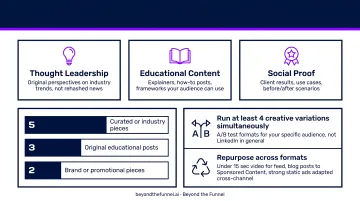
Run at least 4 creative variations simultaneously. A/B test formats to determine what earns attention with your specific audience : not what performs on LinkedIn in general. Repurpose across formats: condense longer video to under 15 seconds for feed placements, adapt blog posts into Sponsored Content excerpts, convert strong static ads from other channels.
Step 4: Amplify Organic Content with Paid Distribution
Two paid models work best together:
| Approach | Purpose | When to Use |
|---|---|---|
| Always-on | Maintains baseline visibility between spikes | Continuously, at a modest daily budget |
| Campaign-based | Spikes visibility around events, launches, or ebook releases | Time-limited, tied to specific moments |
Running both in parallel is the most effective structure. Campaigns spike visibility; always-on sustains it between spikes. Your brand stays present during the independent research moments that matter most: evenings, weekends, and the gaps between meetings when decision-makers do their own due diligence.
For always-on campaigns, CPM bidding typically encounters lower competing bids and produces more efficient cost per reach than engagement-optimized bidding.
Setting Up a LinkedIn Brand Awareness Campaign in Campaign Manager
Choosing the Right Objective
The brand awareness objective optimizes ad delivery for reach and impressions — not clicks, not conversions. Use it when maximum visibility with the right professional audience is the goal, not an immediate action.
This is a critical distinction. Judging a brand awareness campaign by its CTR or lead volume is equivalent to canceling a billboard because nobody bought something the moment they saw it.
Ad Set Types: Accelerate vs. Classic
- Accelerate: AI-powered delivery that auto-optimizes targeting, creative, and bidding. Best for brands new to LinkedIn paid awareness who want faster initial data with less setup complexity.
- Classic: Full manual control over targeting, creative, and bid strategy. Best for experienced teams running rigorous audience or creative tests.
Ad Format Selection
| Format | Best Use |
|---|---|
| Single Image Ads | Broad awareness, consistent always-on presence |
| Video Ads (under 15 sec) | Feed-based awareness, highest engagement potential |
| Document Ads | Educational awareness — guides, frameworks, reports |
| Carousel Ads | Multi-point educational content |
| Thought Leader Ads | Promoting executive content from personal profiles |
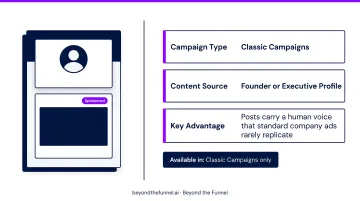
Thought Leader Ads are available in Classic campaigns and allow brands to promote content directly from founder or executive profiles — giving posts a human voice that standard company ads rarely replicate.
Targeting Strategy
For broad brand awareness: Use wide parameters — industry, job function, seniority — targeting 300,000+ members. This keeps CPM competitive and gives LinkedIn's algorithm enough delivery data to optimize efficiently.
For ABM: Upload a target account list via Account Targeting, cross-referenced against LinkedIn's company database. This builds brand presence throughout entire buying committees before sales engages. That matters: 74% of B2B buyer teams show unhealthy internal conflict during purchasing decisions, so reaching stakeholders early reduces friction later.
Retargeting: Use the LinkedIn Insight Tag to serve brand content to website visitors on LinkedIn, keeping your brand visible after initial site contact. This bridges awareness to consideration without requiring prospects to revisit your site unprompted.
Each of these targeting approaches works best when audience segments are validated before scaling spend. Working with a LinkedIn Certified Marketing Expert like Beyond the Funnel helps avoid the costly mistake of optimizing for the wrong audience — a validation-first approach the team has applied across 1,000+ managed LinkedIn accounts.
How to Measure Brand Awareness on LinkedIn
Set Baselines Before Launch
Raw numbers mean nothing without context. Before launch, document:
- Impressions and reach from previous periods
- Current engagement rate benchmarks (Oktopost's Q1 2026 B2B benchmark reports a typical 5.1% engagement rate across B2B pages)
- Follower count and composition by ICP fit
- Profile views as a pre-campaign baseline
Create a dedicated campaign structure in Campaign Manager so brand awareness content is measured independently from lead generation activity. Blending the two muddies your data and makes it nearly impossible to evaluate either effort accurately.
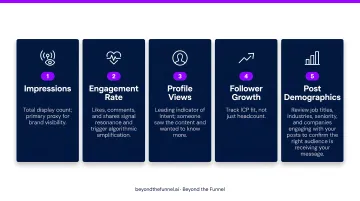
The Five Core Organic KPIs
- Impressions — total display count; primary proxy for brand visibility
- Engagement rate — likes, comments, and shares signal resonance and trigger algorithmic amplification
- Profile views — leading indicator of intent; someone saw the content and wanted to know more
- Follower growth — track ICP fit, not just headcount
- Post demographics — review job titles, industries, seniority, and companies engaging with your posts to confirm the right audience is receiving your message
Paid Campaign KPIs
For paid campaigns, Reach is the primary key result — unique member accounts reached. Alongside Reach, monitor:
- CPM trends (rising CPM can signal audience saturation or targeting that's too narrow)
- Video view rates for video ads
- New followers gained from Sponsored Content
Use Campaign Manager's demographic reporting to validate that your targeted segments are actually being reached. Audience drift — where delivery skews toward segments outside your ICP — is common. Caught early, it's a quick fix; caught late, it's an expensive one.
Reporting Cadence
- Weekly — Creative fatigue, CPM spikes, audience saturation signals
- Monthly — Content strategy adjustment based on top-performing formats
- Quarterly — Assess whether brand awareness investment correlates with shorter sales cycles, higher lead quality, or improved win rates from target accounts
Consistent reporting at each cadence is what separates brands that optimize their way to growth from those that guess their way through it.
Key Variables That Affect LinkedIn Brand Awareness Results
Audience Precision vs. Scale
Too broad, and you're burning budget on professionals outside your ICP. Too narrow, and CPM spikes while reach drops below the threshold needed for meaningful awareness. The 300K+ target for Sponsored Content reflects the minimum audience size LinkedIn's algorithm needs to optimize delivery efficiently — not a suggestion.
Content Quality and Format
Thought leadership with a distinct, undiluted point of view earns deeper engagement than generic industry reshares. Beyond the Funnel's experience across 1,000+ managed accounts confirms this pattern — personal, human-led content outperforms polished corporate advertising.
Specific formats that consistently win in feed-based awareness:
- Video under 15 seconds with a clear opening hook
- Authentic, brand-specific visuals over stock imagery
- First-person POV posts from founders or subject matter experts
Consistency and Always-On Discipline
Brand awareness compounds over time — sporadic campaign bursts rarely build lasting recall. B2B decision-makers research non-linearly, revisiting categories for weeks or months before engaging. An always-on presence ensures your brand appears throughout that journey, not just during active campaign windows.
Common Mistakes When Building LinkedIn Brand Awareness
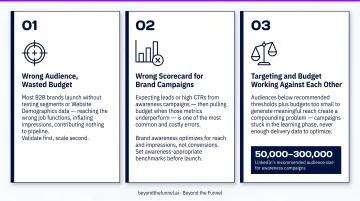
Most LinkedIn brand awareness campaigns fail for one of three predictable reasons.
Your budget is buying the wrong audience: Most B2B brands assume they know their LinkedIn audience and launch without testing segments or using Website Demographics data. This produces brand content reaching the wrong job functions — inflating impressions while contributing nothing to pipeline. Validate first, scale second.
You're judging brand campaigns by the wrong scorecard: Expecting leads or high CTRs from brand awareness campaigns, then pulling budget when those metrics underperform, is one of the most common (and costly) errors. Brand awareness objectives optimize for reach and impressions, not conversions. Set awareness-appropriate benchmarks before launch — otherwise, every campaign looks like a failure even when it's working.
Your targeting and budget are working against each other: Setting audiences below recommended thresholds while allocating budgets too small to generate meaningful reach creates a compounding problem. Campaigns get stuck in the learning phase, never accumulate enough delivery data to optimize, and produce results that mean nothing statistically. As a baseline, LinkedIn recommends audiences of 50,000–300,000 for awareness campaigns — and your budget needs to match that scale.
Conclusion
LinkedIn brand awareness works when organic content strategy, paid amplification, precise targeting, and proper measurement work together and reinforce each other. The brands that win don't simply post more — they reach the right professionals, consistently, with content that earns attention and builds recall over time.
Most failures trace back to three fixable causes: wrong audience, wrong content format, or wrong measurement framework. Addressing these turns LinkedIn from a guessing game into a predictable brand-building channel.
Fixing all three at once — while managing campaigns, testing creative, and interpreting data — is where execution tends to break down. For B2B brands that want a faster path to results, working with a LinkedIn Certified Marketing Expert means every targeting decision, creative test, and budget allocation is grounded in data rather than guesswork. Beyond the Funnel, led by Joshua Stout — one of 80 LinkedIn Certified Marketing Experts worldwide and 1 of 16 in the U.S. — applies that expertise to help B2B brands build awareness that compounds into pipeline.
Frequently Asked Questions
How do you use LinkedIn for brand awareness?
Combine organic tactics — Company Page content, thought leadership posts, executive profile activation — with paid Sponsored Content using the brand awareness objective. Both channels work best together: organic builds credibility, paid extends reach to audiences who don't follow you yet. Use LinkedIn's job title, seniority, and company size filters to ensure impressions land with decision-makers, not just a broad professional crowd.
What is the brand awareness objective on LinkedIn?
It's a Campaign Manager objective that optimizes ad delivery for reach and impressions rather than clicks or conversions. It's available across Single Image, Video, Carousel, Document, and other formats, using CPM-based bidding. Use it when your goal is maximum visibility with the right audience — not an immediate action.
What is the 5-3-2 rule on LinkedIn?
A content mix framework: 5 pieces of curated or industry content, 3 pieces of original educational content, and 2 brand or promotional posts per content cycle. The ratio keeps your feed useful to followers first, which tends to earn higher organic reach than purely promotional posting schedules.
How do you measure brand awareness on LinkedIn?
Track five core KPIs: impressions, engagement rate, profile views, follower growth quality, and post demographic data. For paid campaigns, Reach is the primary key result — it reflects how many unique members actually saw your content, not just how many times it was served.
What audience size should I target for a LinkedIn brand awareness campaign?
Target 300,000+ members for Sponsored Content brand awareness campaigns to enable cost-effective delivery. For Text and Dynamic Ads, 60,000–400,000 is the recommended range. Audiences smaller than these thresholds restrict reach, drive up CPM, and prevent campaigns from generating meaningful delivery data.
What is the difference between reach and impressions on LinkedIn?
Reach measures the number of unique member accounts that saw your content. Impressions counts the total number of times content was displayed — one person can generate multiple impressions. For brand awareness campaigns, Reach is the primary metric because it reflects actual audience breadth, not just display frequency.