](https://file-host.link/website/beyondthefunnel-lynxk9/assets/blog-images/7f5a64ac-bbd1-4199-8250-d1c6fdc9b649/1785933573456430_20a1034cf0e5404097cfacf436e15803/360.webp)
Introduction
Your LinkedIn Company Page is often the first stop a B2B buyer makes before they ever talk to your sales team. With more than 1.3 billion members now on the platform, that first impression has a lot of competition.
Creating a Page takes ten minutes. Making it actually work? That's a different story. Visibility, follower growth, and lead generation all hinge on your setup, posting consistency, and promotion beyond your existing audience.
This guide breaks down the exact steps to optimize a LinkedIn Company Page, the factors that influence performance, and the mistakes that hold most Pages back. It also covers when it's time to pair organic effort with paid promotion.
TL;DR
- Complete every profile field, then commit to consistent content and real engagement.
- LinkedIn rewards continuous activity, not a one-time profile setup.
- SEO-rich copy, content formats, employee advocacy, and analytics reviews drive results.
- Organic work builds the base; targeted LinkedIn Ads turn it into predictable growth.
How to Optimize Your LinkedIn Company Page: Step-by-Step
Step 1: Complete Your Foundational Page Elements
Half-finished Pages leak credibility. Start with the basics, and get them right the first time.
- Logo and banner: Use high-resolution, brand-consistent visuals sized to LinkedIn's current specs (check LinkedIn's Page Admin settings for exact pixel dimensions, since these have shifted over the years).
- Tagline: Front-load keywords into the first 150 characters so the full line displays in search results, not just a truncated fragment.
- Core details: Fill in your website URL, location, industry, company size, and specialties completely.
LinkedIn's own Pages best practices guide notes that Pages with complete information receive far more weekly views than those left half-finished. It's one of the easiest wins available, and most companies skip it.
Step 2: Craft a Keyword-Optimized "About Us" Section
Your About Us section does double duty: it sells your company to a human, and it feeds keywords to search engines.
Structure it around your mission, positioning, and offerings, but write it the way your buyers actually talk, not the way your internal deck does. Research the terms your target audience searches for, not just the jargon your team uses internally.
Front-load the first two to three sentences. LinkedIn only shows a limited character count before the "see more" cutoff, so your strongest hook needs to land immediately.
Step 3: Build Out Supporting Pages
A single Company Page can't carry every audience segment. That's where supporting Pages come in.
- Showcase Pages: Create these for sub-brands, product lines, or distinct audience segments that need their own voice.
- Career Pages: Culture content matters more than most teams realize. Seventy-five percent of job seekers weigh an employer's brand before applying, often citing unfamiliarity with daily work life as a top hesitation.
- Product Pages: These support social proof through customer spotlights and reviews, giving prospects a reason to trust you beyond your own claims.
Step 4: Establish a Consistent Content and Posting Cadence
Consistency beats volume. A Page that posts weekly, every week, will outperform one that bursts and disappears.
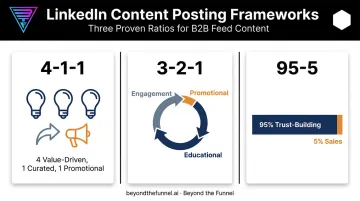
Several posting-ratio frameworks can help balance your content:
- 4-1-1: For every one promotional post, share one curated piece from another source and four value-driven pieces.
- 3-2-1: Rotate between three content types (educational, engagement, promotional) to keep the feed varied.
- 95-5: Rooted in B2B buying-cycle research, this reminds you that most of your audience isn't ready to buy right now, so most content should build trust, not push a sale.
Format matters just as much as ratio. LinkedIn's Pages best practices page reports that companies posting weekly see roughly 2x the engagement compared to sporadic posting, and video content tends to generate substantially higher engagement than static posts.
Native documents and carousels are also worth prioritizing. They keep users scrolling within the post itself instead of clicking away.
Minimum cadence to aim for: one post per week, non-negotiable, with two to three being ideal once you have the bandwidth.
Step 5: Grow Your Audience, Engage, and Track Results
Growth doesn't happen passively. It takes a bit of nudging.
- Activate employee advocacy: invite first-degree connections to follow the Page, and notify employees when new content goes live so they can share it.
- Use up to three relevant hashtags per post to extend discoverability without diluting reach.
- Respond promptly to comments and DMs. Every reply is a trust signal, both to the person commenting and to LinkedIn's algorithm.
- Review native analytics monthly: visitors, followers, and update performance all tell a story worth reading.
- Add UTM tracking links to posts so you can tie LinkedIn activity back to actual website traffic and conversions, not just vanity metrics.
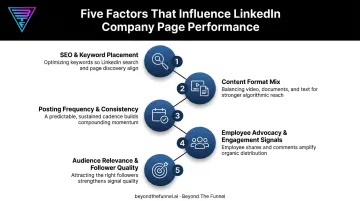
Key Factors That Affect Your LinkedIn Page's Performance
Outcomes on LinkedIn aren't random. They come down to a handful of controllable variables.
SEO & Keyword Placement
Discoverability starts here. Pages with optimized taglines and About Us sections surface higher in both LinkedIn's internal search and external search engines like Google, putting your Page in front of prospects actively searching for what you offer.
Content Format Mix
LinkedIn's feed algorithm doesn't treat all formats equally. Video and native documents, such as carousel PDFs, typically pull ahead of static text or link posts in both reach and engagement.
Posting Frequency & Consistency
Irregular activity reads as a dormant Page, both to followers and to the algorithm. Consistent weekly posting compounds visibility over time, while sporadic bursts of activity followed by silence reset that momentum.
Employee Advocacy & Engagement Signals
Early engagement from real people, not just the brand account, shapes how far LinkedIn distributes a post. Employee shares and comments extend reach well past your direct follower count, exposing the post to entirely new networks.
Audience Relevance & Follower Quality
A big follower count means little if it's the wrong audience. Validated, targeted followers by industry, seniority, and company size produce far better leads than raw follower volume, since quality outperforms quantity in B2B lead generation.
Common Mistakes When Optimizing a LinkedIn Company Page
Most underperforming Pages share the same handful of problems:
- Incomplete or outdated fields — old logos, dead links, or a blank About Us section that tells visitors nothing.
- All-promotional content — ignoring frameworks like 4-1-1 erodes follower trust, and audiences disengage from brands that only talk about themselves.
- Treating the Page as a static brochure — ignoring comments, DMs, and employee engagement opportunities leaves reach on the table.
- Never checking analytics — content decisions made on guesswork instead of real performance data consistently underperform.
When Organic Optimization Isn't Enough: Pairing Your Page With LinkedIn Ads
Organic reach has a ceiling. That ceiling gets lower fast when your goal is reaching senior B2B decision-makers at scale, since most of them will never see your organic posts no matter how good they are.
This is where Sponsored Content and Page-follower campaigns come in. They take your already-optimized organic posts and put them in front of precisely targeted audiences beyond your current follower base. Targeting options include:
- Job title
- Seniority level
- Company size
You don't need a massive budget to start. LinkedIn's advertising platform allows daily budgets starting at just $10, though meaningful B2B campaigns typically require more sustained investment to gather enough data for real optimization.
Making that investment count starts with a structured approach rather than guesswork. Beyond the Funnel approaches this pairing through audience validation and full-funnel testing. The framework comes from founder Joshua Stout, one of only 80 LinkedIn Certified Marketing Experts worldwide, refined across more than 1,000 managed ad accounts. Rather than assuming which audiences will convert, the process tests and confirms it with real data before scaling spend.
Combining strong organic fundamentals with data-driven paid amplification is what separates Pages that plateau at a few hundred followers from those that turn into genuine pipeline generators.
Conclusion
Optimizing a LinkedIn Company Page isn't a task you check off a list once. It's an ongoing discipline that rewards the companies willing to keep showing up.
Most Pages that underperform aren't victims of bad luck. They're missing complete profiles, posting inconsistently, or never checking whether anyone's actually engaging.
Get those fundamentals right, and you'll see the difference in your analytics within weeks. When you're ready to scale past what organic reach alone can deliver, an expert partner can help. Beyond the Funnel's full-funnel LinkedIn Ads strategy turns that foundation into predictable, measurable growth.
Frequently Asked Questions
What are the common LinkedIn posting rules (3-2-1, 4-1-1, 95-5) for company page optimization?
4-1-1 pairs one promotional post with four value-driven posts and one curated post. 3-2-1 rotates through three content types for variety. 95-5 reflects that most of your audience isn't ready to buy, so content should mostly build trust, not push sales.
How often should a company post on LinkedIn?
Weekly is the minimum baseline worth committing to. LinkedIn has noted that companies posting weekly tend to see noticeably higher engagement than those posting sporadically.
What image sizes are recommended for a LinkedIn Company Page logo and banner?
LinkedIn's official specs have shifted over time, so check your Page Admin upload settings for current dimensions before publishing. What matters most is consistent, high-resolution branding that matches your other channels.
How can I increase followers on my LinkedIn Company Page?
Invite first-degree connections, activate employee advocacy, use relevant hashtags, and cross-promote the Page on your website and other channels. Consistency in posting also plays a major role in steady follower growth.
Do I need a large budget to advertise on LinkedIn?
No. LinkedIn's ad platform allows daily budgets starting at just $10, though a validated audience strategy matters more than raw spend for getting meaningful results.
How long does it take to see results from LinkedIn Page optimization?
Foundational changes like a completed profile often show quick wins in views within weeks. Follower growth and lead generation typically build over several months of consistent activity.