Introduction
LinkedIn's B2B click costs run higher than almost any other ad platform, which means picking the wrong campaign objective isn't a small mistake. It's an expensive one.
Choose "Website Visits" when you actually needed leads, or "Brand Awareness" when you needed clicks, and you're stuck. LinkedIn doesn't let you edit an objective after a campaign goes live. You'd have to scrap it and start over, budget already spent.
This guide breaks down all seven LinkedIn objectives, maps them to funnel stages, and gives you a framework for getting the choice right the first time.
TL;DR
- LinkedIn groups its core objectives into three funnel stages: Awareness, Consideration, and Conversion
- Your objective choice determines who sees your ad, which bidding options unlock, and what you pay
- Website Visits is the most versatile, cost-efficient starting point for most B2B campaigns
- Objectives lock in permanently at launch, making upfront selection non-negotiable
- Budget, tracking maturity, and audience size matter as much as funnel stage when deciding
What Are LinkedIn Campaign Objectives?
A LinkedIn campaign objective is the specific outcome you select at campaign creation. It tells LinkedIn's delivery algorithm and bidding system exactly which member behavior to chase, whether that's an impression, a click, or a form submission.
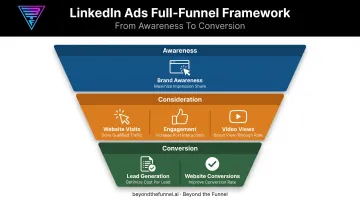
LinkedIn's current objective roster includes seven options, six of which apply to marketing campaigns as documented in LinkedIn's official campaign objectives matrix:
| Funnel Stage | Objective | Optimizes For |
|---|---|---|
| Awareness | Brand Awareness | Reach or impressions |
| Consideration | Website Visits | Landing-page clicks |
| Consideration | Engagement | Likes, comments, shares, follows |
| Consideration | Video Views | Video completions |
| Conversion | Lead Generation | Native form submissions |
| Conversion | Website Conversions | Tracked on-site actions |
Job Applicants exists as a separate, recruiting-only objective and sits outside this marketing framework entirely.
Once you launch a campaign, that objective is locked. There's no edit button. If you picked wrong, you build a new campaign from scratch, which means new setup time and a fresh learning phase for the algorithm.
The Three Funnel Categories
Each objective belongs to one of three buckets, and understanding the bucket logic matters more than memorizing individual objectives:
- Awareness — optimizes purely for reach on a CPM basis, built for top-of-funnel visibility
- Consideration — covers Website Visits, Engagement, and Video Views; optimizes for clicks, social actions, or video completions
- Conversion — covers Lead Generation and Website Conversions; optimizes for form fills or tracked on-site actions, both of which need real tracking infrastructure behind them
Brand Awareness
Brand Awareness optimizes for the cheapest possible impressions. It performs best with large budgets and high-frequency content designed to stay in front of the same audience repeatedly.
The tradeoff: you're often reaching low-intent members who aren't close to a buying decision, so don't expect this objective to move a pipeline number.
Website Visits
Website Visits optimizes for clicks and pairs well with manual CPC bidding, which keeps costs predictable. For most B2B accounts, it's the default, most balanced choice.
It works for:
- Driving qualified traffic to educational content
- Sending prospects to demo request pages
- Building initial site engagement before you have conversion tracking in place
Engagement
Engagement optimizes for likes, comments, shares, and follows. Use it to build a warm audience of people who already interacted with your brand, then retarget them later with conversion-focused campaigns.
Video Views
Video Views optimizes for video completions at a lower cost-per-view than other formats. It only supports video creative, so it's reserved for accounts already producing video content.
Best used for quick awareness plays or building a retargeting audience out of people who watched a meaningful portion of your video.
Lead Generation
Lead Generation uses LinkedIn's native pre-filled forms, which typically drive higher submission rates than external landing pages. One agency analysis reported roughly 13% form conversion versus 4% for landing pages. That figure lacks a published methodology, so treat it as directional.
The catch: effortless submissions can attract lower-intent prospects. Pairing this objective with CPC bidding instead of automated bidding helps filter for more serious buyers.
Website Conversions
Website Conversions optimizes for a specific on-site action tracked via the Insight Tag. LinkedIn requires an associated conversion event before the campaign can even activate.
Two cautions worth remembering:
- It needs meaningful conversion volume to optimize well; thin data means inefficient delivery
- It frequently costs more than Website Visits for the exact same end result, since you're paying a premium for the tracked signal
Why Choosing the Right Objective Matters
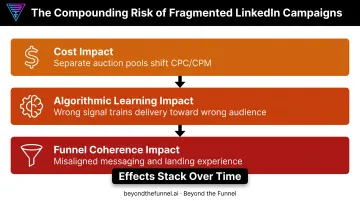
Getting this decision wrong doesn't just mean a suboptimal campaign. It compounds across cost, algorithm training, and funnel consistency.
Cost impact. Each objective competes in a separate auction pool. One 2025 analysis of 70+ B2B SaaS companies found CPCs ranging from $10.48 to $15.72 across a single year. Other benchmark reports put averages closer to $5-6. That spread shows how auction dynamics, audience, and objective choice shift what you pay.
Algorithmic learning impact. Your objective feeds the signal LinkedIn's delivery system optimizes toward. Choose Engagement and you train the algorithm to find people who click "like." Choose Website Conversions and it hunts for people who complete a specific tracked action. Those are different audiences entirely, even within the same targeting parameters.
Funnel coherence impact. Matching objective to funnel stage keeps ad format, messaging, and landing experience aligned. A cold audience hitting a "Book a Demo" landing page from a Brand Awareness campaign creates friction. A warm, retargeted audience hitting that same page from a Website Visits campaign converts at a very different rate.
The three effects stack. A mismatched objective doesn't just underperform once. It skews your delivery data going forward, making every future optimization decision slightly worse.
What to Consider When Choosing the Right LinkedIn Campaign Objective
These factors move the decision past "which objective sounds right" and connect it to measurable KPIs and account-level outcomes.
Goal, Funnel Stage, and Format Fit
Match the objective to whether you need reach, education, or hard conversion. Each stage drives a different KPI:
- Reach goals track impressions and frequency
- Education goals track CTR and time on page
- Conversion goals track cost-per-lead and form completion rate
Not every format works with every objective. Video Views only supports video creative. Lead Generation supports fewer formats than Website Visits. Check format compatibility before you settle on an objective, especially if your creative is already built.
Budget, Tracking, and Audience Constraints
Impression-based objectives like Brand Awareness need substantial budgets to generate enough reach to matter. Smaller budgets typically perform better on click or lead-focused objectives, where every dollar buys a specific, trackable action rather than diluted impressions.
Website Conversions requires the Insight Tag to be firing and a real conversion history behind it. Without sufficient volume, the algorithm has nothing to learn from and defaults to inefficient delivery.
Narrow, account-based audiences generate fewer raw conversions simply due to smaller pool size. For these campaigns, Website Visits or Engagement usually outperform Conversion-stage objectives, which need volume to function well.
Retargeting and Full-Funnel Strategy
Engagement and Video Views campaigns build a retargeting pool cheaply. You can then re-engage that pool later with Website Visits or Lead Generation campaigns, creating a sequence instead of a series of one-off pushes:
- Build the pool: Run Engagement or Video Views to identify an interested audience
- Warm them up: Retarget with Website Visits content that educates further
- Convert: Layer in Lead Generation or Website Conversions once intent signals are clear
How Beyond the Funnel Can Help
Objective selection is one decision inside a much larger strategy problem, and getting it wrong compounds across every campaign that follows. Beyond the Funnel helps B2B brands replace that guesswork with audience validation, creative testing, and full-funnel strategy built for LinkedIn.
Founder Joshua Stout is one of 80 LinkedIn Certified Marketing Experts worldwide, and one of only 16 in the U.S. He has managed and optimized more than 1,000 LinkedIn ad accounts across SaaS, finance, technology, and healthcare.
What sets Beyond the Funnel apart:
- Proprietary testing framework that validates audiences with real campaign data before scaling budget, then refines objectives and creative from the results
- Full-funnel structure connecting awareness, consideration, and conversion into one measurable system instead of isolated campaigns competing for the same budget
- Transparent reporting so clients see performance, learnings, and next steps, not just a dashboard of numbers
That approach shows up in pipeline. Former Evidation Head of Commercial Marketing Michael Arbini reported Stout's LinkedIn strategy helped grow opportunities from a few dozen to over 100 in a single year.

Conclusion
Objective selection is a decision point, not a formality on the way to audience targeting. Get it wrong, and you're locked into paying for the wrong signal until the campaign ends.
Match the objective to your funnel stage, budget, and how mature your conversion tracking actually is. Popularity in Campaign Manager is irrelevant.
Review objective performance regularly. The right choice today may not hold in six months, once conversion data builds and your account has more signal to work with. Revisit the match as your funnel and tracking mature—then lock in the objective that buys the outcome you need next.
Frequently Asked Questions
What are the 5 main marketing objectives?
Broader marketing frameworks reference five customer journey stages: awareness, consideration, purchase, retention, and advocacy. LinkedIn's ad platform maps its six objectives specifically to the first three of these stages.
What is the 95-5 rule on LinkedIn?
Research from the Ehrenberg-Bass Institute and LinkedIn's B2B Institute finds about 5% of B2B buyers are in-market at any time, while 95% aren't ready yet. Balance Awareness and Engagement for the 95% with Conversion objectives for the in-market 5%.
Can I change my LinkedIn campaign objective after launching a campaign?
No. Objectives lock in at creation and cannot be edited afterward. If you need a different objective, you'll need to build and launch a new campaign entirely.
Which LinkedIn objective is best for B2B lead generation?
Lead Generation works well when paired with CPC bidding to filter for intent. Many advertisers get lower-cost, higher-intent results by driving traffic to a dedicated landing page through Website Visits instead.
Should I use Website Conversions or Website Visits for demo sign-ups?
Website Visits works better for most accounts, since Website Conversions needs substantial historical data to optimize properly. Without that volume, it often costs more for the same outcome.
Do LinkedIn campaign objectives affect how much I pay for ads?
Yes. Each objective competes in a separate auction pool, which directly shapes your CPM or CPC. A mismatched objective can inflate costs without improving results.