Introduction
Your buyers are already on LinkedIn. Before they ever fill out a form or book a demo, they're researching vendors, checking out company pages, and sizing up who actually knows their industry.
Here's the problem: LinkedIn Ads have a reputation for being expensive and confusing. Many B2B marketers try a campaign, watch the cost-per-click climb, and walk away convinced the platform "doesn't work" for their budget.
The cost concern is real. LinkedIn Ads run higher than Meta or Google on raw click cost. What that comparison misses is lead quality, deal size, and how well LinkedIn matches B2B buying behavior.
This guide breaks down why LinkedIn works for B2B and what the ad formats actually do. You'll see what to expect on cost, how to target the right people, and how to avoid the mistakes that waste budget.
Key Takeaways
- Professional targeting lets you reach a VP of Procurement at a 500-person manufacturer by title—not guesswork.
- Expect higher CPCs than Meta or Google, but stronger pipeline efficiency when measured on revenue instead of clicks.
- Most underwhelming LinkedIn results trace back to unvalidated audiences and generic creative, not the platform.
- Match ad format to funnel stage—Sponsored Content, Messaging, and Text Ads each play a distinct role.
- A structured testing framework lowers cost-per-lead over time by cutting what doesn't work early.
Why LinkedIn Ads Are Effective for B2B Marketing
LinkedIn's targeting is built on professional identity, not browsing habits. You can layer job title, seniority, company size, and industry in ways no other ad platform replicates. That's the entire reason B2B marketers keep coming back to it.
Adoption backs this up. 89% of B2B marketers use LinkedIn for lead generation, and 62% say it produces leads effectively, according to HubSpot's marketing statistics report. At those adoption levels, LinkedIn is close to standard practice.
Is the Higher Cost Worth It?
This is the objection most marketers raise first, and it's a fair one. LinkedIn clicks cost more than Meta or Google clicks. But cost-per-click isn't the metric that matters for B2B pipeline.
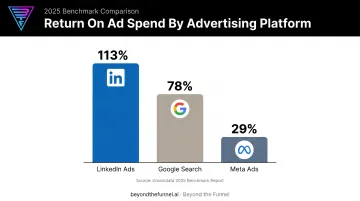
Dreamdata's 2025 LinkedIn Ads benchmark report, based on thousands of deals across hundreds of B2B companies, found:
- 113% ROAS on LinkedIn Ads
- 78% ROAS on Google Search
- 29% ROAS on Meta Ads
Cost per company influenced was also 25% higher on Google Search and 70% higher on Meta than on LinkedIn, despite LinkedIn's higher sticker price per click. Judge the channel on revenue, not clicks, and the math flips in LinkedIn's favor.
Where Campaigns Actually Fail
Disappointing LinkedIn results almost always trace back to two things: audiences that were never validated with real data, and creative that blends into the feed instead of stopping the scroll.
Beyond the Funnel's testing framework, refined across 1,000+ managed accounts, is built around both problems. Audiences and messaging get validated with live data before spend scales, so budget follows what the data supports instead of untested assumptions about job title or industry.
LinkedIn Ad Formats Every B2B Marketer Should Know
LinkedIn offers several ad formats, and each one fits a different stage of the funnel. Picking the wrong format for the goal is one of the fastest ways to burn budget without results.
Sponsored Content (Single Image, Video, Carousel, Document Ads)
These are feed-native ads that blend in with organic posts, which makes them ideal for awareness and thought leadership:
- Single Image Ads — one strong visual for quick brand recognition
- Video Ads — great for product demos or founder-led messaging
- Carousel Ads — swipeable cards for multi-step stories or feature breakdowns
- Document Ads — in-feed documents that work well for gating research reports or guides
A common use case: run a Document Ad to gate an industry report behind a lead form, or use a short Video Ad to walk through a product demo without asking for a click first.
Sponsored Messaging (Message Ads & Conversation Ads)
These formats land directly in a prospect's inbox, which makes them effective for high-intent segments and event promotion.
- Message Ads — one direct message with a single CTA; best for simple offers like webinar invites
- Conversation Ads — branching paths with multiple CTAs so prospects self-select a demo, case study, or signup
Choose Message Ads for one clear offer. Choose Conversation Ads when different prospects need different next steps.
Dynamic Ads & Text Ads
Dynamic Ads personalize creative with the viewer’s profile data (photo, job title, company). They’re strongest for mid-funnel recognition and efficient traffic:
- Spotlight Ads — send people to a landing page or product
- Follower Ads — grow your Company Page audience
Text Ads are the low-cost, self-service format for early messaging tests. They run in the sidebar, not the feed, so they’re best when you want cheap signal before you scale spend.
How Much Do LinkedIn Ads Cost for B2B?
This is the question every B2B marketer asks first, and the honest answer is: more than you'd pay elsewhere, but with better downstream economics.
Typical CPC and CPL Ranges
An analysis of $28 million in ad spend across 70+ B2B SaaS companies by HockeyStack found quarterly average CPCs ranging from $10.48 to $15.72. Cost-per-lead figures vary widely by funnel stage, industry, and audience specificity, so treat any published number as a directional benchmark, not a guarantee.
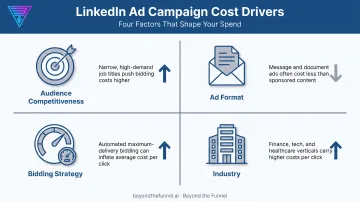
What Drives Cost Up or Down
- Audience competitiveness: a broad "Marketing Managers" audience costs less than a razor-narrow VP-level segment everyone else is also bidding on
- Ad format: Sponsored Messaging often costs more per send than feed placements
- Bidding strategy: CPC bidding gives more control; CPM can lower cost at scale if your creative already converts well
- Industry: finance and tech tend to run pricier auctions than less competitive verticals
Making the Economics Work
LinkedIn doesn't publish a fixed universal minimum daily or lifetime budget. The minimum shown in Campaign Manager depends on your currency, objective, and market. The platform gives an upfront cost estimate before you launch, so check that number rather than relying on a generic figure.
LinkedIn's costs only make sense with the right customer lifetime value behind them. A common B2B and SaaS benchmark is an LTV-to-CAC ratio of at least 3:1, meaning a customer should generate at least three times what it cost to acquire them.
If your average deal size is small and your sales cycle is short, LinkedIn's premium CPCs may not pencil out. If your LTV is healthy, the math works in your favor fast.
Cost-per-lead isn't fixed. It drops as underperforming audiences and creative get cut early instead of left running on autopilot. That's the core of Beyond the Funnel's approach: validate first, then scale spend only toward what's already proven to work.
Targeting the Right B2B Audience on LinkedIn
Precision targeting is LinkedIn's biggest advantage, but only if you build the audience correctly from the start.
Building an ICP in Campaign Manager
Start with the same criteria you'd use to define your best customer:
- Company size — narrow to the employee range that matches your typical deal
- Job function and seniority — target the actual decision-maker, not just anyone with a related title
- Industry — exclude verticals that historically don't convert for your offer
Audience Expansion: Reach vs. Precision
LinkedIn's Audience Expansion setting uses your seed audience to find similar users. That boosts reach, but it also dilutes targeting precision.
- Turn it on when you need volume and have budget to test broadly
- Turn it off for ABM campaigns or narrow, high-value segments where every impression needs to count
Matched Audiences for ABM
For account-based campaigns, LinkedIn's Matched Audiences let you upload contact or account lists directly, or retarget site visitors tagged through the Insight Tag. You give LinkedIn the exact accounts to reach, which is why it works so well as a serious ABM channel.
Best Practices to Maximize LinkedIn Ad ROI
Getting the targeting right is half the equation. The rest comes down to creative discipline and ongoing measurement.
Creative that performs:
- Test multiple ad variations at once rather than one-off guesses
- Use real people in imagery. Stock photos of handshakes get scrolled past
- Keep copy benefit-focused and short; long paragraphs don't survive the feed
Offer by funnel stage: A gated research report belongs at the top of the funnel. A demo request belongs at the bottom. Mixing these up sets the wrong conversion expectations and skews your read on what's actually working.
Measure continuously: Install the LinkedIn Insight Tag, track performance inside Campaign Manager, and adjust budget or creative based on what the data shows. A campaign that looked strong in week one can flatten by week three without active optimization.
Why Partner with a LinkedIn Ads Expert
LinkedIn's ad products change often, and the platform's auction mechanics reward advertisers who understand the nuances most generalist marketers never touch. A team running Google, Meta, and LinkedIn all at once rarely has the bandwidth to master LinkedIn's specific quirks.
Beyond the Funnel was built around that gap. Founder Joshua Stout is one of just 80 LinkedIn Certified Marketing Experts worldwide (and 1 of only 16 in the U.S.) with experience managing and optimizing over 1,000 LinkedIn ad accounts across SaaS, finance, technology, and healthcare.
That experience shaped a testing framework built on:
- Audience validation before scaling spend
- ICP-driven creative refined through iterative testing
- Full-funnel structure connecting awareness through conversion
- Transparent reporting that shows what's working and why
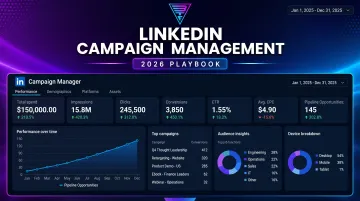
One client, Evidation, grew its pipeline from a few dozen to over 100 opportunities in a single year with Beyond the Funnel's full LinkedIn strategy.
If you're ready to move past guesswork and turn LinkedIn into a predictable growth channel, connect with Beyond the Funnel for a strategy consultation.
Frequently Asked Questions
Are LinkedIn ads effective for B2B?
Yes, when paired with validated targeting and creative rather than assumptions. LinkedIn's professional targeting data and its position in the buyer's research process give it an edge no other ad platform matches for B2B.
How much do LinkedIn ads cost for B2B?
CPCs typically range from $10–$16, with CPL varying widely by funnel stage and industry. Audience competitiveness, ad format, and bidding strategy all influence where you land.
What is the minimum budget to start advertising on LinkedIn?
LinkedIn doesn't publish a universal fixed minimum. The amount depends on your currency, objective, and market. Check the estimate Campaign Manager shows before launch, and budget enough to gather meaningful data, not just the bare minimum.
Which LinkedIn ad format is best for B2B lead generation?
Sponsored Content with Lead Gen Forms works well for gated content and broader reach. Message or Conversation Ads perform better for high-intent segments closer to a decision.
How long should I run a LinkedIn ad campaign before judging results?
Give any test at least two weeks, which matches LinkedIn's own built-in minimum for A/B testing. Beyond that, wait until you have enough conversions to trust the data before making changes.
Can small businesses benefit from LinkedIn ads, or is it only for enterprise brands?
Smaller B2B companies can see strong ROI with a high enough customer lifetime value and a tightly defined ideal customer profile (ICP). Narrow targeting often outperforms broad reach when budgets are limited.