The problem? Many brands either don't know these partners exist, or they confuse them with individual experts and agencies. That confusion leads to poor tool choices, wasted budget, and missed performance.
This guide breaks down exactly what the LinkedIn Marketing Partner Program is, how its six official categories work, what partners actually deliver to B2B brands, and — critically — how partner tools differ from certified individual expertise. By the end, you'll know how to evaluate both.
Key Takeaways
- LinkedIn Marketing Partners are vetted technology companies and platforms, not individual consultants or agencies
- LinkedIn currently organizes partners into six official categories, each addressing a distinct operational need
- A LinkedIn Marketing Partner badge signals integration quality, not strategic expertise
- The LinkedIn Certified Marketing Expert designation belongs to individuals — companies cannot hold it
- Gartner's 2025 research puts martech utilization at just 49% — a partner tool is only as good as the strategy behind it
What Is the LinkedIn Marketing Partner Program?
The LinkedIn Marketing Partner Program is LinkedIn's official framework for vetting third-party technology companies and service providers who integrate with LinkedIn's advertising infrastructure. According to LinkedIn's official partner page, Marketing Partners are "trusted third-party providers" offering integrated solutions and managed services across LinkedIn Ads, LinkedIn Pages, and LinkedIn Events.
Who Can Become a Partner
The program is designed for organizations and software platforms, not individual marketers or agencies. LinkedIn's public documentation refers to providers, products, integrations, and managed-service organizations — not solo practitioners.
The vetting process evaluates:
- Product or service capabilities
- Customer impact and track record
- Quality, performance, and reliability standards
- Technical API readiness
LinkedIn's Marketing API access operates on tiers. All applicants start in Development tier; Standard access is required for campaign management solutions across multiple ad accounts.
Certain private API products — including Audience Insights and Media Planning — are reserved for B2B marketing technology companies that meet additional criteria around engineering readiness and data management.
What the Badge Actually Signals
When you see the LinkedIn Marketing Partner badge on a vendor's website, it tells you the platform has been reviewed and approved for use with LinkedIn's API. That reduces integration risk and confirms platform policy compliance. What it doesn't tell you is whether the tool will solve your specific business problem. Partner status confirms technical compliance, not strategic fit — that evaluation still falls on you.
LinkedIn Marketing Partner Categories: A Complete Breakdown
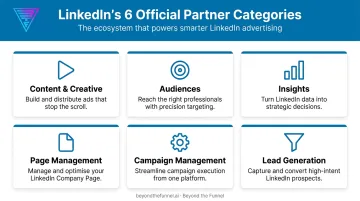
LinkedIn currently organizes its partners into six official categories. Each addresses a different operational gap within a LinkedIn marketing program.
| Category | What It Helps You Do |
|---|---|
| Content & Creative | Video and image creation, scalable creative production, strategic creative support |
| Audiences | Account targeting, customer retargeting, dynamic and intent-based targeting |
| Insights | Audience analysis, content strategy, media planning, brand measurement |
| Page Management | Schedule posts, monitor mentions, engage followers, analyze Page performance |
| Campaign Management | Create, manage, and optimize LinkedIn ads at scale across multiple accounts |
| Lead Generation | Automatically route leads to CRM or marketing automation platforms |
Three categories tend to drive the most immediate impact for B2B advertisers:
- Campaign Management partners are most relevant for teams handling high ad volume or multi-account structures — they extend what's possible inside native Campaign Manager
- Lead Generation partners connect LinkedIn Lead Gen Forms directly to platforms like HubSpot, Salesforce, or Marketo, reducing lead friction and enabling automated nurturing
- Insights partners pull LinkedIn data into unified reporting environments, letting you analyze LinkedIn performance alongside Google, Meta, and email in one place
The right starting point depends on where your program is breaking down. If attribution is broken, start with Insights. If leads go unworked before sales follows up, start with Lead Generation.
What LinkedIn Marketing Partners Actually Provide
Partner-level tools extend Campaign Manager in ways the native platform can't match on its own. The three areas where these partnerships create the clearest practical value:
Deeper Integration Capabilities
Partners with Standard API access can manage campaigns across multiple ad accounts, automate workflows, and sync data with external platforms in real time. Certain private API products — like Audience Insights — are only available to qualified B2B technology partners, meaning not every listed vendor has access to every capability.
Operational Scale
Partner tools handle the operational weight that Campaign Manager wasn't built to carry alone. For teams running multi-brand programs, high ad volume, or complex ABM campaigns, that means:
- Bulk editing across accounts without repetitive manual updates
- Scheduled publishing with automated workflows
- Automated lead routing directly into CRM systems
- Cross-channel reporting in a single view
This is work that would otherwise require significant manual effort inside Campaign Manager.
Cross-Channel Visibility
For most B2B marketing teams, unified reporting delivers the most immediate value: LinkedIn performance data in the same dashboard as Google, Meta, and email. Without it, budget decisions get made in silos — with no clear picture of which channel is actually driving pipeline.
One important caveat: partner tools provide infrastructure, not strategy. Someone still needs to interpret the data, set priorities, and make the calls that move the needle — that's a distinct skill set no platform can automate.
LinkedIn Marketing Partner vs. LinkedIn Certified Marketing Expert: What's the Difference?
This distinction matters more than most guides acknowledge, and conflating the two is a genuine buying risk.
LinkedIn Marketing Partners are organizations — software companies, managed service providers, technology platforms — vetted by LinkedIn for their integration quality and service capabilities.
LinkedIn Certified Marketing Experts are individuals who have passed LinkedIn's advanced certification process and demonstrated hands-on mastery of LinkedIn advertising strategy.
These are two completely separate designations. Subscribing to a partner tool doesn't mean you're getting expert strategy. It means you have better technology.
Why This Matters for B2B Buyers
A Campaign Management partner can bulk-edit your campaigns and surface performance data across accounts. It cannot tell you whether your audience segmentation is wrong, whether your creative is hitting the right funnel stage, or why leads are coming in but pipeline isn't growing.
That kind of diagnosis requires someone who understands LinkedIn's platform at a structural level — someone who can read what the report means and act on it correctly, not just pull the numbers.
The LinkedIn Certified Marketing Expert designation represents that individual-level mastery. It's genuinely rare: Joshua Stout, founder of Beyond the Funnel, holds this designation and is one of approximately 80 LinkedIn Certified Marketing Experts worldwide — with only 16 based in the U.S. That rarity reflects how selective the credential is.
"Most brands don't have a LinkedIn Ads problem — they have a structure problem. A partner tool will surface the numbers. It won't tell you the campaign was built incorrectly from day one." — Joshua Stout, across 1,000+ audited LinkedIn ad accounts
The Practical Takeaway
The strongest LinkedIn marketing setups pair both:
- A partner-level tool for data, automation, and integrations
- A certified expert for strategy, creative testing, and campaign architecture
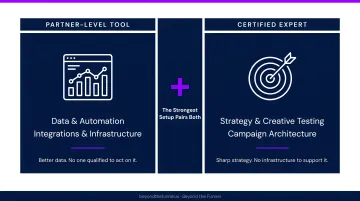
One without the other means better data with no one qualified to act on it — or sharp strategy with no infrastructure to support it.
How to Choose the Right LinkedIn Marketing Partner
Start with your bottleneck, not the vendor's feature list.
Match the problem to the category first:
- Reporting and attribution gaps → Insights partners
- Lead quality and CRM sync issues → Lead Generation partners
- Campaign scale and operational complexity → Campaign Management partners
- Content volume and scheduling → Content & Creative or Page Management partners
Once you've matched your problem to a category, the next step is evaluating the vendors within it. Not all partners are equal — here's what separates the credible ones from the crowd.
Three Vetting Criteria That Actually Matter
Verify the badge is active. Check the official LinkedIn partner directory rather than taking a vendor's word for it. Not every vendor displaying the logo holds current partner status.
Find case studies that match your context. A tool that works for a global enterprise SaaS brand isn't necessarily the right fit for a mid-market healthcare company. Look for proof from companies your size, in your industry, with your use case.
Understand the support model. Some partners are self-serve platforms; others include dedicated onboarding. Complex B2B funnels typically need guided implementation. Clarify the support structure before you sign.
Questions to Ask Before Committing
- Which LinkedIn Marketing API products and access tier does your platform use?
- What does LinkedIn data look like inside your reporting tool — can you show us a live example?
- Do you integrate directly with our CRM, or do you rely on third-party connectors?
If a vendor stumbles on these questions, that tells you something. The right partner answers them clearly — and often without hesitation.
Common Mistakes B2B Brands Make With LinkedIn Partner Tools
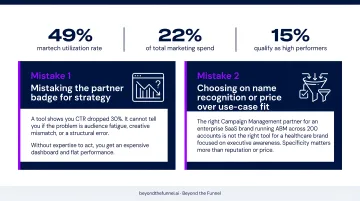
Gartner's 2025 Marketing Technology Survey puts the risk plainly: martech utilization has dropped to 49%, martech now represents nearly 22% of total marketing spend, and only 15% of organizations qualify as high performers who meet strategic goals and show positive ROI. The top barrier to adoption is complexity.
For LinkedIn partner tools specifically, the mistakes tend to follow predictable patterns:
Mistake 1: Mistaking the partner badge for strategy. A tool can show you that CTR dropped 30% last month. It cannot tell you whether the problem is audience fatigue, a creative mismatch with the funnel stage, or a structural campaign error. Without internal or external expertise to act on that data, you end up with an expensive dashboard and flat performance.
Mistake 2: Choosing on name recognition or price instead of use-case fit. The right Campaign Management partner for an enterprise SaaS company running ABM across 200 target accounts is not the right tool for a healthcare brand focused on executive awareness. Specificity matters more than general reputation — or the fact that a tool is the cheapest option in the category.
The smarter approach: invest in a partner tool only when you have the campaign volume, CRM discipline, and internal ownership to act on what it surfaces. The Gartner data isn't just a warning about martech broadly — it describes exactly how LinkedIn partner tools get adopted, underused, and quietly blamed for poor results.
Frequently Asked Questions
What is the LinkedIn Partner Program?
The LinkedIn Marketing Partner Program is LinkedIn's official framework for vetting third-party technology companies and platforms that integrate with LinkedIn's API. It's a designation for software vendors and managed-service providers — not individual marketers or agencies.
What are the different categories of LinkedIn Marketing Partners?
LinkedIn currently organizes partners into six categories: Content & Creative, Audiences, Insights, Page Management, Campaign Management, and Lead Generation. Each category addresses a specific operational need within a LinkedIn marketing program.
What is the difference between a LinkedIn Marketing Partner and a LinkedIn Certified Marketing Expert?
Marketing Partners are vetted technology companies or service organizations. Certified Marketing Experts are individual practitioners who have passed LinkedIn's advanced certification exam — Most high-performing B2B brands benefit from both: the right tool stack and a certified strategist who knows how to use it. For context, there are only 80 LinkedIn Certified Marketing Experts worldwide, including 16 in the U.S., such as Joshua Stout, founder of Beyond the Funnel.
How do I find a LinkedIn Marketing Partner for my business?
Visit LinkedIn's official partner directory at business.linkedin.com/advertise/partners/find-a-partner, where you can filter by category, solution type, and supported region to find currently certified vendors.
Do I need a large advertising budget to work with a LinkedIn Marketing Partner?
Partner tools serve businesses at various spend levels. The operational value — analytics, automation, and multi-account management — tends to justify the investment most clearly once you have consistent monthly LinkedIn ad activity and a CRM process to handle what the tool surfaces.
What should I look for when evaluating a LinkedIn Marketing Partner?
Three things: confirm the badge is active on LinkedIn's official directory (not just the vendor's site), find case studies from companies comparable to yours in size and industry, and clarify whether the platform includes guided onboarding or is purely self-serve.