That scroll-past problem is getting more expensive. A 2025 HockeyStack analysis of 70+ B2B SaaS companies and $28 million in ad spend found average LinkedIn CPC climbed from $10.48 in Q1 to $15.72 by Q3 — a 1.5x jump in a single year.
Targeting usually isn't the real problem. The copy is. Most B2B ad copy gets written to satisfy a marketing committee, not the LinkedIn member scrolling past it before their second coffee. That mismatch drains budget and fills pipelines with low-quality leads.
This guide covers what LinkedIn ads actually look like, the character limits that quietly sabotage good ideas, the copy components that convert, proven frameworks, funnel-stage matching, and the mistakes worth avoiding. It draws on insight from Beyond the Funnel founder Joshua Stout, one of just 16 LinkedIn Certified Marketing Experts in the U.S.
Key Takeaways
- LinkedIn intro text truncates around 150 characters, so your strongest hook needs to land before "see more"
- Cold audiences need educational, low-friction messaging — save hard conversion CTAs for warm traffic
- Frameworks like PAS, BAB, and stat-led openers consistently beat generic brand messaging
- Testing 4-5 ad variations per campaign and refreshing creative regularly prevents fatigue from draining your budget
What Do LinkedIn Ads Look Like? Formats & Character Limits
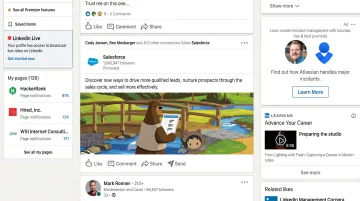
LinkedIn ads don't look like ads. That's the point.
Sponsored Content, Video, Carousel, Document, Message/Conversation Ads, and Text Ads all appear natively in the feed, styled like the organic posts around them. The only tell is a small "Promoted" label under the company name.
Character Limits by Format
Copy limits vary by format, and going over them means truncation, not rejection. LinkedIn's current ads guide recommends:
| Format | Headline | Intro Text | Description | CTA Button |
|---|---|---|---|---|
| Single Image | ~70 characters | ~150 characters | ~70 characters | ~20-25 characters |
| Video | ~70 (200 max) | ~150 (600 max) | N/A | ~20-25 characters |
| Carousel | 45 per card | ~255 characters | N/A | N/A |
| Document | ~70 characters | ~150 characters | N/A | N/A |
| Message/Conversation | N/A | up to 8,000 characters | N/A | 25 characters |
| Text Ads | 25 characters | N/A | 75 characters | N/A |
These are recommendations, not fixed policy, and specs shift. Always double-check the live LinkedIn ads guide before finalizing a build.
The "See More" Problem
Most readers never click "see more." If your value proposition sits after the cutoff, it might as well not exist. Treat the visible portion of intro text as the entire pitch — not a teaser for the rest.
Character limits aren't the only moving target. Image dimensions, aspect ratios, and video specs change too—pull current numbers from LinkedIn's specs page instead of last year's screenshot.
Core Components of High-Converting LinkedIn Ad Copy
Headline
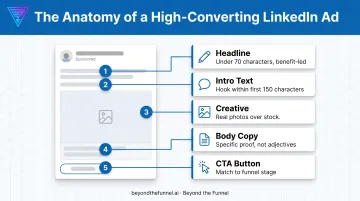
LinkedIn gives you roughly 70 characters before the headline truncates. Five patterns consistently perform well:
- Benefit-for-persona: "Faster Pipeline Reports for RevOps Leaders"
- Action verb + outcome: "Cut Onboarding Time in Half"
- Number + specific result: "3 Steps to Cut CAC by 20%"
- How-to + outcome: "How SaaS Teams Fill Pipeline Without Cold Calls"
- Contrarian opener: "Stop Chasing MQLs. Start Chasing Revenue."
Introductory Text
The first 150 characters need to answer one question: what's in it for me? Compare these two openers for the same offer:
Weak: "We help B2B companies grow with a full suite of marketing services designed to drive results."
Strong: "Your LinkedIn CPC just jumped 40%. Here's the copy framework keeping our clients' cost-per-lead flat."
The second version names a specific pain and promises a specific fix. The first could belong to any agency, in any industry.
Body/Description Copy
Description copy should be benefit-focused and specific to one persona, not a generic value statement. Stats and testimonials outperform adjectives every time. One example Beyond the Funnel has used in client creative:
"Josh helped us map out and execute a full LinkedIn strategy that took our pipeline from a few dozen to over 100 opportunities in one year." — Michael Arbini, Former Head of Commercial Marketing, Evidation
That's a named person, a named company, and a measurable result — far stronger than "trusted by top B2B brands."
Call-to-Action
Match the CTA button to the offer and the funnel stage:
- Download: gated content, awareness stage
- Learn More: soft engagement, awareness/consideration
- Register: webinars, events
- Sign Up: trials, newsletters
- Request Demo: high-intent, warm audiences only
Creative Pairing
Copy and visuals aren't separate decisions. Real photos of actual people, products, or workspaces consistently outperform stock imagery. Readers subconsciously flag stock photos as ads the moment they see them.
Video needs burned-in captions. A 2019 Verizon Media/Publicis Media survey of 5,616 U.S. consumers found 69% watch video with the sound off in public. If your message only lives in the audio, most viewers miss it entirely.
Clarity and Brevity
Concise, single-idea copy beats verbose, multi-benefit copy almost every time.
Before: "Our platform offers comprehensive analytics, seamless integrations, robust reporting, and dedicated support to help your team succeed."
After: "See your pipeline in real time. No spreadsheets required."
One idea, clearly stated, wins the scroll.
Proven Copywriting Frameworks for LinkedIn Ads
You do not need a blank page for every LinkedIn ad. These frameworks give you a repeatable structure for hooks, body copy, and CTAs—so you can brief faster and test smarter.
PAS (Problem-Agitation-Solution)
Name the problem, agitate the cost of ignoring it, then introduce the offer as the fix.
- Problem: "Your sales team burns 10 hours a week on manual reporting."
- Agitate: "That's 500 hours a year not spent selling, while competitors close faster."
- Solution: "See how [offer] automates it in one click."
BAB (Before-After-Bridge)
Show the painful current state, the aspirational outcome, then position the offer as the bridge between them.
- Before: "Stuck guessing which LinkedIn audiences actually convert."
- After: "Imagine knowing exactly which titles and industries drive pipeline."
- Bridge: "That's what audience validation testing gives you."
Hook Formulas That Earn the Click
Stat-led openers beat vague claims like "industry-leading results." "From a few dozen opportunities to 100+ qualified leads in one year" outperforms "we drive growth for B2B brands" because the number is concrete and checkable.
Contrarian and question hooks stop the scroll with cold, top-of-funnel audiences:
- Contrarian: "Most LinkedIn budget is wasted on job titles, not buying committees."
- Question: "Still measuring LinkedIn success by impressions?"
Testing Discipline
Treat creative like a system, not a one-shot bet:
- Run 4–5 variations per campaign instead of backing a single creative
- Pause clear underperformers early using CTR and engagement trends
- Refresh creative on a set cycle before frequency climbs and results decay
- Spot fatigue early: falling CTR and rising impressions per person show up before CPL does
Matching Ad Copy to Funnel Stage and Audience
Most of your total addressable market isn't shopping right now. The Ehrenberg-Bass Institute's 95:5 research treats 95% as a heuristic tied to purchase frequency: for categories bought roughly every five years, only about 5% of buyers are in-market in any given quarter.
The exact share shifts by category, but the principle holds. Most of your copy should build memory, not force an immediate close.
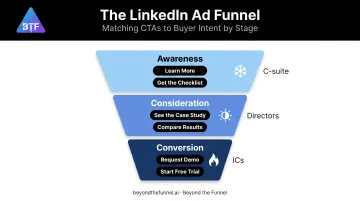
Awareness Stage
Cold audiences need educational, insight-led copy and soft CTAs:
- "Learn More"
- "Get the Checklist"
- "Read the Guide"
Consideration Stage
Audiences who've engaged with content or visited your site respond to proof-forward copy: case studies, benchmark data, and comparative claims.
Strong CTAs at this stage include:
- "See the Case Study"
- "Compare Results"
- "Download the Benchmark Report"
Conversion Stage
Reserve direct offers like "Request Demo" or "Start Free Trial" for warm, high-intent audiences only. Pitching a hard CTA to cold traffic inflates cost-per-lead because you're asking for commitment before trust exists.
Seniority matters too. Match the message to the reader:
- C-suite: strategic outcomes and market position
- Directors: ROI proof and pipeline impact
- Individual contributors: tactical, workflow-level benefits
Matching copy to both funnel stage and seniority is how Beyond the Funnel structures full-funnel LinkedIn programs for B2B brands.
Common LinkedIn Ad Copy Mistakes to Avoid
Strong offers still underperform when the copy makes one of these mistakes. Catch them before you launch.
- Pitching "Request a Demo" to cold audiences — inflates cost-per-lead and pulls in unqualified conversions
- Listing features instead of outcomes — writing for internal stakeholders instead of one reader with one pain point
- Using vague social proof like "trusted by thousands" instead of named results, logos, or specific metrics
- Running one static creative for months instead of testing variations and refreshing before fatigue sets in
Frequently Asked Questions
What do LinkedIn ads look like?
LinkedIn ads appear as Promoted posts within the feed, spanning formats like single image, video, carousel, and document ads. They blend visually with organic content aside from the small "Promoted" label.
Do LinkedIn ads cost money?
Yes. LinkedIn Ads run on an auction model billed by CPC, CPM, CPV, or CPS depending on your bidding strategy. There's no fixed price. Cost depends on targeting, competition, and campaign objective.
What is the best character length for LinkedIn ad copy?
Aim for headlines under 70 characters and intro text under 150 characters to avoid truncation. Always confirm current limits against LinkedIn's live ads guide, since specs vary by format.
How often should I refresh LinkedIn ad creative?
Watch for falling CTR, rising frequency, and declining engagement as your signal. Most advertisers refresh creative every few weeks and test multiple variations to stay ahead of fatigue.
What's the difference between a LinkedIn Thought Leader Ad and regular Sponsored Content?
Thought Leader Ads sponsor a first-person post from an individual member and often earn more organic trust. Sponsored Content promotes posts from the company Page or ads built directly in Campaign Manager.
How do I write LinkedIn ad copy for a cold audience?
Lead with a relatable problem or insight, not the product itself. Use a low-friction CTA like "Read the Guide" instead of a hard sell. Cold audiences aren't ready to buy yet.