This choice hits B2B marketers harder than most. A longer sales cycle, multiple decision-makers, and a narrower ICP mean a misaligned platform doesn't just waste clicks — it stalls revenue. US B2B digital ad spending grew 14.6% year-over-year in 2024, yet many marketing teams are still allocating budget based on habit rather than strategy.
This guide breaks down exactly how LinkedIn Ads and Google Ads differ for B2B — and gives you a clear framework for deciding which one (or both) belongs in your plan.
Key Takeaways
- LinkedIn targets by professional identity; Google targets by search intent — these are fundamentally different approaches
- LinkedIn produces higher-quality B2B leads; Google produces higher volume at lower initial cost
- Longer sales cycles and enterprise targets favor LinkedIn; shorter cycles with defined search demand favor Google
- The strongest full-funnel B2B strategy often runs both platforms simultaneously
- Platform choice should follow your sales cycle, ICP (Ideal Customer Profile), and current funnel objective
LinkedIn Ads vs. Google Ads for B2B: Quick Comparison
Both platforms can work for B2B — but they serve different goals, budgets, and buyer journeys. Here's how they stack up across the dimensions that matter most.
| Dimension | LinkedIn Ads | Google Ads |
|---|---|---|
| Typical B2B CPC | $5.58 avg; $6.40 for senior decision-makers | $5.34 for non-branded B2B search (Jul 2025) |
| Targeting Method | Professional profile attributes | Keyword/search intent |
| Ad Formats | Sponsored Content, Message Ads, Lead Gen Forms, Text Ads | Search, Display, YouTube, Performance Max |
| Lead Quality vs. Volume | Higher quality, lower volume | Higher volume, broader qualification needed |
| Ideal Funnel Stage | Top-of-funnel awareness + mid-funnel ABM | Mid-to-bottom funnel demand capture |
| Best-Fit Use Case | Enterprise B2B, ABM, complex/high-ticket sales | Broad-appeal services, shorter sales cycles |
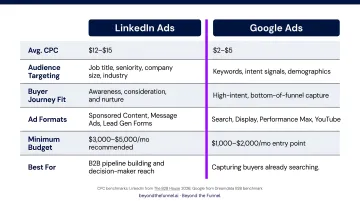
CPC benchmarks: LinkedIn from The B2B House 2026; Google from Dreamdata B2B benchmark
What Are LinkedIn Ads?
LinkedIn is the world's largest professional network with more than 1.3 billion members across 200+ countries. That scale matters less than what makes the platform unique: members voluntarily share verified professional data — job title, seniority, company, industry, skills — and they're browsing in a professional mindset. No other ad platform pairs that data with that intent.
Targeting Capabilities
LinkedIn lets you build audiences around professional attributes that directly mirror your ICP:
- Job title and function — reach specific roles within a buying committee
- Seniority level — filter by VP, Director, Manager, C-Suite
- Company name and size — target named accounts or specific revenue bands
- Industry — isolate verticals without demographic guesswork
- Skills and group membership — reach professionals who self-identify with relevant expertise
For a B2B marketer trying to reach a "VP of Finance at a SaaS company with 200–500 employees," LinkedIn is the only platform where that filter combination exists.
Key Ad Formats for B2B
- Sponsored Content (single image, carousel, video) — drives awareness and engagement in the feed
- Message Ads / Conversation Ads — delivered directly to LinkedIn inboxes for high-intent outreach
- Lead Gen Forms — pre-filled forms that reduce friction and capture verified professional data
- Text Ads — lower-cost sidebar placements useful for retargeting and brand reinforcement
Where LinkedIn Fits in the B2B Buying Journey
LinkedIn earns its premium at the top and middle of the funnel — particularly when buyers don't yet know they need a solution. It's the primary tool for ABM strategies targeting named accounts or the full buying committee, not just one contact.
The platform consistently performs for enterprise SaaS, financial services, and healthcare technology — offers with longer sales cycles that require education before a prospect will convert. Dreamdata's 2026 B2B benchmark found LinkedIn Ads delivered 121% ROAS, outperforming other B2B ad platforms across 66M+ sessions and 3.5M+ customer journeys.
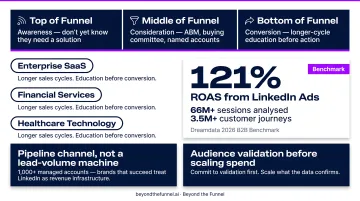
That pattern holds across Beyond the Funnel's 1,000+ managed accounts: brands that succeed on LinkedIn treat it as a pipeline channel, not a lead-volume machine — and commit to audience validation before scaling spend.
What Are Google Ads?
Google's core advantage is search intent. When a VP of IT types "cybersecurity compliance software" into Google, they're not passively scrolling — they're actively researching. Google puts your ad in front of that person at exactly that moment.
With 91.27% of global search engine market share as of June 2026, Google's reach for demand capture is unmatched.
Key Ad Formats for B2B
- Search Ads — text-based, keyword-triggered; strongest for bottom-funnel buyers actively comparing options
- Display Ads — visual banners across the Google Display Network; useful for retargeting and brand recall
- YouTube Ads — video-based awareness; effective for reaching business audiences during research phases
- Performance Max — cross-channel automation across Google's full inventory; growing adoption among B2B brands
Google's Core Strengths for B2B
- Lower average CPC compared to LinkedIn for many categories
- Faster data feedback loops — you see what's working in days, not weeks
- Massive reach for categories with established search demand
- Stronger performance for shorter sales cycles or commodity solutions
These strengths make Google especially effective when buyers are already in motion. That's the key context for understanding where it fits in the funnel.
Where Google Fits in the B2B Buying Journey
Google captures mid-to-bottom funnel demand. When a buyer is comparing vendors, searching a solution category, or looking for a specific provider, Google is where they show up. The Display Network extends that reach, retargeting buyers who visited your site but didn't convert.
B2B categories with strong search volume — IT services, marketing software, accounting platforms, logistics technology — tend to perform well on Google Ads because purchase intent is already baked into the query. WordStream's 2025 benchmark shows Business Services conversion rates averaging 5.14% on Google Ads, a useful reference point for B2B planning.
One critical context: Dreamdata's B2B non-branded Google Search benchmark shows CPC climbed from $4.13 in August 2024 to $5.34 by July 2025 — a 29% increase — while CTR dropped 26% over the same period. High-intent B2B search is valuable, but auction pressure is rising.
Which Platform Is Right for Your B2B Strategy?
There's no universal winner. The right platform is the one that maps to your audience, sales cycle, and funnel objective. Here's how to think through the decision.
Factor 1: Sales Cycle Length
Longer, complex cycles → LinkedIn. When a deal involves 5+ stakeholders and 6–12 months of consideration, you need a platform built for awareness and relationship development, not just click capture.
Shorter, transactional cycles → Google. If your prospect is ready to buy within days or weeks of first contact, Google's demand capture is faster and more cost-efficient.
Factor 2: Audience Precision vs. Search Behavior
Defined by professional attributes → LinkedIn. If your ICP is "Director of Operations at a manufacturing company with 500–2,000 employees," LinkedIn is the only platform that can build that audience reliably.
Defined by what they search → Google. If your buyers type specific queries ("ERP software for distributors," "compliance training platform"), Google meets them at peak intent.
Factor 3: Budget and Cost Expectations
Google offers a lower CPC entry point and faster feedback — useful for early-stage testing or tighter budgets. LinkedIn requires more investment to generate statistically meaningful data, but when executed correctly, it reaches decision-makers that no keyword targeting can reliably find.
Situational Recommendations
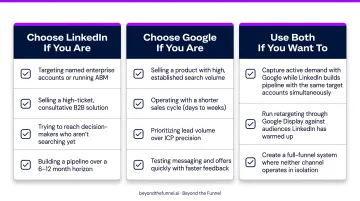
Choose LinkedIn if you are:
- Targeting named enterprise accounts or running ABM
- Selling a high-ticket, consultative B2B solution
- Trying to reach decision-makers who aren't searching yet
- Building a pipeline over a 6–12 month horizon
Choose Google if you are:
- Selling a product with high, established search volume
- Operating with a shorter sales cycle (days to weeks)
- Prioritizing lead volume over ICP precision
- Testing messaging and offers quickly with faster feedback
Use both if you want to:
- Capture active demand with Google while LinkedIn builds pipeline with the same target accounts simultaneously
- Run retargeting through Google Display against audiences LinkedIn has warmed up
- Create a full-funnel system where neither channel operates in isolation
Real-World Example: LinkedIn as a Pipeline Catalyst
Evidation, a health technology company, worked with Beyond the Funnel to build a structured LinkedIn strategy after struggling to scale qualified pipeline. The challenge wasn't traffic — it was quality and alignment with their target audience.
The result: pipeline grew from a few dozen opportunities to over 100 in a single year, according to Michael Arbini, Evidation's Former Head of Commercial Marketing. "Josh helped us map out and execute a full LinkedIn strategy that took our pipeline from a few dozen to over 100 opportunities in one year. He's strategic, collaborative, and deeply understands how to turn LinkedIn into a growth channel."
When your ICP is specific and your sales cycle is long, channel selection matters as much as campaign execution. LinkedIn's professional targeting gave Evidation access to the right decision-makers — not just more clicks.
If your B2B pipeline needs that kind of realignment, Beyond the Funnel's LinkedIn advertising services are built for exactly that — audience validation, creative testing, and full-funnel strategy led by one of 16 LinkedIn Certified Marketing Experts in the U.S.
Conclusion
LinkedIn Ads and Google Ads serve different jobs in a B2B marketing strategy. That difference is the whole point.
Google captures buyers who are already looking. LinkedIn reaches buyers who will need you before they know it. The real question isn't which platform is cheaper per click. It's which platform is most likely to generate pipeline that actually closes given your specific sales cycle, ICP, and revenue goal.
Use these signals to guide your decision:
- Lean LinkedIn when your deal is complex, your audience is narrow, and your buyers aren't searching yet
- Lean Google when search demand exists, your cycle is short, and you need volume now
- Use both when you're serious about building a full-funnel B2B engine
Test with intention. Measure lead quality, not just volume. And revisit your allocation as your strategy matures — what wins at $5K/month in spend often needs a full rebuild at $50K.
Frequently Asked Questions
How much more expensive are LinkedIn Ads compared to Google Ads?
LinkedIn's average B2B CPC is around $5.58 globally, rising to $6.40 for senior decision-makers. Google's B2B non-branded search CPC hit $5.34 by mid-2025, closer than most expect. The real gap shows up at CPL, where LinkedIn's narrower targeting commands a premium that's often justified by lead quality and deal size.
Which platform is the best for B2B marketing?
Neither is universally better. LinkedIn wins when your ICP is defined by professional attributes and your sales cycle is long. Google wins when search demand is established and conversion speed matters. Many B2B brands run both in a complementary full-funnel strategy rather than choosing one exclusively.
Are LinkedIn Ads good for B2B?
Yes — particularly for complex, high-value sales targeting specific decision-makers. LinkedIn's unique professional targeting across 1.3 billion members makes it the strongest platform for reaching buying committees by title, seniority, and company. Dreamdata's 2026 benchmark found LinkedIn delivered 121% ROAS across B2B advertisers in their dataset.
Can you run LinkedIn Ads and Google Ads at the same time for B2B?
Running both simultaneously is often the most effective B2B strategy. Google captures buyers actively searching; LinkedIn builds pipeline with decision-makers who aren't searching yet. Together, they cover more of the buying journey than either platform can alone.
What is a good starting budget for LinkedIn Ads for B2B?
Plan for at least $3,000–$5,000 per month in ad spend to generate enough data for meaningful optimization. LinkedIn's CPCs are higher than most channels, and narrow professional audiences need adequate impression volume to validate targeting.
Which platform generates better quality leads for B2B?
LinkedIn typically produces better-targeted leads with stronger ICP alignment, since targeting is based on verified professional attributes rather than inferred intent. Google produces higher volume. "Better quality" ultimately depends on how your business defines it: title match, deal size, or conversion rate to pipeline.