This is where many B2B advertisers quietly lose budget. The objective you select doesn't just label your campaign — it tells LinkedIn's algorithm what signal to optimize toward, who to show your ads to, and what your campaign needs to function at all. Choose wrong, and you're not just missing a metric; you're pointing the algorithm in the wrong direction from day one.
This guide breaks down both objectives in plain English, compares them directly, and gives you a clear framework for choosing the right one based on where your audience is and whether your campaign is actually ready.
Key Takeaways
- Website Visits optimizes for clicks — best for cold audiences, content promotion, and building retargeting pools
- Website Conversions optimizes for on-site actions (like demo requests) and requires conversion tracking to work
- Without sufficient conversion volume, Website Conversions campaigns often underdeliver or inflate costs
- A full-funnel approach uses both: Visits to warm audiences, Conversions to close them
- Picking the wrong objective cascades into poor click quality, wasted spend, and misattributed results
Website Visits vs. Website Conversions: Quick Comparison
| Dimension | Website Visits | Website Conversions |
|---|---|---|
| Funnel Stage | Mid-funnel (consideration) | Bottom-funnel (conversion) |
| Primary Optimization | Landing page clicks | Defined on-site conversion actions |
| Conversion Tracking Required | No (optional for reporting) | Yes: Insight Tag + conversion events required |
| Available Bidding | Manual CPC, Maximum Delivery, Cost Cap | Manual Bidding (Classic); Maximum Delivery (Accelerate) |
| Best Audience Temperature | Cold to warm | Warm to hot (retargeting) |
| Cost Behavior | More predictable CPCs | CPCs vary based on algorithm learning and conversion signal |
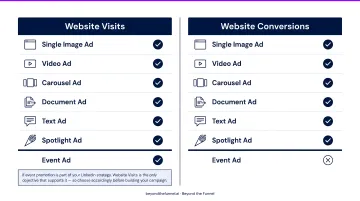
Ad format note: Both objectives support single image, video, carousel, document, text, and spotlight ads. However, according to LinkedIn's official Campaign Manager documentation, Event ads are supported under Website Visits but not under Website Conversions. If event promotion is part of your LinkedIn strategy, Website Visits is the only objective that supports it — so choose accordingly before building your campaign.
What Is the LinkedIn Website Visits Objective?
Website Visits sits in the consideration stage of LinkedIn's campaign funnel. When you select it, you're telling the algorithm to find people most likely to click through to your website or landing page. The key result metric is landing page clicks.
How the Optimization Works
LinkedIn optimizes delivery toward users who are more likely to click. Conversion tracking via the Insight Tag is not required to run these campaigns — though you can still track conversion data as a secondary reporting metric. The algorithm won't use conversions as its optimization signal; it's working purely toward clicks.
That makes Website Visits a practical starting point for advertisers still building out their conversion tracking infrastructure — a common situation for teams new to LinkedIn ads.
Why Manual CPC Matters Here
Website Visits supports Manual CPC bidding, which is a meaningful lever on a platform known for higher costs. With manual bidding, you set a ceiling on what you'll pay per click — giving you more predictable cost control when testing new audiences or messaging.
Primary Use Cases
- Introducing your brand to cold, top-of-funnel audiences who've never encountered you
- Driving traffic to high-value content: whitepapers, case studies, industry reports
- Building website visitor audiences for retargeting — on LinkedIn or other platforms
- Testing audience-to-message fit before committing to conversion-focused campaigns
Its Role as a Data Engine
Often overlooked, Website Visits builds the retargeting pools that fuel your future Conversions campaigns. Before you have conversion volume to work with, you need someone to retarget. Website Visits creates that audience of engaged visitors, without the campaign infrastructure that Website Conversions demands.
What Is the LinkedIn Website Conversions Objective?
Website Conversions sits at the bottom of LinkedIn's funnel. Selecting it tells the algorithm to find users most likely to complete a specific action you've defined on your website — a form submission, demo request, content download, or consultation booking.
The Hard Prerequisite
This objective requires conversion tracking to function. Specifically, you need to:
- Install the LinkedIn Insight Tag on your website
- Define at least one conversion event in Campaign Manager
- Associate that conversion event with your campaign before it can be activated
LinkedIn's official Insight Tag conversion tracking documentation confirms that this setup captures both post-click and view-through conversions. Without it, the Website Conversions objective simply cannot optimize the way it's designed to.
The Data Volume Challenge for B2B
LinkedIn's algorithm needs sufficient conversion data to exit its learning phase and optimize effectively. Enterprise demo requests, consultation bookings, and high-ticket form fills are inherently low-volume events — companies might generate a handful per week, not dozens.
When the algorithm lacks enough signal, it can't identify what a "likely converter" looks like. Your campaign either underdelivers, broadens delivery in ways you didn't intend, or inflates CPCs while failing to find qualified traffic.
This is one of the most common structural problems in B2B LinkedIn campaigns — and it's entirely avoidable if you match the objective to your actual data reality.
Primary Use Cases
- Retargeting warm audiences who've visited your site or engaged with previous campaigns
- Bottom-funnel campaigns with high-intent CTAs (demos, trials, consultations)
- Nurture campaigns where the audience already knows who you are
Bidding Strategy Note
Website Conversions behaves differently depending on your ad set type:
- Classic campaigns support Manual Bidding for direct cost control
- Accelerate campaigns use Maximum Delivery only — LinkedIn manages spend to maximize conversion volume
Accelerate can work well when you have strong conversion data and want to scale. Classic gives you more control when you're still testing.
Which Objective Should You Choose?
The Most Common Mistake
Advertisers default to Website Conversions because it sounds more performance-oriented. The logic feels right — you want conversions, so pick the conversion objective. But without adequate conversion volume or a sufficiently warm audience, the algorithm has nothing to learn from. The campaign stalls, CPCs climb, and performance looks mysteriously flat.
The cause is rarely creative or budget. It's a structural mismatch between what the objective requires and what the campaign can actually deliver.
A Practical Decision Framework
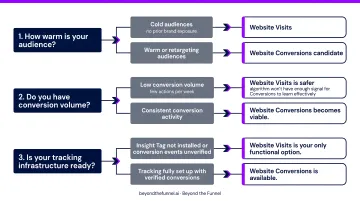
Before selecting your objective, answer three questions:
1. How warm is your audience?
- Cold audiences (no prior brand exposure) → Website Visits
- Warm or retargeting audiences → Website Conversions candidate
2. Do you have conversion volume?
- Low conversion volume (few actions per week) → Website Visits is safer; your algorithm won't have enough signal for Conversions to learn effectively
- Consistent conversion activity → Website Conversions becomes viable
3. Is your tracking infrastructure ready?
- Insight Tag not installed or conversion events unverified → Website Visits is your only functional option
- Tracking fully set up with verified conversions → Website Conversions is available
Clear Situational Recommendations
Choose Website Visits when:
- Launching to a new audience segment
- Promoting content (whitepapers, reports, webinars)
- Running awareness-to-consideration campaigns
- Conversion data is sparse or tracking isn't verified yet
Choose Website Conversions when:
- Targeting a retargeting audience built from prior campaigns
- Running bottom-funnel campaigns with a specific, well-defined conversion action
- You have consistent conversion volume to feed the algorithm
The Full-Funnel Sequencing Play
The strongest LinkedIn campaigns don't treat these as competing options — they use both in sequence. Website Visits runs first to warm cold audiences and build retargeting pools. Once those pools reach sufficient size and the algorithm has click-behavior signals to work from, Website Conversions campaigns re-engage those warmed prospects with a high-intent CTA.
This sequencing is exactly how Beyond the Funnel structures LinkedIn campaigns for B2B clients: consideration and conversion as a connected system, not isolated campaigns. The result is a measurable pipeline where each objective hands qualified prospects to the next stage rather than starting from scratch.
Conclusion
Neither objective is universally better. Website Visits isn't a consolation prize, and Website Conversions isn't the right choice just because it sounds more results-driven. The right decision depends on where your audience sits in the funnel, whether your conversion tracking is functional, and whether you have the data volume LinkedIn needs to actually optimize.
Getting this wrong doesn't just hurt one metric — it changes what the algorithm is working toward at every impression, affecting click quality, cost efficiency, and lead relevance across every campaign it touches.
For most B2B brands, the real answer isn't picking one permanently. It's knowing when to use each and building a campaign architecture that sequences them intelligently.
If your funnel sequencing needs work, Beyond the Funnel can help. Founder Joshua Stout is one of 16 LinkedIn Certified Marketing Experts in the U.S. — with 1,000+ managed accounts behind the methodology. The team builds full-funnel LinkedIn strategies that move B2B audiences from cold to converted. Let's talk strategy.
Frequently Asked Questions
What is the difference between Website Visits and Website Conversions on LinkedIn?
Website Visits optimizes for landing page clicks — it's a mid-funnel objective that works without conversion tracking. Website Conversions optimizes for specific on-site actions you've defined (like form fills or demo requests) and requires the LinkedIn Insight Tag and verified conversion events to function.
Do I need the LinkedIn Insight Tag for the Website Visits objective?
No — the Insight Tag is optional for Website Visits. You can still track conversions as a secondary reporting metric, but the algorithm optimizes toward clicks, not conversions. The Insight Tag is mandatory for Website Conversions.
Can I track conversions with the Website Visits objective?
Yes. Website Visits campaigns can record conversion data for reporting purposes. The distinction is that the algorithm still optimizes for landing page clicks — conversion data is a monitoring tool in this setup, not the optimization signal.
When should I switch from Website Visits to Website Conversions?
Consider switching when you have consistent conversion volume, a warm or retargeting audience segment, and verified conversion tracking in place. Don't switch based on time alone — the trigger should be data readiness, not calendar days.
How much conversion data does LinkedIn need to optimize Website Conversions campaigns?
LinkedIn generally needs around 50 conversions per month per campaign to exit the learning phase and optimize effectively. B2B campaigns with low-frequency actions — like enterprise demo requests — rarely hit that threshold, which is why Website Visits is the smarter starting point for most B2B advertisers.
What is the 95-5 rule, and why does it matter for LinkedIn campaign strategy?
The 95-5 rule, developed by the Ehrenberg-Bass Institute for LinkedIn's B2B Institute, holds that roughly 95% of B2B buyers aren't actively in-market at any given time. Pushing conversion-focused objectives to cold audiences ignores this reality. Website Visits is the better objective for warming buyers who aren't yet ready to act.