Introduction
Walk into most B2B marketing meetings and you'll hear the same question: how many form fills did the LinkedIn campaign generate this month?
That single metric has become the finish line for entire ad budgets, even though a form fill is just one moment in a much longer buying journey.
The math is getting harder to ignore. One analysis of $28 million in B2B SaaS ad spend found average LinkedIn CPC jumped from $10.48 in Q1 to $15.72 by Q3 2025 — a 1.5x increase largely driven by rising competition.
Meanwhile, sales teams keep complaining about the same thing: gated-content leads that show up unqualified, unresponsive, or simply not ready to buy.
This guide breaks down what demand generation actually means on LinkedIn, the content frameworks and full-funnel tactics that build pipeline without gating every asset, and how to measure success when the form fill isn't the only signal that matters.
Key Takeaways
- Demand gen builds upper-funnel trust; lead gen captures warm intent. Combine both instead of choosing one.
- B2B buying committees span multiple departments, so campaigns need more than one target persona.
- Use the 3-2-1 and 95-5 rules to keep your content calendar balanced, not repetitive or overly salesy.
- Track engagement, brand lift, and pipeline influence, not form-fill volume alone.
- Organic content, diverse ad formats, and structured testing consistently beat a forms-only approach.
What Is LinkedIn Demand Generation? Demand Gen vs. Lead Gen
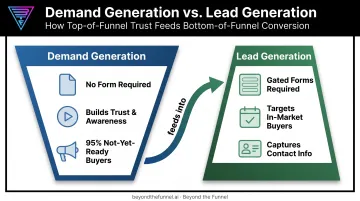
Demand generation is the upper-funnel work of building awareness and interest without asking for anything in return. No form, no email trade, no gated PDF. Lead generation sits downstream of it, using forms and offers to capture contact details once someone's already interested.
The two aren't competing strategies. Demand gen creates the interest that lead gen later converts. Skip the first step and you're just fishing in an empty pond with a nicer rod.
This distinction matters more now because the B2B buyer's journey has stretched out and gone largely self-directed. Buying committees routinely span multiple departments: IT, finance, operations, and end users all weigh in before a deal closes, not just the one contact who filled out your form.
By the time buyers reach out, most of their research is already done. 6sense's 2024 study of 2,509 B2B buyers found that 69% of the purchase process happens before sellers ever get involved.
That's the core case for demand gen: it makes your brand the obvious, trusted choice before a prospect ever hits your website. Lead gen forms just convert demand that already exists. They can't manufacture it.
Why Lead Gen Forms Alone Aren't Enough Anymore
Gated content answers one question: who's willing to trade an email address for a PDF? That's not the same as who's ready to buy. It's a filter for curiosity, not intent, and it tends to flood SDR queues with names that never respond to outreach.
Cognism ran into this directly. The company found its content-driven leads converted far worse down-funnel than leads coming from declared-intent actions like demo requests. Its response: strip the gates off entirely and let the content do its job of building trust first.
The same pattern shows up across B2B teams:
- Gated forms filter for form-fillers, not buyers
- Volume goes up while sales-qualified conversion goes down
- SDR teams burn hours chasing names that ghost every follow-up
- Rising ad costs make each low-quality lead more expensive to acquire
The Building Blocks of a Full-Funnel LinkedIn Demand Gen Strategy
A full-funnel LinkedIn presence isn't one campaign type run harder. It's several layers working together, each doing a different job.
Start Organic, Then Scale What Works
Before spending a dollar on ads, publish a batch of point-of-view posts on your company or founder page. Watch what happens: which posts pull real comments (not just emoji reactions), which drive profile views, and which trigger inbound DMs.
That's your ICP telling you what resonates, for free, before you commit ad budget to it.
Diversify Formats and Targeting
Lead Gen Forms aren't the only ad unit on LinkedIn, and treating them as the default leaves engagement on the table:
- Conversation Ads and Message Ads open a direct, low-pressure dialogue
- Document Ads let prospects flip through a guide natively, no download required
- Native video builds familiarity without asking for anything
Pair format diversity with layered targeting. Instead of building one campaign around a single "decision-maker" persona, combine job function, seniority, and skills filters to reach the finance lead, the IT stakeholder, and the day-to-day user, since B2B purchases rarely rest on one signature.
Close the Loop with Retargeting and Sales Alignment
Once people engage, don't let that interest evaporate. Build Matched Audiences from your engaged viewers and use Company Engagement reporting to spot accounts warming up. Serve them deeper content or a Conversation Ad instead of starting the relationship cold.
Two more habits seal this system. Publish ungated evergreen assets, such as benchmark reports or a regular newsletter, on your LinkedIn Page so awareness keeps compounding after the campaign ends. Export engaged-account lists to your SDR team so outbound starts with "I saw you engaged with our post on X" instead of a cold script.
LinkedIn Content Rules for Demand Gen: The 3-2-1 and 95-5 Rules
The 95-5 Rule: Most Buyers Aren't Ready Yet
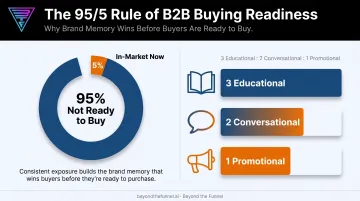
Ehrenberg-Bass Institute researcher John Dawes puts it plainly: at any given moment, up to 95% of B2B buyers aren't in the market to buy. It's a heuristic, not an exact measurement, but the implication holds regardless: most of your audience isn't ready to convert today.
That reshapes how you should think about your content mix. If 95% of your audience is out-of-market, content built purely for immediate conversion is talking to almost nobody. The job of most posts is to build brand memory, so when that 95% eventually enters the market, your name is already familiar.
The 3-2-1 Framework for Weekly Posting
A practical way to put that into practice is a 3-2-1 mix. For every six posts, aim for three educational, two conversational, and one promotional. It's a mix, not a formula carved in stone, but it keeps a feed from turning into a wall of pitches.
Applied to a weekly calendar, it might look like this:
| Day | Post Type | Purpose |
|---|---|---|
| Monday | Educational (industry insight) | Build category authority |
| Tuesday | Conversational (poll or question) | Drive engagement |
| Wednesday | Educational (how-to breakdown) | Build category authority |
| Thursday | Conversational (customer story, no pitch) | Build trust |
| Friday | Educational (data or trend) | Build category authority |
| Every other week | Promotional (offer, demo CTA) | Convert the in-market 5% |
Most of the week builds authority. The promotional slot stays light on purpose—so the ask reaches the in-market 5% without training everyone else to scroll past pitches.
Measuring Demand Gen Success Beyond Form Fills
Clicks and form fills drastically undercount what demand gen actually does. Someone who watches three of your videos, reads a Document Ad, and mentions your brand in an internal Slack channel never shows up in a last-click report, yet that's exactly the influence demand gen is built to create.
Top-Funnel Engagement Metrics to Watch
Start tracking signals that show interest is building, even without a conversion:
- Engagement rate (reactions, comments, shares relative to impressions)
- Video completion rate
- Click-through rate on organic and paid posts
- Open rates on Message and Conversation Ads
- Page views and follower growth on your Company Page
Brand Lift: Measuring Perception Shifts
LinkedIn's Brand Lift testing splits your audience into an ad-exposed group and a control group, then surveys both on the same questions:
- Do you recall this ad?
- Have you heard of this brand?
- How likely are you to consider it?
- How favorably do you view it?
Run this pre- and post-campaign to quantify whether your content is changing minds, not just racking up impressions.
Connecting Content Touches to Pipeline
Pair LinkedIn Conversion Tracking, which captures post-click and view-through conversions, with your CRM. That connection lets you see which accounts engaged with content weeks before a deal opened, rather than crediting whatever channel happened to get the last click.
Those attribution insights only stay useful if you act on them. Set a recurring cadence, such as biweekly creative and message reviews, to A/B test formats and narratives, then double down on whatever is actually moving engagement and pipeline. Testing once and walking away wastes most of the signal.
How to Build Your LinkedIn Demand Gen Engine: DIY or Partner
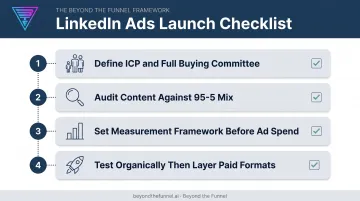
If you're starting in-house, a basic checklist keeps you from launching blind:
- Define your ICP and the full buying committee, not just one persona
- Audit existing content against the 95-5 mix — is everything a pitch?
- Set a measurement framework (engagement, brand lift, pipeline) before spending on ads
- Test organically first, then layer in paid formats based on what already resonates
Launching is the easy part. Sustaining tests across creative, audience, and offers month after month is where most internal teams run out of bandwidth next to the rest of the marketing calendar.
That's often where a specialized partner earns its keep. Beyond the Funnel, founded by Joshua Stout (one of 80 LinkedIn Certified Marketing Experts worldwide and 16 in the U.S.), built its framework across more than 1,000 managed LinkedIn ad accounts.
For Evidation, that approach grew pipeline from a few dozen opportunities to over 100 in a single year, using the same audience validation, ICP messaging, and full-funnel structure outlined above.
Whether you build it yourself or bring in help, the principle is the same: validate before you scale.
Frequently Asked Questions
What LinkedIn content rules (like the 3-2-1 and 95-5 rules) should I follow for demand generation?
The 95-5 rule means most buyers aren't ready to buy, so prioritize content that builds brand memory. A 3-2-1 mix—three educational, two conversational, one promotional—keeps your calendar balanced without over-pitching.
What are demand generation activities?
Core activities include thought leadership, multi-format ads (video, Document Ads), retargeting engaged accounts, and ungated resources. The goal is pre-purchase awareness—not an immediate form fill.
What's the difference between LinkedIn demand generation and lead generation?
Demand gen builds trust and awareness with no gate or form required. Lead gen captures contact info through forms once interest already exists. They work best combined, with demand gen feeding the pipeline that lead gen converts.
How long does it take to see results from LinkedIn demand generation?
Plan on several months before you see clear brand-lift or pipeline impact. Consistent testing compounds results over time, unlike the quicker but shallower wins from lead-form campaigns.
Can small businesses run LinkedIn demand generation on a limited budget?
Yes. Thought leadership and ungated content need time and consistency more than a large ad budget. Many teams validate messaging first, then scale with paid once it works.
Which LinkedIn ad formats work best for demand gen beyond lead forms?
Conversation Ads, Message Ads, Document Ads, and native video all build engagement without gating value behind a form. They let prospects interact with your brand on their terms, which fits earlier funnel stages better than a hard conversion ask.