Neither reaction is right, and most marketers can't explain what actually happened.
Misreading these two numbers leads to bad calls: pulling budget from a working campaign, doubling down on a format that's actually just recycling the same small audience, or reporting the wrong story to leadership. This guide breaks down what impressions and members reached really measure, how the gap between them forms, and how to use both numbers to make sharper B2B LinkedIn decisions.
Key Takeaways
- Impressions count every view, including repeats; reach counts each viewer once
- Reach can never exceed impressions, regardless of algorithm distribution
- A wide gap signals recirculation within your existing audience, not new-audience growth
- Neither metric proves performance alone—pair both with engagement rate
- Beyond the Funnel prioritizes validated audience reach over raw impression volume in B2B campaigns
What Does "Impressions" Mean on LinkedIn?
LinkedIn's own help documentation defines impressions simply: the number of times your post was displayed on screen. LinkedIn even flags this as an estimate that "may not be precise," so don't treat the number as gospel.
Here's the part that trips people up: one person scrolling past the same post three times generates three impressions, not one. Impressions measure distribution and exposure. They don't measure how many distinct humans actually saw your content.
In-network vs. out-of-network impressions. LinkedIn breaks impressions into two buckets:
- In-network: the percentage of impressions from members who follow or are connected to you
- Out-of-network: the percentage from members who don't follow or connect with you
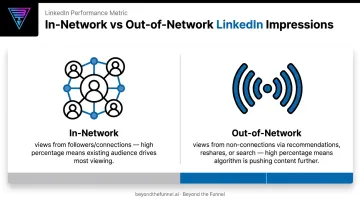
A high out-of-network percentage signals the algorithm is pushing your content beyond your existing circle, through feed recommendations, reshares, or search. A high in-network percentage usually means your current audience is doing most of the viewing.
That split explains where views come from, but it doesn't explain why the count climbs in the first place.
What drives impressions up? Several factors typically inflate impression counts:
- Frequent, consistent posting
- Strong early engagement in the first hour
- Reshares that put the post back in front of new feeds
- Algorithmic resurfacing, where LinkedIn re-serves a post days after publishing
None of these guarantee new eyeballs. They just mean the post is showing up more often, sometimes to the same people repeatedly.
What Does "Members Reached" Mean on LinkedIn?
Members reached is the antidote to impression inflation. LinkedIn defines it as the number of distinct members and Pages who viewed your post, with repeat views excluded entirely.
This creates one hard rule: members reached will always be equal to or lower than impressions, never higher. There's no scenario where more unique people saw a post than the total number of times it displayed.
What Actually Grows Members Reached
Unlike impressions, this metric only moves when new people enter the picture. Growth typically comes from:
- Follower growth, which expands your baseline in-network audience
- Shares that push content into networks you don't already have access to
- Algorithmic distribution through feed recommendations and search, which LinkedIn has confirmed as documented routes for reaching people outside your immediate connections
LinkedIn hasn't published a specific rule guaranteeing distribution to second- or third-degree connections. The confirmed mechanisms are recommendations, shares, and search, not a formula you can game.
Members Reached vs Impressions: What the Gap Tells You
Put the two side by side and the distinction gets simple fast:
| Metric | What it counts | Repeat views |
|---|---|---|
| Impressions | Total displays | Counted every time |
| Members reached | Distinct viewers | Counted once |
Example: If one person opens your post five separate times, that's 5 impressions but only 1 member reached. Multiply that across your audience and you can see how a small, engaged group can generate impressive-looking impression counts without much new exposure.
Two patterns show up most often:
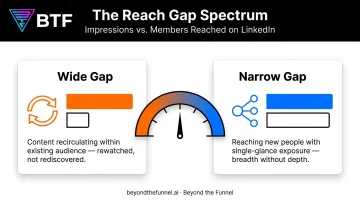
- Wide gap (impressions far exceed members reached): Your content is circulating inside an existing audience rather than breaking out. It's getting rewatched, not rediscovered.
- Narrow gap (members reached sits close to impressions): You're reaching new people, but most are giving your content a single glance — breadth without depth.
LinkedIn hasn't published its exact counting methodology for either metric, so treat both as directional trend indicators rather than forensic-precise measurements.
That caution matters more given current trends. Socialinsider's 2024 analysis found LinkedIn engagement climbed 44% year over year, pushing average engagement rates to 3.85%. Rising engagement alongside a widening reach gap can mean your existing audience is getting more invested, even if you're not breaking into new networks yet. Track both numbers together before concluding your reach has stalled.
Why These Metrics Matter for B2B LinkedIn Ad Strategy
The right metric depends entirely on the goal. For organic thought leadership, impressions support brand awareness; repeated exposure keeps your name in front of the same decision-makers. For lead generation and pipeline goals, members reached within your actual target audience matters far more.
Here's why quality of reach outranks volume. The 2025 Edelman-LinkedIn B2B Thought Leadership Impact Report, surveying nearly 2,000 LinkedIn-member executives, found 56% of target decision-makers use thought leadership content to vet vendors. A campaign that racks up impressions among the wrong audience contributes nothing to that vetting process.
Organic vs. Paid: Different Rules Apply
Paid campaigns in Campaign Manager report reach differently than organic posts do:
- Paid member reach: An estimated count of unique accounts with at least one impression, available only for date ranges of 92 days or fewer
- Organic members reached: No date-range restriction applies
Mixing the two in a leadership report creates confusion, so keep them separate.
This is where Beyond the Funnel's approach diverges from the impressions-first mindset. Led by one of 80 LinkedIn Certified Marketing Experts worldwide, the agency builds full-funnel strategies around validated audience reach within a defined ideal customer profile. Vanity impression counts don't factor in. Reach only counts if it lands on the right professionals.
Neither metric proves a campaign worked on its own. Engagement rate has to be paired with both impressions and members reached to determine whether reach actually converted into real interest.
How to Improve Both Impressions and Members Reached
Most tactics that boost impressions also lift members reached, since the two metrics share the same underlying levers.
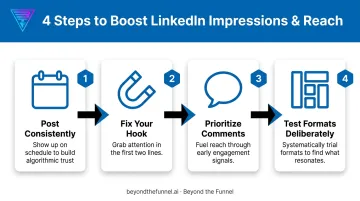
- Post on a consistent cadence. Sporadic bursts confuse the algorithm's relevance signals. A steady rhythm, whether daily or a few times a week, builds trust with distribution systems over time.
- Fix your hook. Weak opening lines or flat ad creative suppress both metrics before distribution even starts. The first two lines decide whether someone stops scrolling.
- Prioritize comments over passive reactions. Early, substantive engagement signals content quality that can expand distribution to new members reached, not just repeat views from your existing audience.
- Test formats deliberately. Format performance varies more than most marketers expect.
| Organic format | 2025 average engagement rate |
|---|---|
| Native document/PDF | 7.00% |
| Multi-image | 6.45% |
| Video | 6.00% |
| Image | 5.30% |
| Text | 4.50% |
Data from Socialinsider's analysis of 1.3 million LinkedIn business posts.
There's a tension here: video posts show strong engagement rates, but average video views have dropped 36% year over year in the same dataset. Higher engagement doesn't automatically mean guaranteed reach, so format testing has to be ongoing, not a one-time decision.
Beyond the Funnel builds this ongoing testing directly into client accounts, running format and creative tests on a set cadence so B2B brands know which posts to scale instead of guessing which one might land this week.
Common Misconceptions About Impressions and Members Reached
A few myths keep circulating in LinkedIn analytics conversations, and they're worth correcting directly.
Myth: More impressions automatically means more reach. Not true. The same small audience seeing your content repeatedly can inflate impressions entirely, making high impression counts with flat reach a warning sign rather than a win.
Myth: Members reached equals engagement. LinkedIn counts someone as "reached" even if they never like, comment, or click anything, since reach measures exposure rather than interest.
Myth: Members reached only includes existing followers. This one's persistent but wrong, because members reached includes anyone LinkedIn's algorithm distributes your content to, follower or not, through recommendations, search, or reshares.
Frequently Asked Questions
What does "members reached" mean on LinkedIn?
Members reached is the number of distinct members and Pages who saw your post or ad at least once. Repeat views from the same person aren't counted more than once, regardless of how many times they scrolled past it.
What is the difference between members reached and impressions on LinkedIn?
Impressions count every display, including repeats from the same viewer. Members reached counts only unique viewers. Because of this, members reached can never exceed impressions.
Why are my LinkedIn impressions much higher than my members reached?
This usually means your existing audience is seeing the content repeatedly rather than the algorithm distributing it to new people. Check your in-network versus out-of-network impression split for confirmation.
Which metric matters more for B2B lead generation, impressions or members reached?
Members reached within a defined target audience matters more for lead generation, since it reflects new prospects entering your view. Impressions matter more when the goal is repeated brand awareness exposure.
How do I find my members reached and impressions on LinkedIn?
Both metrics appear under Combined post analytics on organic posts, alongside reactions, comments, and shares. For paid campaigns, they're located in the Campaign Manager reporting dashboard.
Does a high number of members reached guarantee better ad performance?
No. Reach alone doesn't confirm performance. It needs to be paired with engagement rate and, for paid campaigns, conversion metrics to judge whether that reach actually translated into interest.