Introduction
Founders have two things in short supply: time and cash. Every hour spent posting is an hour not spent closing deals, and every ad dollar has to justify itself fast.
That makes the Twitter/X versus LinkedIn question more than a branding debate. Your platform choice shapes pipeline quality, how fast leads turn into conversations, and whether you build authority with buyers or just with peers.
The data leans one direction. In Content Marketing Institute's 2025 B2B survey, 85% of marketers named LinkedIn their best-value organic platform, compared with just 7% for X/Twitter. That gap doesn't make LinkedIn your only option — the right split still depends on your deal size, your audience, and what you're trying to build.
Key Takeaways
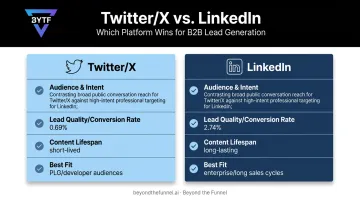
- LinkedIn drives 4x more leads: 2.74% vs. 0.69% conversion rate (HubSpot, 5,000+ companies)
- Twitter/X wins on speed and reach, especially with developers and technical audiences
- Deal size, sales cycle length, and buyer seniority should decide your split, not personal preference
- Most fast-growing B2B companies favor one platform as primary, not an even 50/50 split
Twitter vs LinkedIn: Quick Comparison
Audience & Buyer Intent
Twitter/X is broad and casual. You'll find developers, indie hackers, and tech journalists there, but intent is mixed: people scroll for entertainment as much as insight.
LinkedIn is smaller but far more intent-driven. Members show up in a professional context, often with a job to do. A 2020 YouGov study cited by X found that 1 in 3 business decision-makers used Twitter to connect with buyers and vendors — a real signal, but one that still trails LinkedIn's professional density.
Lead Quality & Conversion
Twitter is engagement-first. Likes and retweets feel good, but they're hard to translate into verified buying intent.
LinkedIn's advantage comes from data: real job titles, real companies, real seniority levels attached to every profile. That's why HubSpot's research found LinkedIn converting visitors to leads at nearly four times the rate of Twitter.
Content Lifespan & Growth Speed
Twitter/X moves fast, with a short shelf life that demands frequent posting to stay visible. LinkedIn content sticks around longer, rewarding consistency over sheer volume.
Best Fit for Founders
| Platform | Best For |
|---|---|
| Twitter/X | PLG SaaS, developer tools, build-in-public audiences |
| Enterprise sales, consulting/agencies, long sales cycles, paid pipeline growth |
Twitter and LinkedIn for B2B: What Each Platform Actually Offers Founders
Twitter (X) for B2B Founders
Twitter operates as a real-time conversation feed rather than a formal professional network. That distinction matters for founders. For founders, that means building visibility in a fast-moving room full of builders, journalists, and investors.
What this gets you:
- Faster follower growth with lower content-production effort
- Easier direct access to VCs, journalists, and technical communities
- A natural home for "build in public" updates and reply-based growth
An older but relevant Twitter and Compete study tracked over 6,000 US users across 400+ B2B tech sites and found Twitter-exposed users converted at 11%, versus 4% for average internet users. It's dated, but it points to something real: Twitter works well for top-of-funnel awareness in technical, PLG-driven products.
LinkedIn for B2B Founders
LinkedIn is a verified professional network, and that verification is the whole point. When a founder is chasing predictable revenue, knowing exactly who's seeing your content (by job title, seniority, company size, and industry) changes the math entirely.
Core operational benefits:
- Precise targeting through organic posts and LinkedIn Ads/Sales Navigator
- Higher-quality inbound because the audience is self-selecting into a professional mindset
- A path from organic testing straight into paid scaling once messaging works
Most founders start organic on LinkedIn to test messaging, then layer in paid ads once they see what resonates. This is where Beyond the Funnel's founder, Joshua Stout, has spent the bulk of his career. He has managed and optimized over 1,000 LinkedIn ad accounts across SaaS, finance, technology, and healthcare clients, turning early organic signals into structured, scalable campaigns.
Twitter vs LinkedIn: Which Platform Should Founders Choose?
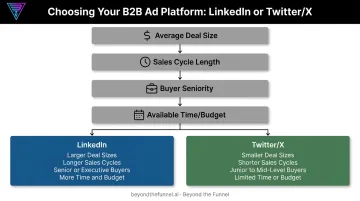
Before picking a lane, weigh four factors:
- Average deal size — smaller, self-serve deals tolerate more experimentation; larger deals need precision
- Sales cycle length — short cycles favor speed; long cycles favor sustained credibility
- Buyer seniority — technical users versus VP/C-suite decision-makers
- Available time and budget — how much you can realistically sustain each week
Choose Twitter/X if:
- You're building a PLG or self-serve product
- Your buyers are developers or technical evaluators
- You need fast top-of-funnel volume on a tight budget
Choose LinkedIn if:
- Your average deal size is $50,000+
- Your buyers sit at VP or C-suite level
- Your sales cycle runs six months or longer
Most founders don't have to choose exclusively. The smarter move is a primary/secondary split: put the majority of your time and budget behind the platform that matches your deal size, and keep a lighter presence on the other for awareness.
Once your LinkedIn messaging has been tested organically and you know which posts get replies from the right people, that's your cue to move into paid. Testing tells you what resonates; ad spend tells you how far it scales. This is where a LinkedIn ads partner like Beyond the Funnel earns its keep, building full-funnel campaigns around what's already proven to convert.
Real-World Example: Turning LinkedIn Into a Predictable Growth Channel
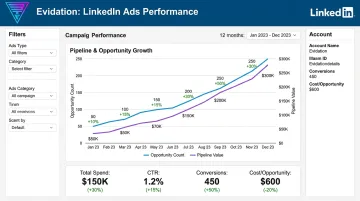
Evidation, a health data company, is the kind of B2B business where LinkedIn's professional targeting matters more than Twitter's reach. Long sales cycles and senior healthcare buyers don't respond well to a fast-scrolling feed. They respond to consistent, credible presence in the places they already work.
Before working with Beyond the Funnel, Evidation's pipeline was thin. According to Michael Arbini, the company's former Head of Commercial Marketing:
"Josh helped us map out and execute a full LinkedIn strategy that took our pipeline from a few dozen to over 100 opportunities in one year."
Those numbers represent real, qualified pipeline, not Twitter-style vanity metrics like impressions or shares. The shift happened because Evidation stopped guessing and started testing:
- Audience validation before scaling any spend
- Messaging refined through iteration, not assumption
- Full-funnel structure connecting awareness through conversion
The right approach depends on your sales cycle and buyer type. If your sales cycle is short and your buyers are casual, this approach might be overkill. But for founders selling into healthcare, finance, or enterprise SaaS with six-figure deal sizes, a structured, testing-driven LinkedIn strategy tends to outperform splitting effort evenly with Twitter.
If your pipeline looks more like Evidation's "before" than its "after," a strategy conversation with Beyond the Funnel is a reasonable next step.
Conclusion
There's no single winner here. Twitter/X suits founders who need speed, reach, and access to technical communities. LinkedIn wins when you need decision-maker access and pipeline you can actually forecast.
Tie your choice back to outcomes that matter: shorter sales cycles, higher-quality leads, and time well spent. Test the platform, measure results, and let the data decide before you commit real budget. If LinkedIn looks like the better fit, Beyond the Funnel can help you validate your audience and build a full-funnel campaign that turns clicks into pipeline.
Frequently Asked Questions
What is the best social platform for B2B?
There's no universal answer. LinkedIn generally leads for lead generation and decision-maker access, while Twitter/X leads for awareness and thought leadership. The right choice depends on your deal size and audience.
Which platform is best for B2B advertising?
LinkedIn is the stronger paid platform for B2B, thanks to precise targeting by job title, seniority, and industry. Twitter/X ads work better for broader awareness campaigns.
Is Twitter good for B2B?
Twitter/X works well for thought leadership, developer-focused products, and founder personal branding. It's less effective than LinkedIn for direct lead generation, largely due to limited professional targeting.
Should founders use both LinkedIn and Twitter?
Yes, most fast-growing B2B companies do. They typically assign one platform as the primary lead-gen channel and the other as a secondary awareness or community channel.
How do founders decide how much budget to allocate to LinkedIn vs Twitter?
Base it on deal size, sales cycle length, and buyer seniority. Start with organic testing on one platform, then layer in paid LinkedIn campaigns once your messaging is validated.
Does personal branding work better on LinkedIn or Twitter?
Twitter/X often builds founder credibility faster through real-time conversation. LinkedIn builds professional credibility with enterprise buyers who tend to verify experience and connections before engaging.