Objective selection isn't a small setup detail anymore. Between rising costs, tighter funnel-stage targeting, and LinkedIn's objective-first Campaign Manager flow, the choice you make on day one shapes everything downstream.
This article breaks down every LinkedIn ad objective by funnel stage, explains what actually separates them, and gives you a practical framework for matching objective to goal, not guesswork.
Key Takeaways
- Choose objectives by funnel tier: Awareness, Consideration, or Conversion
- Website Visits is the most flexible, cost-efficient starting point for most B2B accounts
- Conversions and Lead Generation only optimize well with enough historical volume
- Objectives lock once your ad set launches, so upfront selection matters
- Match your objective to format compatibility, budget, and tracking setup
What Is a LinkedIn Ad Objective (and Why Does It Matter)?
A LinkedIn ad objective tells the algorithm what to optimize for, whether that's impressions, clicks, engagement, views, leads, or on-site conversions. It's the single decision that shapes everything else in Campaign Manager.
Once you select an objective, LinkedIn locks in:
- Available ad formats (Video Views only works with video, for example)
- Bidding strategies you can use
- Algorithm scoring and delivery in the auction pool
This matters for real B2B outcomes. The right objective drives down cost-per-lead, improves lead quality, and gives you a clean way to measure ROI. Get it wrong, and the algorithm chases the wrong signal entirely.
Common failure points include:
- Overspending on low-value impressions that never turn into pipeline
- Inflated cost-per-lead because the objective doesn't match the offer
- Algorithm stuck in learning mode because conversion volume is too thin to optimize against
Types of LinkedIn Ad Objectives
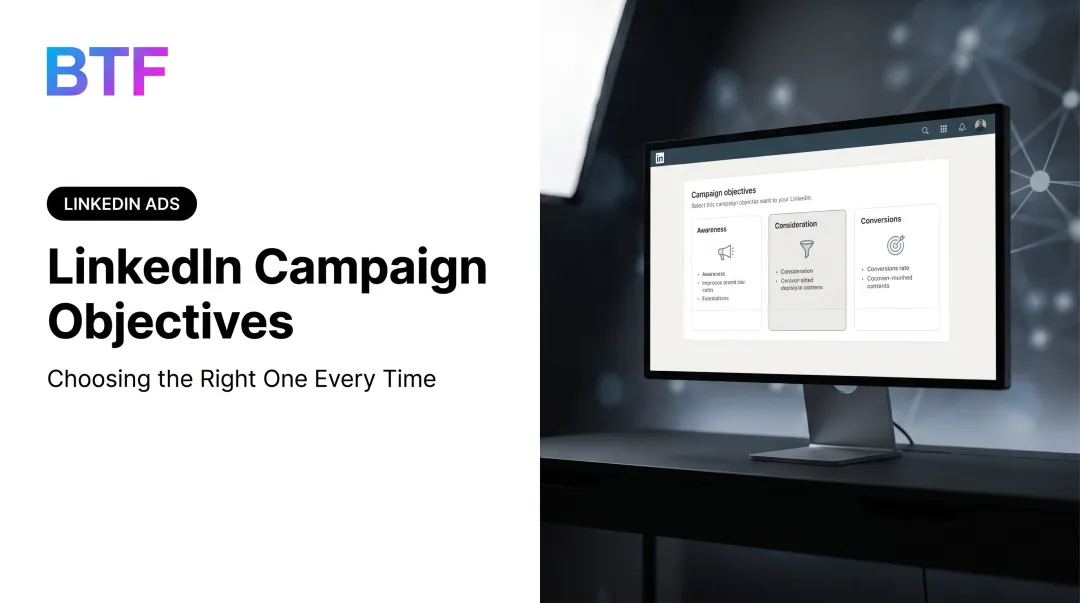
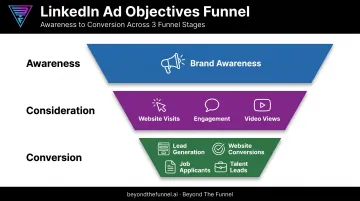
LinkedIn organizes its eight objectives into three funnel-based tiers: Awareness, Consideration, and Conversion. Each tier maps to a different stage of the B2B buyer journey, and within each tier, specific objectives suit different formats, budgets, and measurement needs.
Awareness Objectives
This tier has one objective: Brand Awareness. It optimizes purely for reach on a CPM basis, meaning LinkedIn prioritizes showing your ad to as many relevant people as possible rather than chasing clicks or actions.
Unlike Consideration or Conversion, Brand Awareness prizes cheap, wide reach over interaction. You're paying for eyeballs, not engagement.
Best suited for:
- New product or brand launches
- Top-of-funnel campaigns building category awareness
- Pairing with Thought Leader ads or organic-style content
For context, platform-wide LinkedIn CPMs averaged $33.80 in 2026, according to The B2B House's LinkedIn ad benchmark report. That figure spans all objectives, not Brand Awareness alone, but it gives you a directional sense of what reach-focused delivery costs on the platform.
The tradeoff: Brand Awareness can attract low-value impressions from people who will never convert. It also doesn't build a retargeting pool as effectively as click- or engagement-based objectives, since there's no action tied to the impression.
Consideration Objectives
This tier covers three mid-funnel objectives: Website Visits (clicks to a destination), Engagement (likes, comments, shares, follows), and Video Views (video completions). Each optimizes for a different kind of interaction.
Website Visits drives traffic, supports education-focused campaigns, and can push demo sign-ups when paired with the right landing page—which is why it's the default pick for most mid-funnel work.
These objectives optimize for interaction, not pure reach and not hard conversions. That middle position is what makes the tier versatile.
Best suited for:
- Prospects who need nurture before they're ready to convert
- Warm retargeting pools built from engaged users
- Educational or thought-leadership content distribution
Key strengths:
- Balanced CPM/CPC pricing compared to Awareness or Conversion tiers
- More control over cost through manual bidding
- Retargeting pools built from people who already showed interest
The limitation is straightforward. Engagement and Video Views don't guarantee leads on their own. A high engagement rate on a post doesn't automatically translate to pipeline. You'll need a follow-up play, usually a Conversion-tier campaign, to actually capture that interest.
Conversion Objectives
This is the bottom-funnel tier, covering Lead Generation (native LinkedIn forms), Website Conversions (tracked on-site actions), and Job Applicants (recruitment campaigns). A fourth option, Talent Leads, exists but only for companies with an active LinkedIn Recruiter contract.
Lead Generation and Website Conversions both target bottom-funnel actions, but they differ in one key way: Lead Gen keeps the user on LinkedIn with a pre-filled native form, while Website Conversions sends them to your site to complete an action you've defined.
Every objective here optimizes toward a specific, trackable outcome instead of general interest or reach.
Best suited for:
- Gated content offers (whitepapers, reports, guides)
- Demo requests and event registrations
- Recruitment campaigns targeting active job seekers
A 2020 LinkedIn best-practices document found Lead Gen Forms produced up to 3X better conversion rates compared to Sponsored Content driving traffic to standard landing page forms, according to LinkedIn's Lead Gen Best Practices guide.
It's older data without published methodology, so treat it as directional rather than a current benchmark. The underlying logic still holds: removing friction tends to lift completion rates.
The catch: Website Conversions needs enough historical conversion volume for LinkedIn's algorithm to optimize properly. Without it, your campaign can get stuck underdelivering. Lead Gen Forms solve that volume problem but sometimes produce lower-intent leads since the form pre-fills automatically, requiring less effort from the user.
How to Choose the Right LinkedIn Ad Objective for Your B2B Campaign
The right objective matches your funnel stage, budget, and ability to measure what happens next—not whichever option looks newest or most advanced.
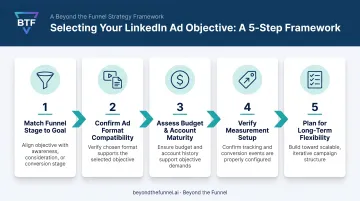
Here's the framework we walk B2B clients through:
Match funnel stage to campaign goal. Brand Awareness for launches and category-building; Consideration objectives to nurture warm prospects; Conversion objectives when you're ready to capture demand directly.
Confirm ad format compatibility. Video Views only works with video ads. Job Applicants only supports job-specific formats. Check the format matrix before you commit to an objective, not after.
Assess budget and account maturity. Website Conversions and Lead Generation both need enough historical spend and conversion data behind them. A brand-new account with zero conversion history will struggle to make these objectives perform.
Verify your measurement setup. Before choosing any conversion-based objective, confirm your LinkedIn Insight Tag or Conversions API is installed and firing correctly. Skipping this step is one of the most common reasons conversion campaigns underdeliver.
Plan for long-term flexibility. Objectives cannot be changed once your ad set has launched. If performance underdelivers, you'll need to build a new campaign from scratch, not tweak the existing one.
At Beyond the Funnel, this is where a structured testing framework earns its keep. Rather than guessing which objective, audience, and creative combination will scale, our team validates each variable with real campaign data before committing meaningful budget. It's the same approach that helped one client, Evidation, grow its qualified pipeline from a few dozen opportunities to over 100 in a single year.
That kind of validation matters most for B2B brands new to LinkedIn advertising, where a single wrong objective choice can waste weeks of spend before anyone notices the algorithm was never optimizing toward the right outcome.
Mistakes to Avoid When Selecting Your Objective
Even experienced marketers trip on objective selection. Most common mistakes:
- Jumping to Website Conversions or Lead Generation too early — without conversion history, the algorithm stalls in learning mode
- Using Brand Awareness when you need traffic or leads — you pay for impressions from people who were never going to click
- Ignoring format limits — Video Views without video, or Job Applicants without job creative, mismatches goal and execution before launch
Each of these mistakes shares a root cause: choosing an objective based on what sounds sophisticated rather than what your account and offer are actually ready for.
Conclusion
LinkedIn ad objectives directly control how your campaigns get delivered, priced, and measured across the entire B2B funnel. There's no universal "best" choice. Each objective serves a distinct stage. Matching the objective to your actual goal—not how advanced it sounds—is what drives efficient spend.
If you're unsure which objective fits your current growth stage, a LinkedIn Certified Marketing Expert can cut through the guesswork. Beyond the Funnel's testing framework validates objective, audience, and creative combinations before you scale budget, so you avoid expensive lessons in production.
Frequently Asked Questions
What are the 5 marketing objectives?
General marketing frameworks reference five objectives: awareness, consideration, conversion, loyalty, and advocacy, according to Semrush's marketing funnel breakdown. LinkedIn's ad platform condenses this into three funnel tiers with eight specific objectives.
How many campaign objectives does LinkedIn currently offer?
LinkedIn offers eight: Brand Awareness, Website Visits, Engagement, Video Views, Lead Generation, Website Conversions, Job Applicants, and Talent Leads. Talent Leads is only available to companies with an active LinkedIn Recruiter contract.
Can I change my LinkedIn ad objective after launching a campaign?
No. Once a Classic ad set has launched, its objective and ad format cannot be edited. You'll need to build a new campaign from scratch to switch objectives.
Which LinkedIn ad objective is best for B2B lead generation?
Lead Generation forms typically produce higher lead volume since users stay on-platform with a pre-filled form. Website Visits or Website Conversions often deliver higher-intent leads, since users actively navigate to your site and complete an action there.
Should I use Website Conversions or Website Visits for demo sign-ups?
Website Visits is the safer default for most accounts. Website Conversions requires enough historical conversion volume to optimize well, and newer accounts often lack that data.
How does my chosen objective affect LinkedIn ad costs?
Each objective competes in a different auction pool, which shifts your CPM or CPC. Conversion-focused objectives like Website Conversions and Lead Generation typically carry a cost premium over Awareness or Consideration objectives.