But the trend isn't as one-directional as many assume. Gupta Media's 2025 analysis of tens of billions of ad impressions found LinkedIn CPM actually dropped 16% year-over-year in 2024. Costs still swing wildly depending on who you're targeting.
Reaching 1,000 senior finance buyers costs nothing like reaching 1,000 marketing coordinators. This article breaks down real CPM benchmarks, the factors that push your costs up or down, and how to budget for (and lower) your cost per 1,000 impressions.
Key Takeaways
- Average LinkedIn B2B CPM runs $25–$60; narrow audiences can push it far higher
- Audience seniority and industry competitiveness are the two biggest CPM cost drivers
- CPM fits awareness goals; CPC and CPL are better for demand-gen campaigns
- Tighter segmentation, fresher creative, and smarter bidding lower CPM
- A "good" CPM only matters when paired with CTR and pipeline results
How Much Does It Cost to Reach 1,000 B2B Buyers on LinkedIn?
CPM stands for cost per mille, "mille" being Latin for thousand. It's simply what you pay for every 1,000 ad impressions:
CPM = (Total Ad Spend ÷ Total Impressions) x 1,000
LinkedIn doesn't charge a flat CPM rate. Depending on your objective and bid strategy, you can be billed by CPM, CPC (cost per click), CPV (cost per video view), or CPS (cost per send, for Sponsored InMail). CPM is the default for awareness-focused campaigns using maximum delivery or cost-cap bidding.
Average LinkedIn CPM Benchmarks
Industry benchmarks vary by source. WordStream cites $25-$45; other industry guides push the upper bound closer to $60 for competitive audiences. Neither range is a guarantee, since LinkedIn prices every impression through a live auction.
What drives your rate:
- Broad, low-competition audiences (junior titles, generalist targeting) tend to land near the bottom of the range
- Narrow, senior, or highly competitive audiences (think CFOs at fintech companies) can push well past $60 per thousand impressions
CPM also moves with advertiser demand and auction dynamics quarter to quarter. It is not locked on a permanent climb.
CPM by Ad Format
LinkedIn doesn't publish a fixed CPM by format, but the mechanics of each format matter:
- Sponsored Content (feed ads) typically command the highest CPM, competing for scroll attention next to organic posts with heavy relevance scoring
- Text Ads run in sidebar and lower-visibility placements, so CPM is usually lower, along with reach and interaction
- Dynamic Ads personalize creative with viewer profile data, which can improve relevance and offset some cost
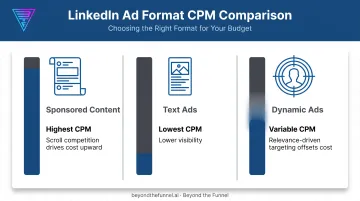
Across formats, pricing still hinges on the audience you target.
CPM by Industry
Not all B2B verticals pay the same rate for the same decision-maker's attention.
SaaS, tech, and financial services tend to see higher CPMs. These industries chase the same narrow pool of buyers (CMOs, VPs of Engineering, finance directors), and that competition drives auction prices up.
Healthcare B2B campaigns have less published benchmark data, but tend to fall in a moderate range. Decision-maker pools are often more fragmented across clinical, operations, and IT roles.
Beyond the Funnel has managed LinkedIn accounts across SaaS, finance, technology, and healthcare. Audience overlap between competitors is consistently one of the clearest cost signals across all four.
Key Factors That Influence Your LinkedIn CPM
CPM isn't a fixed rate card. It's set through a real-time auction shaped by your audience, your creative, and how you bid. These levers move the price most.
Audience specificity and seniority. Targeting a narrow slice of C-suite or VP-level buyers means fewer available impressions and more advertisers chasing the same people. That competition drives CPM up. Broader, junior-level targeting spreads demand across a much larger pool, which typically brings CPM down.
Industry and competition level. Crowded B2B niches push CPM higher when dozens of vendors bid on the same buyer personas. Categories like SaaS, fintech, and cybersecurity often sit at the top of the range because identical job titles and account lists attract heavy demand.
Ad relevance score. LinkedIn combines your bid with a relevance score built from targeting quality, budget settings, and predicted engagement. Strong click-through rates, comments, and shares improve ad rank and can lower your effective CPM. Low-relevance ads pay a premium to compete.
Ad format and placement. Sponsored Content in the main feed generally costs more per impression than Text Ads. Feed placements carry higher engagement expectations and tighter competition for space.
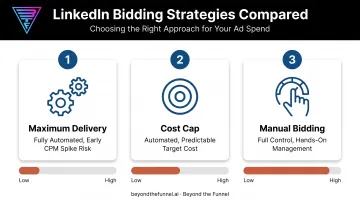
Bidding strategy. LinkedIn offers three approaches:
- Maximum delivery - fully automated, built to spend your budget, and prone to early CPM spikes
- Cost cap - automated but held to a target result cost for more predictability
- Manual bidding - you set the bid directly for maximum control, with more hands-on management
Geography. Mature ad markets like the U.S. and Western Europe usually cost more than emerging regions. Advertiser spend and buyer density concentrate there, so impression prices rise with demand.
Low CPM vs High CPM: What Does It Actually Mean?
Neither a high nor a low CPM is inherently good or bad. Context is everything.
High CPM signals a competitive, hard-to-reach audience. Paired with strong click-through rates and engagement, that higher cost can still deliver excellent value because you're reaching people who actually respond.
Low CPM means impressions are cheap to deliver, usually because the audience is broad or low-competition. But if engagement is weak, a low CPM can be a warning sign that the audience isn't relevant.
HockeyStack's 2025 analysis of $28 million in B2B SaaS LinkedIn spend shows why raw cost alone misleads:
- Q1 averaged $10.48 cost-per-click at a 0.82% CTR
- Q3 rose to $15.72 cost-per-click, while CTR climbed to 0.96%
The "more expensive" quarter actually performed better.
Pair CPM with CTR and downstream pipeline data. That's the only reliable way to judge whether a cost is efficient.
How to Lower Your LinkedIn CPM and Maximize B2B Reach
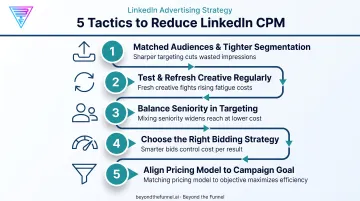
Most B2B teams can meaningfully reduce CPM through audience, creative, and bid optimization, without sacrificing lead quality.
Use Matched Audiences & Tighter Segmentation
Instead of relying on generic industry or job-title filters, upload your own account and contact lists through LinkedIn's Matched Audiences tool. This narrows delivery to accounts you actually want to reach, cutting down on wasted impressions served to irrelevant profiles.
Test and Refresh Creative Regularly
Ad fatigue drags relevance scores down over time, which raises CPM. Run A/B tests on copy, imagery, and format on a consistent cadence, and swap out underperforming creative before engagement starts to slide.
Balance Seniority in Targeting
Targeting the C-suite exclusively narrows your pool and inflates cost. Test campaigns that also include managers and senior individual contributors, who often influence the same buying decisions, to widen the audience while still reaching the buying committee.
Choose the Right Bidding Strategy
Start with manual or cost-cap bidding to control spend while you gather performance data. Shift to automated maximum-delivery bidding once you have enough historical signal to trust the algorithm's optimization.
Align Pricing Model to Campaign Goal
CPM suits brand awareness, where the goal is reach and visibility. CPC or CPL models generally fit demand-gen campaigns better, since you're paying for action rather than exposure. Choosing the wrong model means overpaying for impressions that were never going to convert.
Work with an Expert When Budgets Are High-Stakes
LinkedIn's auction and relevance scoring get complicated fast, and small targeting mistakes can burn through budget quickly at scale. At higher spend levels, many B2B brands bring in a specialized partner to protect efficiency.
Beyond the Funnel is led by Joshua Stout, one of just 80 LinkedIn Certified Marketing Experts worldwide and one of only 16 in the U.S. Across more than 1,000 managed LinkedIn ad accounts, the team runs structured audience and creative testing designed to control CPM without sacrificing lead quality.
When Beyond the Funnel took over Evidation's LinkedIn strategy, pipeline grew from a few dozen opportunities to over 100 in a single year through full-funnel structure that improved both efficiency and conversion quality.
What Most B2B Marketers Get Wrong About LinkedIn CPM
Three mistakes show up again and again:
- Judging success by CPM alone. A low number means nothing if it's not paired with CTR, cost-per-lead, and actual pipeline impact.
- Assuming one benchmark fits every campaign. "Good" CPM depends heavily on your audience's seniority, your industry, and what the campaign is trying to accomplish.
- Cutting budget the moment CPM rises. Before pulling back, check whether the real issue is a falling relevance score, creative fatigue, or targeting that's grown too broad or too stale.
Frequently Asked Questions
What is the CPM on LinkedIn?
CPM is what you pay per 1,000 ad impressions on LinkedIn. Average B2B CPM typically falls between $25 and $60, though your actual cost depends on audience and competition.
Is CPM cost per 1,000 impressions?
Yes. CPM stands for "cost per mille," with mille meaning thousand in Latin. It measures cost per 1,000 impressions—unlike CPC, which measures cost per click.
What is a good CPM for LinkedIn ads in B2B marketing?
There's no single universal number. A "good" CPM depends on your audience's seniority, your industry's competitiveness, and your campaign goal. Always pair the CPM figure with CTR and lead quality before judging performance.
How do you calculate LinkedIn CPM?
Use the formula: (Total Ad Spend ÷ Total Impressions) x 1,000. If you spend $500 and generate 15,000 impressions, your CPM is ($500 ÷ 15,000) x 1,000, or roughly $33.
Why is LinkedIn advertising more expensive than Facebook or Google Ads?
LinkedIn's professional audience data lets advertisers target buyers by job title, seniority, and company with precision most platforms can't match. That specificity, combined with fewer total ad slots than consumer platforms, commands a premium.
How much budget do I need to reach 1,000 B2B decision-makers on LinkedIn?
At a $25–$45 CPM, 1,000 impressions cost about that much. Reaching 1,000 unique decision-makers usually takes several thousand impressions, so budgets run higher for narrow, senior audiences.