According to LinkedIn's 2017 Sophisticated Marketer's Guide, LinkedIn generates more than 80% of B2B social media leads. And yet most B2B brands treat it like a digital résumé — posting sporadically, skipping paid entirely, and wondering why nothing converts.
The gap between being active on LinkedIn and generating revenue from it comes down to one thing: system. This guide walks through the full picture — from profile setup and organic social selling to content frameworks and LinkedIn Ads — so you can build a channel that actually produces pipeline.
Key Takeaways
- LinkedIn drives 80%+ of B2B social media leads, but most brands post without strategy and leave that advantage unclaimed
- Your profile is a sales asset — it should answer your buyer's question, not list your career history
- Over-promotion kills organic reach — content mix frameworks like 4-1-1, 5-3-2, and 95-5 give you a structure to stay valuable without going silent
- LinkedIn Ads extend your reach to cold audiences with precision targeting unavailable on other B2B platforms
- Consistent results come from testing, measurement, and iteration — not volume alone
What You Need Before Using LinkedIn for Sales and Marketing
Skipping this foundation is the fastest way to waste time and budget. Before any outreach or ad activity begins, confirm you have these in place:
- Buyer-facing LinkedIn profile (personal and/or company page): the first thing a prospect checks after seeing your content or message. An incomplete or job-history-focused profile kills credibility immediately.
- Defined Ideal Customer Profile (ICP): job titles, industries, company size, and seniority level. Without this, both organic search and LinkedIn Ads targeting will be too broad to convert.
- Documented content strategy with at least three content pillars and a consistent posting cadence. Hootsuite reports that companies posting weekly on LinkedIn see a 2x lift in content engagement.
- Goals tied to business outcomes: keep awareness metrics (reach, impressions, follower growth) separate from revenue metrics (pipeline created, meetings booked, lead conversions) before you start measuring anything.
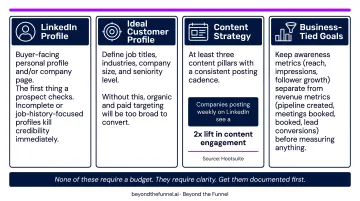
None of these require a budget. They require clarity. Get them documented first, and every tactic that follows — content, outreach, or paid ads — will have a sharper target to hit.
How to Use LinkedIn for Sales and Marketing (Step-by-Step)
LinkedIn sales success follows a sequence. Jumping straight to outreach without profile credibility and content presence is the most common reason B2B teams fail to convert on the platform. Here's the order that works.
Optimize Your Profile as a Buyer-First Asset
Every section of your profile — headline, About, banner, Featured — should answer one question from your ideal buyer: "Can this person solve my problem?"
Stop listing titles and responsibilities. Start writing about outcomes delivered and who you help.
The most commonly neglected elements that directly impact conversion:
- Headline — Write around outcomes, not job titles. "I help SaaS companies cut cost-per-lead by 40% on LinkedIn" outperforms "Head of Marketing" every time
- Professional headshot — According to Inc, citing LinkedIn data, members with a profile photo receive up to 21x more profile views and 36x more messages
- Featured section — Pin your best content, a lead magnet, or a case study here; most people leave it blank
Find and Connect With the Right People
LinkedIn's advanced search filters by job title, industry, seniority, company size, location, and group membership — making it the most precise prospecting tool available for B2B sellers.
Use it to build a qualified prospect list before sending a single message. Then send personalized connection requests that reference something specific: a post they wrote, a shared group, a mutual connection.
Generic requests fail for a practical reason: LinkedIn tracks acceptance rates, and low acceptance rates restrict your future organic reach. Once someone accepts, that connection becomes an engagement opportunity — not an invitation to pitch.
Engage Before You Sell
Before you send any outreach message, spend a few weeks following target prospects and engaging with their content authentically. This warm-up shifts your eventual message from cold pitch to natural next step.
When you comment, skip "Great post." Add a specific insight, a counterpoint, or an example that extends the conversation. That signals expertise — and prospects notice.
Demand Gen Report's 2024 research found that 80% of B2B buyers initiate first contact only after they're 70% through the buying journey, with most already having a preferred vendor in mind.
Your engagement activity is what gets you onto that shortlist before a buyer ever reaches out.
Move Conversations Into the Funnel
When a prospect is warm, move the conversation forward in stages:
- Lead with value first — share a relevant checklist, insight, or framework before making any ask
- Ask open questions — end DMs with something that invites a reply, not a yes/no decision
- Invite, don't pitch — offer a short consultation, a micro-call, or a relevant webinar as the next step
- Let credibility do the closing — by the time you propose a meeting, the ask should feel obvious
Skipping straight to a pitch resets the trust you've built. Each stage earns the next.
Choosing the Right LinkedIn Content Mix for Sales
B2B brands consistently over-index on promotional content. That erodes trust and tanks algorithmic reach at the same time. Content mix frameworks solve this by giving you a ratio to work from before you decide what to post.
Here are the four most widely used frameworks and when each applies:
| Framework | Mix | Best For |
|---|---|---|
| 4-1-1 Rule | 4 educational posts, 1 soft-sell (case study/social proof), 1 hard-sell (direct CTA) | Individual sales reps building personal brand and pipeline |
| 5-3-2 Rule | 5 curated third-party content, 3 original content, 2 personal/humanizing posts | Brand-level marketing focused on thought leadership positioning |
| 95-5 Rule | 95% brand trust and awareness content, 5% direct conversion content | Brand demand generation; acknowledges only 5% of buyers are in-market at any time |
| 3-2-1 Rule | 3 educational, 2 engagement-focused (polls, questions), 1 promotional | Sellers who want algorithmic engagement before any sales message |
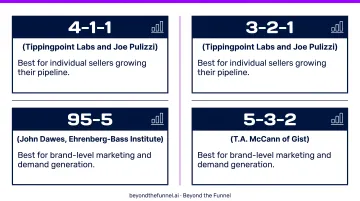
The 4-1-1 (Tippingpoint Labs and Joe Pulizzi) and 3-2-1 frameworks work well for individual sellers growing their pipeline. The 95-5 rule (John Dawes, Ehrenberg-Bass Institute) and 5-3-2 (T.A. McCann of Gist) are better suited for brand-level marketing and demand generation.
Content Format Matters as Much as Mix
According to Socialinsider's 2026 LinkedIn benchmark data, native document posts (carousels) lead all LinkedIn formats with a 7.00% average engagement rate — a 14% year-over-year increase.
Match your format to the outcome you're after:
- Documents/carousels — Highest organic engagement; use for frameworks, how-to guides, data breakdowns
- Video — Strong for thought leadership and behind-the-scenes content
- Text posts — Fast to produce, effective for opinions and short stories
- Polls — Excellent for driving comments and starting conversations
LinkedIn Ads: Scaling What Organic Cannot Do Alone
Organic content builds trust with people who already know you exist. LinkedIn Ads reach qualified buyers who have never encountered your brand — and retarget those who have. That combination creates a full-funnel system; neither layer works as well without the other.
Primary Ad Formats and Their Funnel Stage
- Sponsored Content (single image, carousel, video) — Top-of-funnel awareness and mid-funnel education; highest volume format for B2B brand building
- Message Ads / Conversation Ads — Higher-intent outreach delivered directly to a prospect's LinkedIn inbox; effective for event invitations, offer-specific outreach, and driving action from targeted segments
- Lead Gen Forms — Capture leads without sending prospects off-platform; LinkedIn pre-fills form fields using member profile data, reducing friction compared to external landing pages
Why LinkedIn's Targeting Is the Real Differentiator
LinkedIn's ad targeting documentation confirms targeting across job function, seniority, job title, company name, industry, company size, skills, years of experience, and member interests — across a network of over 1 billion members.
No other paid channel gives B2B advertisers this combination of professional data depth and scale. You can reach the VP of Engineering at a 500-person SaaS company without buying a list or guessing at demographic proxies.
Structure Ads as a Full-Funnel System
LinkedIn Ads fail most often when brands treat them as a direct-response channel in isolation. Awareness campaigns need to run alongside retargeting campaigns, and messaging must match where a buyer is in their journey — not just what you want to sell.
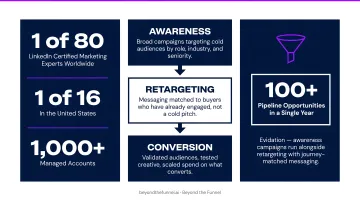
For brands ready to build a structured LinkedIn Ads program without spending months in expensive trial and error, working with a specialist makes a measurable difference. Beyond the Funnel's founder, Joshua Stout, is one of only 80 LinkedIn Certified Marketing Experts worldwide (1 of 16 in the U.S.) and developed a testing framework across 1,000+ managed accounts that validates audiences, tests creative, and scales what converts.
Under that approach, Evidation's pipeline grew from a few dozen opportunities to over 100 in a single year.
Best Practices for Consistent LinkedIn Sales Results
Build the Engagement Routine
Engage with others' content for 15–30 minutes before and after publishing your own post. This signals to LinkedIn's algorithm that you're an active participant — not a broadcaster — and increases content distribution. Over time, that consistent activity compounds into meaningfully wider organic reach.
Track Inputs, Not Just Outcomes
Vanity metrics like likes tell you very little about pipeline health. Track activity inputs instead:
- Meaningful comments left per week
- New connection requests sent (personalized)
- DMs initiated with a value-first message
- Micro-calls or consultations booked
Establish a weekly baseline and give it time before drawing conclusions.
Treat LinkedIn as a Testing System
Evaluate audiences, messaging, content formats, and ad creatives on a regular cadence. The brands that build compounding advantages on LinkedIn share one habit: they establish a testing cadence, validate what works, cut what doesn't, and scale the winners.
Without that structure, results stay unpredictable — and there's no feedback loop to improve from.
Frequently Asked Questions
What are the LinkedIn content-mix rules (4-1-1, 5-3-2, 3-2-1, 95-5) and how do they apply to sales?
Each framework serves a different use case — 4-1-1 fits individual sellers, 5-3-2 suits brand-level curation, and 95-5 applies when most of your buyers aren't yet in-market. All share the same goal: limit promotional content to protect trust and reach. See the full breakdown in the content mix section above.
What is the LinkedIn Social Selling Index (SSI) and does it matter?
LinkedIn defines SSI as a 0–100 score measuring four pillars: establishing your brand, finding the right people, engaging with insights, and building relationships. It's a useful diagnostic benchmark for identifying weak spots in your social selling approach, but no official LinkedIn source confirms it directly influences feed ranking or algorithm distribution.
How often should B2B brands post on LinkedIn?
Hootsuite recommends 1–2 posts per day for maximum reach, and notes that companies posting at least weekly see a 2x engagement lift. For most B2B teams, consistency matters more than frequency — posting three times a week with strong content outperforms daily posting with weak content.
What's the difference between LinkedIn organic content and LinkedIn Ads for B2B marketing?
Organic builds trust within your existing network; LinkedIn Ads extend reach to cold audiences with precise professional targeting and enable retargeting of prior engagers. Used together, organic warms the audience while paid campaigns drive conversion.
How do I connect with decision-makers on LinkedIn without coming across as spammy?
Use advanced search to filter by job title, industry, and seniority. Send personalized connection requests that reference something specific — a post they wrote, a shared group, or a mutual connection. Engage with their content for a week or two before sending any direct message — by then, your name is already familiar.
How long does it take to see real results from a LinkedIn sales strategy?
Organic social selling typically requires 60–90 days of consistent activity before meaningful pipeline appears. LinkedIn Ads move faster, but still need several weeks of testing to optimize toward qualified conversions.