Introduction
Ask ten B2B marketers whether LinkedIn or Facebook drives better results, and you'll get ten confident, contradictory answers. Both platforms have loyal advocates, and both have burned budget for someone who picked wrong.
The stakes are real. Choose the wrong channel and you'll flood your pipeline with unqualified leads, blow through spend chasing clicks that never convert, or simply miss the decision-makers who actually sign contracts.
LinkedIn is projected to capture 47.2% of US B2B display ad spending and 22.9% of all US B2B digital ad spending, according to eMarketer's 2024 analysis. That's a massive concentration on one platform.
This article breaks down where each channel earns its keep, and where a blended approach beats picking a single winner.
Key Takeaways
- LinkedIn's higher cost-per-click often pays off with lower cost-per-qualified-lead for high-ticket B2B deals
- Facebook delivers cheaper reach, making it a strong fit for top-of-funnel awareness and retargeting
- The right platform depends on deal size, sales cycle, and funnel stage, not brand loyalty
- Most high-performing B2B programs run both channels with distinct, complementary roles
LinkedIn Ads vs Facebook Ads: Quick Comparison
Cost & Budget
Complete, apples-to-apples B2B benchmarks for both platforms are hard to find, but the available data still shows a clear cost gap.
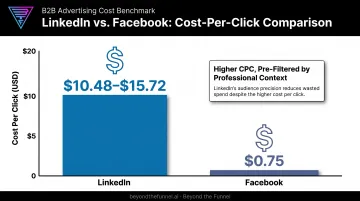
A 2025 HockeyStack analysis of 70+ B2B SaaS companies (spanning $5M–$1B ARR and $5K–$120K ACV) found LinkedIn CPCs ranging from $10.48 in Q1 to $15.72 in Q3, with costs shifting by season and competition.
Facebook runs far cheaper on a per-click basis. LocaliQ's 2025 benchmark data put Business Services traffic CPCs around $0.75. That gap is the core trade-off: Facebook buys more clicks per dollar, but LinkedIn's clicks come pre-filtered by professional context.
Targeting Precision
| Platform | Targeting Basis | Data Type |
|---|---|---|
| Job title, seniority, company, industry, account lists | Member-reported professional data | |
| Demographics, interests, behaviors, lookalikes | Inferred from activity and engagement |
Ad Formats
| Platform | Common Formats |
|---|---|
| Sponsored Content, Message Ads, Lead Gen Forms, Document Ads, Dynamic Ads, Text Ads | |
| Video Ads, Carousel Ads, Lead Ads, Stories, Image Ads, Collection Ads |
Best Funnel Stage
LinkedIn tends to earn its budget at the bottom of the funnel: ABM, demo requests, and decision-maker conversion. Facebook does its best work earlier, building awareness and warming up audiences before sales ever reaches out.
What is LinkedIn Ads?
LinkedIn Ads is the paid advertising platform built into the world's largest professional network, with 1.3 billion-plus members according to LinkedIn's own reporting. That professional context is the whole point: people log in with their actual job title, company, and industry attached, which structurally suits B2B in a way consumer platforms can't replicate.
The practical upside shows up in day-to-day campaign management:
- Verified job-title targeting cuts down on wasted spend against people who'll never buy
- ABM company-list uploads let you target named accounts directly, shortening sales cycles
- Professional-identity filters surface buyers by role and seniority, so sales spends less time sorting junk leads
Core formats worth knowing:
- Sponsored Content: native feed ads for reach and engagement
- Message Ads: direct inbox delivery with a single call to action
- Lead Gen Forms: pre-filled forms that reduce friction on mobile
- Document Ads: strong fit for thought leadership assets like reports and guides
Where LinkedIn Fits in the B2B Buyer Journey
LinkedIn performs best mid-to-bottom funnel: demo requests, ABM account targeting, and converting warm prospects who already know your brand. It's a natural fit for SaaS, financial services, healthcare, and enterprise technology, industries defined by long sales cycles and high contract values, where a wasted lead costs real money.
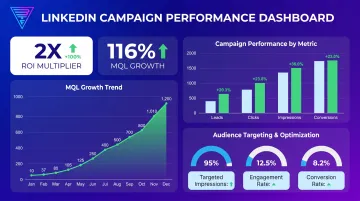
The proof shows up in the numbers. A Closed Loop case study on Corporate Visions, a B2B sales training company, reported 2X ROI and a 116% increase in MQLs after optimizing LinkedIn targeting. Precision targeting is what produces those gains when the audience is right. That same discipline sits at the center of Beyond the Funnel's approach: founder Joshua Stout, one of 80 LinkedIn Certified Marketing Experts worldwide and one of 16 in the U.S., built a testing framework across 1,000+ managed accounts that validates audiences with engagement data before scaling spend.
What is Facebook Ads?
Facebook Ads runs on scale. Meta reported 3.07 billion monthly active users on Facebook as of December 2023, and that massive inventory keeps CPMs comparatively low. For B2B teams, that translates into a mature retargeting and lookalike infrastructure most platforms can't match.
The operational benefits are straightforward:
- Low-cost impressions let teams test more creative variations without blowing the budget
- Meta Pixel enables efficient retargeting of anyone who's already visited your site
- Broad reach builds brand familiarity before your sales team ever picks up the phone
Common formats include Video, Carousel, Lead Ads, and Stories. Targeting is built around Custom and Lookalike Audiences from your existing customer data.
Where Facebook Fits in the B2B Buyer Journey
Facebook earns its place at the top of the funnel: awareness campaigns, content distribution, and remarketing to visitors who bounced off your site without converting. It tends to shine for self-serve SaaS, SMB tools, and shorter-cycle offers, where broad reach matters more than pinpoint precision.
It can drive real volume. A Powered by Search case study on Titan GPS, a fleet-management SaaS company, generated 60 MQLs per month on average over a five-month campaign using lead-magnet offers. That's a solid volume play, though the case doesn't disclose downstream cost-per-qualified-lead or SQL conversion.
LinkedIn vs Facebook Ads: Which Wins for B2B?
There's no universal winner here. The right call depends on four factors:
- Deal size and lifetime value — higher-ticket offers justify LinkedIn's premium CPCs
- Sales cycle length — longer cycles benefit from LinkedIn's account-level precision
- Need for role or account-level targeting — ABM programs lean heavily toward LinkedIn
- Available monthly budget — smaller budgets often stretch further on Facebook
Choose LinkedIn when you're targeting specific job titles, running ABM, or selling $5,000+ offers where cost-per-qualified-lead matters more than cost-per-click.
Choose Facebook for awareness campaigns, tighter budgets, or when you need broad reach across a professional audience that isn't narrowly defined.
The strongest B2B programs don't pick one. They pair Facebook for demand creation (top and mid-funnel) with LinkedIn for demand capture (bottom-of-funnel and ABM). Facebook's cheaper reach builds awareness; LinkedIn's precision closes the gap with decision-makers.
Real-World Example: Shifting Budget to LinkedIn for Higher-Quality Pipeline
Many B2B teams hit the same wall: broad social advertising builds impressions, but the pipeline doesn't reflect it. Leads trickle in, sales spends hours filtering, and the numbers never quite add up to real opportunities.
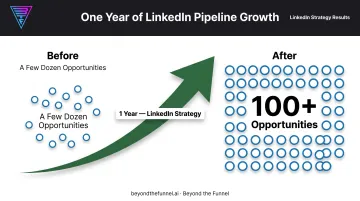
Beyond the Funnel closed that gap for Evidation. Michael Arbini, the company's former Head of Commercial Marketing, worked with founder Joshua Stout to map out and execute a full LinkedIn strategy. The result: Evidation's pipeline grew from a few dozen opportunities to over 100 in a single year.
For companies selling high-value, long-cycle B2B offers, precision targeting outperforms raw reach. If you want to know whether your account could see a similar shift, Beyond the Funnel's testing framework — built across 1,000+ managed LinkedIn accounts — is built to answer that before you scale spend.
Conclusion
Neither platform wins outright. LinkedIn earns its higher price tag through precision: job-title targeting, ABM account lists, and a buyer base that's already thinking in professional terms. Facebook earns its place through scale and cost-efficiency—stronger for awareness and warming prospects before sales gets involved.
Use each where it fits:
- LinkedIn for precision targeting, ABM, and high-intent B2B pipeline
- Facebook for low-cost reach and top-of-funnel warming
Outcomes matter more than platform loyalty: lower cost-per-qualified-lead, shorter sales cycles, and pipeline you can forecast. When you're ready to put real budget behind LinkedIn, work with a partner who's already stress-tested the channel. Beyond the Funnel helps B2B teams validate audiences, refine creative, and build full-funnel LinkedIn programs aimed at predictable growth.
Frequently Asked Questions
Is LinkedIn or Facebook better for B2B advertising?
It depends on your targeting needs and budget. LinkedIn wins when you need to reach specific decision-makers, while Facebook wins on reach and awareness for lower-cost testing.
Why is LinkedIn advertising so much more expensive than Facebook?
LinkedIn's inventory is smaller and built on verified professional data, which commands a premium. Facebook's massive user base creates lower competition per impression, keeping costs down.
Can Facebook ads generate quality B2B leads?
Yes, particularly for awareness and retargeting campaigns. It requires more filtering than LinkedIn since targeting relies on inferred behavior rather than self-reported job data.
What budget do I need to start advertising on LinkedIn vs Facebook?
LinkedIn typically requires at least $5,000 per month in North America to generate meaningful sales results, according to B2Linked. Facebook can produce useful test data with a smaller monthly commitment.
Should B2B companies run LinkedIn and Facebook ads together?
Many high-performing programs do. Facebook handles top-of-funnel awareness, while LinkedIn drives bottom-of-funnel conversion and account-based marketing.
Which platform is best for account-based marketing (ABM)?
LinkedIn is the stronger fit. Its company-level targeting and account list uploads let you reach named decision-makers directly, something Facebook's lookalike audiences can't replicate as precisely.