Yet many marketing teams still report on a single touchpoint. Last-click dashboards get built because they're easy, not because they're accurate. That gap creates real problems: budget gets pulled from channels that quietly build pipeline, while credit piles up on whatever happened right before a deal closed.
This guide breaks down the attribution models available today, how to pick the right one for your sales cycle, best practices for cleaner reporting, common challenges, and what changes when LinkedIn and multi-stakeholder B2B deals enter the picture.
Key Takeaways
- Multi-touch and account-based models beat single-touch reporting in long B2B cycles
- Attribution shows correlation, not causation, so pair it with incrementality testing
- W-shaped and time-decay models suit funnels with defined lifecycle stages
- Centralized data and quarterly model reviews keep reports trustworthy
- LinkedIn touchpoints need an account-level view, not isolated judgment
What Is Marketing Attribution?
Marketing attribution is the practice of assigning credit for conversions or revenue to specific marketing touchpoints across a buyer's journey. Done well, it connects real activity, such as ad clicks, content downloads, LinkedIn engagement, and webinar attendance, to pipeline and revenue. Done poorly, it just counts impressions and calls it a day.
A Touchpoint Example
Picture a prospect who:
- Sees a LinkedIn ad and clicks through
- Downloads a whitepaper two weeks later
- Attends a webinar the following month
- Books a demo and converts
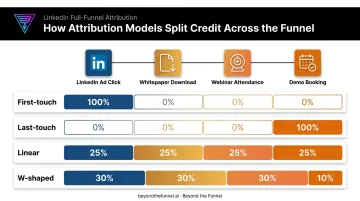
Attribution models assign credit for this same journey in strikingly different ways:
- First-touch gives 100% of the credit to the LinkedIn ad
- Last-touch gives 100% of the credit to the webinar
- Linear splits credit evenly across all four touches
- W-shaped weights the LinkedIn ad, the whitepaper download (lead creation), and the demo booking (opportunity creation) most heavily
Same journey, four different stories about what worked.
Correlation Isn't Causation
Here's the part most attribution reports skip: touchpoint credit reflects correlation, not proof of cause. A prospect who saw five ads might have converted anyway. That's a causal inference problem: correlation alone doesn't establish causation. You need a controlled experiment or credible causal design to know for sure.
That distinction matters more in B2B. A 2024 EMarketer survey of 282 senior US marketers found 78.4% still used last-click attribution, but only 21.5% believed it reasonably reflected a platform's long-term business impact, according to EMarketer's research on last-click measurement. Most respondents knew the model they relied on daily didn't tell the full story.
Longer sales cycles and multi-person buying committees make this worse. When four or more people at a target account each touch several channels before a deal closes, a model built for one visitor's path will over-credit or under-credit somebody.
Marketing Attribution Models Explained
Attribution models fall into two camps: single-touch models, which award all credit to one interaction, and multi-touch models, which spread credit across several. Which camp you need depends on the question you're asking.
Single-Touch Attribution Models
Single-touch models are simple, but simple isn't always useful for B2B, where deals often involve multiple stakeholders and sales cycles stretching six months or longer.
- First-touch attribution: Gives 100% credit to the first interaction. Good for measuring what drives initial awareness. Ignores everything that happens after, including whatever actually closed the deal.
- Last-touch attribution: Awards 100% credit to the final interaction before conversion. Useful for understanding what tips a deal over the finish line, but it ignores months of prior nurturing.
Neither model accounts for the dozen or so touchpoints that typically happen in between, which is exactly why B2B marketers lean on multi-touch models instead.
Multi-Touch Attribution Models
Multi-touch models distribute credit across the journey, which fits B2B's longer, more crowded paths to purchase.
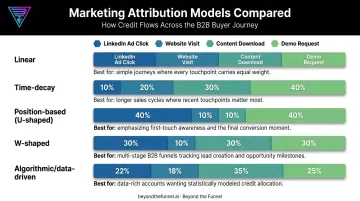
| Model | How credit is assigned | Best for |
|---|---|---|
| Linear | Equal credit to every touchpoint | A balanced view of full journey participation |
| Time-decay | More credit to touches closer to conversion | Long cycles where recent activity matters most |
| Position-based (U-shaped) | 40% first touch, 40% last touch, 20% split among the rest | Highlighting what opens and closes a deal |
| W-shaped | 30% each to first touch, lead creation, and opportunity creation; remainder split among other touches | B2B funnels with clear lifecycle stages |
| Algorithmic/data-driven | Machine learning weights touches by actual influence | Teams with the data volume to support it |
Linear attribution is honest about how many touches mattered, but it pretends they mattered equally. Time-decay corrects for that, though it can shortchange the early brand-awareness work that got a prospect into the funnel in the first place.
W-shaped attribution tends to work well for B2B teams tracking lifecycle stages like lead creation and opportunity creation as distinct milestones. Algorithmic attribution can reduce some of the guesswork in fixed-weight models, but it's still measuring correlation. It just does it with more variables.
How to Choose the Right Attribution Model
There's no universal "best" model. Objectives and audiences differ from one company to the next, so a single perfect multi-touch model doesn't exist.
Before picking a model, weigh:
- Sales cycle length: a two-week deal behaves nothing like a nine-month enterprise sale.
- Touchpoint distribution: do interactions cluster at the top of the funnel, or spread across the entire journey?
- Online vs. offline mix: trade shows and sales calls are harder to track than ad clicks.
- Your tech stack: does your CRM and ad platform actually support the model you choose?
Rule of thumb: Short cycles with few touchpoints suit single-touch models. Long B2B cycles with many touchpoints, like a six-month LinkedIn campaign running alongside sales outreach, call for multi-touch or W-shaped models instead.
Don't treat model selection as a one-time decision. Run two models side by side for a quarter and compare the stories they tell. Revisit the choice on a regular cadence, quarterly works well for most teams, since channel mix and go-to-market strategy shift over time.
Marketing Attribution Best Practices
Good attribution reporting takes ongoing discipline, not a single model chosen once and left alone.
Centralize your data first. Ad platforms, your CRM, email tool, and offline event lists all hold pieces of the buyer journey. If they live in separate silos, no model can stitch together an accurate picture. Pull everything into one reporting system before analyzing anything.
Track the full funnel, not just new leads. Touches that happen after someone becomes a sales-qualified lead, such as a follow-up webinar, a retargeting ad, or a case study a rep shares mid-deal, often move a deal forward more than the channels that get the credit. Leaving them out skews credit toward top-of-funnel channels.
Align on KPIs before you collect data. Conversion rate, customer acquisition cost, and ROI by channel need clear, agreed-upon definitions from day one. If sales and marketing calculate CAC differently, your report will spark arguments instead of decisions.
Tell a story tied to revenue, not touchpoint counts. A report showing "LinkedIn generated 4,200 clicks" doesn't move budget conversations. A report showing "LinkedIn-influenced deals in Q3 accounted for $380,000 in pipeline" does.
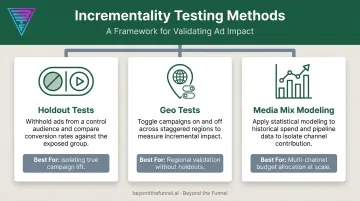
Validate with incrementality testing. Attribution describes correlation. To check whether a channel is truly causing conversions:
- Holdout tests: Withhold ads from a control group and compare conversion rates against an exposed group. The gap estimates incremental lift.
- Geo tests: Turn campaigns on and off across different regions on a staggered schedule, then compare outcomes. This works well for B2B, where purchase effects can lag for months.
- Media mix modeling: Layer historical spend and pipeline data into a statistical model to isolate each channel's incremental contribution. Useful when sales cycles stretch across multiple quarters.
Run one of these validation checks periodically, not constantly. Even a quarterly holdout test can confirm whether your model reflects actual buyer behavior or merely reinforces its own assumptions.
Common Marketing Attribution Challenges
Even with the right model, attribution runs into real-world friction.
Siloed data. Ad platforms, CRM systems, and analytics tools each hold a fragment of the buyer journey. Without a unified view, teams debate whose data is "right" instead of what it means. Consolidate everything into one dashboard or warehouse before drawing conclusions.
Privacy shifts. Third-party cookie restrictions and consent requirements under GDPR and similar regulations are reducing how much of the journey you can track. Chrome hasn't fully eliminated third-party cookies, but consent rules still limit non-essential tracking, so paths will keep having gaps.
The fix is leaning harder into first-party data (information you collect directly, like CRM records) and zero-party data (information customers proactively share).
Internal politics. Attribution models can get quietly bent by whoever controls the reporting. A team protecting its budget has an incentive to favor a model that flatters its own channel.
The fix relies on governance: decide on your model, data sources, and reporting cadence before results come in, and keep those decisions away from whichever team benefits most from a favorable number.
Marketing Attribution for B2B & LinkedIn Advertising
B2B buying journeys rarely involve one person clicking one ad. They involve multiple stakeholders engaging with LinkedIn ads, sales conversations, and content over several months, often four or more decision-makers weighing in before a deal closes. Simple last-click attribution, built for a single visitor's path, misses almost all of that.
Why Account-Based Attribution Works Better
Instead of tracking one visitor's journey, account-based attribution credits company-wide engagement. If three people at a target account each interacted with your LinkedIn ads, downloaded a report, and attended a webinar, that's a signal worth measuring at the account level, not three disconnected conversions.
A single contact clicking an ad might look unimportant on its own. But if that click is one of six touches across an account's buying committee in the same month, it's part of a much bigger story.
Folding LinkedIn Touchpoints Into the Full Funnel
Several LinkedIn touchpoints need a place in a full-funnel attribution view rather than being judged in isolation:
- Sponsored content
- InMail messages
- Event ads
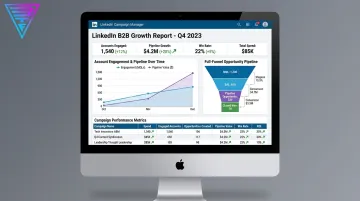
- Thought-leadership posts LinkedIn's own Revenue Attribution Report connects ad activity directly to CRM outcomes, reporting revenue won, pipeline amount, and opportunity win rate rather than just clicks.
That kind of visibility only works if campaigns are built to be measured. Ongoing audience and creative testing matters here. Without it, attribution data reflects noise (random variation in who happened to see which ad) rather than genuine influence on pipeline.
This is where a testing-driven approach matters. Beyond the Funnel's full-funnel LinkedIn strategy, built by founder Joshua Stout, one of 80 LinkedIn Certified Marketing Experts worldwide, treats audience validation and creative testing as prerequisites for trustworthy attribution data.
One client, Evidation, saw its opportunity pipeline grow from a few dozen deals to more than 100 in a single year after mapping out and executing a full LinkedIn strategy across the funnel. Rigorous testing and transparent reporting on what moves accounts forward drove that growth, not guesswork about which touchpoint mattered.
Frequently Asked Questions
What is marketing attribution?
Marketing attribution is the process of assigning credit for conversions or revenue to specific marketing touchpoints across the buyer's journey. It helps teams understand which channels actually contribute to pipeline, not just which ones get the most clicks.
How accurate is marketing attribution?
Attribution reflects correlation, not causation, so accuracy varies by model and data quality. Pairing attribution with incrementality testing, like holdout or geo tests, gives a more reliable read on real impact.
What is an example of attribution in marketing?
A prospect clicks a LinkedIn ad, downloads a whitepaper weeks later, then converts. First-touch credits the ad, last-touch credits the download, and a linear model splits credit evenly between both.
What's the difference between single-touch and multi-touch attribution models?
Single-touch models give 100% of the credit to one interaction, either the first or last touch. Multi-touch models distribute credit across several touchpoints, which better reflects how B2B buyers really decide.
How often should you review or update your attribution model?
Most teams benefit from reviewing their attribution model at least quarterly. New channels, shifting budgets, and changes in sales cycle length can make a previously accurate model outdated.
Is marketing attribution difficult to set up for B2B companies with long sales cycles?
Long B2B cycles add real complexity, more stakeholders, more touchpoints, longer lags between contact and close. Multi-touch and account-based models, paired with the right reporting tools, make it manageable rather than overwhelming.