Format choice isn't a minor creative decision anymore. LinkedIn's feed increasingly splits attention between organic content and paid amplification, and which format you choose directly affects visibility, trust, and the quality of leads that eventually hit your pipeline.
This article breaks down the content types actually driving engagement on LinkedIn in 2026, how they differ, and how to build the right mix for your B2B brand — whether you're posting organically, testing paid creative, or both.
Key Takeaways
- Video, documents, and text beat off-platform links for reach and interaction
- Content types should match the funnel stage, from awareness to trust
- Diverse, consistent formats beat repeating the same post type
- Your best format mix depends on audience and goals, not trends
- Testing performance beats guessing — every time
What Is Engaging Content on LinkedIn (and Why It Matters in 2026)?
Engaging content on LinkedIn earns comments, shares, and dwell time — the signals that tell LinkedIn's algorithm this content is worth showing to more people. Likes alone rarely move the needle.
Likes are passive. Comments and shares require effort, and LinkedIn's feed increasingly rewards content that keeps users on the platform instead of sending them elsewhere. A post that sparks a real conversation in the comments will consistently outperform a post that just gets scrolled past with a thumbs-up.
Why This Matters for Your Pipeline
This distinction has real pipeline implications. LinkedIn's own reporting puts 63 million decision-makers, 10 million C-level executives, and 180 million senior-level influencers on the platform, according to Hootsuite's 2026 LinkedIn statistics roundup. Format choice determines whether your content reaches those people or gets buried before it has a chance.
Here's what typically goes wrong without a deliberate content strategy:
- Posting inconsistently, which prevents the algorithm from building momentum
- Relying on one format for every post, regardless of the message
- Publishing content that gets low early engagement and simply disappears from feeds
- Treating LinkedIn like a broadcast channel instead of a conversation
Types of LinkedIn Content That Engage in 2026
LinkedIn content isn't one-size-fits-all. Different formats suit different goals, audiences, and stages of a B2B relationship. Below, we've ranked the formats by how LinkedIn's algorithm and B2B audiences currently respond to them, based on observed engagement behavior.
Native Video
Native video, uploaded directly to LinkedIn rather than linked from YouTube or Vimeo, autoplays in the feed and tends to hold attention longer than an external link post, which forces users to leave the platform.
The 2026 nuance is length and format:
- Short, vertical, subtitled clips (15–60 seconds) tend to perform best for reach and completion, since most viewers scroll with sound off
- Longer, interview-style clips build deeper trust with a smaller, more engaged audience, even if they don't rack up the same view counts
Best use cases include:
- Product explainers and quick demos
- Executive point-of-view clips
- Event recaps and conference highlights
- Behind-the-scenes moments that show real people, not polished stock footage
Brands testing video creative for LinkedIn ads often find the same short-form, captioned formats that work organically also perform best in paid campaigns. That overlap is one of the signals Beyond the Funnel uses when running creative testing frameworks for B2B clients, validating which video length and style actually resonate with a target audience before scaling ad spend behind it.
Document/Carousel Posts
A document post, often called a carousel, is a PDF uploaded to the feed that users swipe through slide by slide. Because it requires active engagement to move through, it forces a longer dwell time than a static image ever could.
This format is particularly strong for B2B topics because it breaks down dense material into digestible pieces:
- Frameworks and step-by-step processes
- Data breakdowns and benchmark reports
- How-to guides with one idea per slide
The performance data backs this up. Buffer's 2026 analysis found that LinkedIn carousel posts saw a 21.77% median engagement rate: 196% higher than video and 585% higher than text-only posts in the same dataset. Separately, Socialinsider measured native documents at a 7.00% average engagement rate across its 2025 sample, ahead of every other format it tracked.
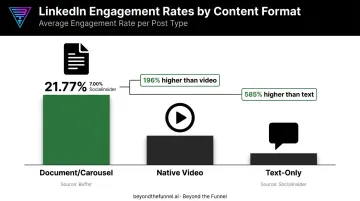
Both studies point the same direction: documents currently have the strongest, most consistently replicated engagement signal on LinkedIn.
Text-Only and Thought Leadership Posts
No image. No link. Just a strong opening line and a clear point of view. That's the entire format, and it still works. Not because LinkedIn secretly favors text, but because it loads instantly and rewards a genuinely useful or contrarian take.
What makes a text post work:
- A scroll-stopping first line that doesn't bury the point
- Short paragraphs, often one or two sentences each
- A specific, defensible opinion rather than generic commentary everyone's already heard
One caveat: text-only posts actually measured lowest in both the Buffer and Socialinsider format comparisons for raw engagement rate. That doesn't make them useless. It makes them a format for building authority and voice, not the format to lean on for reach alone.
Polls and Interactive Posts
LinkedIn polls let you ask a question with up to four answer options and a set duration: one day, three days, one week, or two weeks. Because voting takes one tap, they generate quick, low-friction engagement almost immediately after posting.
Used strategically, polls work well for:
- Gathering genuine audience insight before writing a follow-up post
- Sparking conversation in the comments when the question is specific and relevant
Metricool's research found polls generated the highest average impressions for Company Pages in its dataset, despite making up less than 1% of all posts analyzed. That's a strong reach signal. It's also a reason to use polls sparingly. When every post is a poll, audiences stop engaging with genuine curiosity and start clicking out of habit.
Data-Driven Visual Posts (Original Research, Stats, Infographics)
This format centers on a single image or graphic built around a proprietary statistic, benchmark, or industry insight your brand generated or uncovered, not a stat borrowed from someone else's report.
Professionals on LinkedIn actively look for data that helps them make decisions or benchmark their own performance. The 2025 Edelman-LinkedIn B2B Thought Leadership Impact Report found that 64% of business buyers trust thought leadership more than traditional marketing materials when evaluating a vendor's capabilities, and 57% specifically valued quick, digestible takeaways over dense reports.
The key differentiator: original research and proprietary data consistently build more credibility than generic stock graphics or third-party stats reformatted into a template. If the data is yours, say so.
Personal Stories and Behind-the-Scenes Content
Milestones, career journeys, team highlights, culture moments, shared through a personal narrative rather than a corporate announcement. This format humanizes a B2B brand in a way a press release never will.
A few realities worth knowing:
- Metricool found personal profiles averaged 63% higher engagement than Company Pages, which supports distributing this content through real employees, not just the brand page
- Comments tend to come more naturally when a real person is telling the story, not a logo
The trade-off is authenticity. This format requires a genuine "face" behind the post. A polished, overly corporate version of a personal story reads as inauthentic almost immediately, and audiences notice.
How to Choose the Right Content Mix for Your Brand
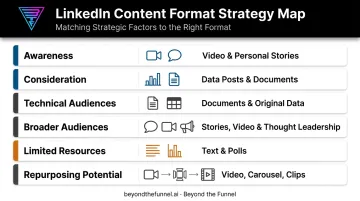
The best content mix isn't whatever's trending this month. It depends on your funnel stage, your audience's seniority, and what your team can realistically produce.
| Factor | What to Prioritize |
|---|---|
| Awareness | Native video and personal stories: quick to consume, easy to share |
| Consideration | Data posts and documents build trust through substance |
| Technical audiences | Documents and original data over stories or casual video |
| Broader audiences | Stories, video, and thought leadership over dense reports |
| Limited resources | Text posts and polls: low production lift, still native |
| Repurposing potential | One video can become a carousel, a text post, and three clips |
A few things to weigh before locking in a mix:
- Purpose and funnel stage: video and stories build initial awareness, while data posts and documents move prospects toward consideration and trust
- Audience seniority and industry: technical buyers in SaaS or finance respond to documents and data; broader audiences respond more to human stories
- Production capacity: video and design-heavy formats take real time; text and polls don't
- Long-term flexibility: favor formats you can repurpose across multiple posts instead of one-off content that dies after a single use
Even after weighing these factors, guessing which format will land is still the most expensive mistake a brand can make. Beyond the Funnel's testing framework (built from managing over 1,000 LinkedIn ad accounts across SaaS, finance, technology, and healthcare) applies this exact principle to paid creative: validate which formats a specific audience actually engages with before scaling spend behind any of them.
Common Mistakes to Avoid When Posting on LinkedIn
Most underperforming LinkedIn accounts fail because of avoidable habits, not bad content:
- Relying on a single format. Only posting text, or only posting links, ignores that different audience segments respond to different formats
- Posting inconsistently. According to Buffer's 2026 frequency study of 2 million+ posts, performance climbs steadily at 2–5 posts weekly, but bursty, unpredictable schedules stall that momentum before it builds
- Ignoring performance data. Continuing to post a format that consistently underperforms, purely out of habit or comfort, wastes the exact signal that should be guiding your strategy
- Prioritizing polish over authenticity. Story-driven and culture content especially suffers when it's over-produced — audiences can tell when a personal post was written by committee
Conclusion
There's no single "best" LinkedIn post type in 2026: there's a right format for a right purpose. Native video builds awareness fast, while documents and data posts build trust and consideration over time. Text and polls fill efficiency gaps, and personal stories humanize the brand behind it all.
Getting the mix right organically tells you something valuable: what your specific audience actually responds to. Pairing that insight with a tested, data-driven LinkedIn ads strategy (the kind of full-funnel approach Beyond the Funnel builds for B2B brands across SaaS, finance, technology, and healthcare) is what turns engagement into predictable pipeline growth, not just better-looking analytics.
Frequently Asked Questions
What types of content do well on LinkedIn?
Native video, document/carousel posts, text-only thought leadership, and original data posts consistently drive the strongest engagement for B2B brands heading into 2026. Documents currently lead by a wide margin.
How often should I post on LinkedIn in 2026?
Consistency matters more than raw volume. Most B2B brands see strong, sustainable results posting 3–5 times per week with a genuine mix of formats.
What is the ideal length for a LinkedIn video?
Short, captioned clips around 15–60 seconds tend to perform best for reach. Longer, interview-style videos work better for building deeper engagement with a smaller, more invested audience.
Do LinkedIn polls still drive engagement in 2026?
Yes, polls remain effective for quick, low-friction engagement and strong impression counts. They work best used selectively for truly useful questions, not as a default content crutch.
Should B2B brands use both organic content and LinkedIn ads?
Absolutely. Organic content shows what resonates with your audience in real time. That insight directly informs which creative formats are worth scaling through paid LinkedIn campaigns.
What's the difference between a LinkedIn article and a newsletter?
Articles are standalone, long-form posts published once. Newsletters are recurring, subscribable series that notify followers each time a new edition publishes — better suited for consistent thought leadership.