Yet most B2B brands treat LinkedIn like an afterthought. They post when someone remembers to, boost a few updates, and wonder why the platform isn't generating pipeline. Random posting wastes budget and misses the decision-makers who actually matter.
This guide breaks down the five pieces of a real LinkedIn strategy: your foundation, your content engine, paid amplification, engagement tactics, and the KPIs that prove it's working.
Key Takeaways
- LinkedIn converts B2B visitors to leads at nearly 4x the rate of Facebook
- Personal employee profiles routinely out-earn company pages on reach and engagement
- Native document posts (carousels) currently lead LinkedIn's organic engagement benchmarks
- Single-objective paid amplification breaks the reach ceiling organic content hits alone
- ROI counts only when Cost Per Lead ties to real pipeline in your CRM
Why LinkedIn Is a B2B Marketing Powerhouse
LinkedIn users show up in a different headspace than they do on Instagram or TikTok. They're logged in as professionals, thinking about their industry, their role, and problems they need solved. That mindset makes them far more receptive to solution-oriented content than the average social feed allows.
The data backs this up. In HubSpot's analysis of over 5,000 businesses, LinkedIn converted visitors to leads at 2.74%, compared to 0.77% for Facebook and 0.69% for Twitter/X. That's roughly 277% more effective than either platform.
While the underlying study is older, the directional gap still holds true for anyone running B2B campaigns today.
Why does this happen? Precision targeting. LinkedIn lets you filter by:
- Job title and seniority
- Company size and revenue range
- Industry and function
- Years of experience
- Groups and skills
No other major platform matches this level of granularity for reaching a VP of Operations at a 500-person healthcare company versus a founder at a 10-person SaaS startup. That specificity is exactly why LinkedIn outperforms generic social targeting for B2B advertisers.
Building Your Strategic Foundation
Before you write a single post or launch a campaign, you need clarity on who you're talking to and what you're saying. Skip this step and everything downstream (content, ads, engagement) ends up unfocused.
Nailing Down Your Ideal Customer Profile (ICP)
Broad demographic targeting ("marketing directors in the US") is outdated. A sharp ICP combines:
- Firmographics: company size, revenue band, industry, tech stack
- Behavioral signals: recent job changes, hiring surges, funding announcements, content engagement patterns
- Role & intent: decision-maker titles, budget authority, buying triggers
LinkedIn Sales Navigator makes this practical. You can filter by seniority level, function, and even engagement recency, then build target lists that reflect accounts actually showing buying signals instead of just matching a job title.
Here's the part most brands skip: auditing whether your current followers even match your ICP. Pull follower demographics by location, seniority, industry, company size, and job function from LinkedIn analytics, then compare that breakdown against your documented ICP.
If followers skew toward students and junior staff while your buyer is a Director of IT, your content is talking to the wrong room. Run this audit quarterly—not once and forget it.
Optimizing Your Company Page and Employee Profiles
Most company "About" sections read like a press release nobody asked for. A simpler, more effective structure follows four beats:
- Hook — Name the specific pain point your prospect feels
- Solution — State plainly what you do about it
- Proof — Back it with a result, client name, or number
- Ask — Tell them what to do next (follow, visit, book a call)
This works because it mirrors how a good sales conversation flows, rather than listing services in corporate speak.
Company pages, however, aren't where most of the organic reach lives. Refine Labs compared its own company page against seven employee profiles and found employee profiles generated 2.75x more impressions and 5x more engagement per post, despite having 46% fewer followers on average.
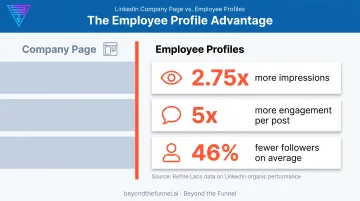
That's one company's data, not a universal law, but the pattern shows up repeatedly across B2B brands. Get executives and sales leaders posting with messaging that mirrors, not duplicates, your company positioning—their profiles will likely outperform your page.
Building a B2B Content Engine That Converts
A content engine turns "we should post more" into a repeatable system. That starts with knowing what to say, choosing the right format, and posting consistently enough that both the algorithm and your audience start to expect you.
Establishing Content Pillars Tied to Buyer Pain Points
Content pillars keep your posting purposeful instead of random. Pick three to four themes tied directly to what your buyer struggles with. For a B2B SaaS company selling to finance teams, pillars might look like:
- Industry insights — commentary on regulatory shifts or budget trends
- Customer wins — specific outcomes clients achieved
- Behind-the-scenes — how your team builds or ships product
- Founder POV — opinions on where the industry is heading
Every post should map back to one of these. If it doesn't fit a pillar, it probably doesn't belong on the page.
Choosing the Right Format for Each Goal
Not every idea deserves the same format. Match the content to the goal:
| Format | Best for | Notes |
|---|---|---|
| Text-only posts | Quick opinions, conversation starters | Low production cost, fast to test |
| Native document/carousel | Frameworks, step-by-step breakdowns | Highest reported engagement rate |
| Short-form video | Product demos, personality-driven content | Strong for awareness-stage reach |
| LinkedIn articles | Long-form thought leadership, SEO value | Slower distribution, longer shelf life |
Socialinsider's analysis of 1.3 million LinkedIn posts found native document posts leading engagement at 7.00%. Video, image, and text engagement are all climbing year over year.
LinkedIn's algorithm rewards substance over surface-level likes, favoring saves and read time. Carousels that actually teach something tend to earn both.
Building a Sustainable Posting Cadence and Content Mix
Consistency beats frequency, full stop. A brand posting three solid times a week for six months will outperform one that posts daily for three weeks and quits.
Observed data varies by industry, but most B2B brands find a rhythm around 2-4 high-quality posts per week works better than chasing a daily quota. Consistency of voice and timing matters more than hitting an exact number.
To avoid over-promoting, use a structured content-mix formula that balances educational, cultural, and promotional posts. (We break down a few popular ratio frameworks, including the 3-2-1, 3-3-3, and 5-3-2 rules, in the FAQ section below.)
Cadence also scales through employee advocacy. When your team shares and comments on company content from their own profiles, you extend reach well beyond the company page alone and often multiply impressions several times over.
Scaling Your Reach with LinkedIn Ads
Organic reach has a ceiling. Even a strong content engine eventually plateaus against LinkedIn's algorithm, and more B2B marketers are shifting budget toward paid campaigns to break past it.
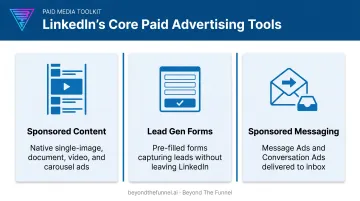
Three paid tools matter most for B2B:
- Sponsored Content — native feed ads including single-image, document, video, and carousel formats
- Lead Gen Forms — pre-filled forms attached to ads or Conversation Ads that capture leads without leaving LinkedIn
- Sponsored Messaging — Message Ads and Conversation Ads delivered directly to a prospect's inbox with a clear call to action
Precision targeting extends into paid through Matched Audiences, where you upload company lists or contact data to run account-based marketing (ABM) campaigns aimed only at accounts you've already identified as good fits. LinkedIn requires a minimum of 300 matched members per audience, so this works best once your target list has real scale.
One structural mistake tanks more campaigns than bad creative: mixing objectives. Structure each campaign around a single goal rather than asking one campaign to do all three:
- Awareness
- Lead generation
- Retargeting
Each objective needs different bidding, creative, and measurement.
This is where a testing framework earns its keep. Before scaling spend, you want evidence that your audience, creative, and messaging actually convert—not a hunch.
Beyond the Funnel's methodology, developed by founder Joshua Stout, one of 80 LinkedIn Certified Marketing Experts worldwide, validates audiences and refines messaging through structured testing before recommending clients scale their budgets. That approach helped Evidation grow its pipeline from a few dozen opportunities to over 100 qualified opportunities in a single year, according to former Head of Commercial Marketing Michael Arbini.
Scaling ad spend without validation first is expensive guessing.
Engaging Your Audience and Building Community
Content and ads get you seen. Engagement gets you remembered.
End your posts with open-ended questions instead of yes/no prompts. "What's the biggest bottleneck in your renewal process?" invites a real answer. "Do you struggle with renewals?" invites a thumbs-up and nothing else. LinkedIn's algorithm reads comment quality as a signal of value, so this matters more than it sounds.
Power commenting is another underused tactic. Have your sales leaders and subject matter experts add genuine insight to posts from prospects, industry influencers, and target accounts. Skip generic praise and share a real point of view.
Done consistently, this builds visibility with the people you're trying to reach, at zero ad cost.
A few more community-building habits worth adopting:
- Join and participate in relevant LinkedIn Groups tied to your industry
- Respond to every comment on your posts within the first hour when possible
- Run employee advocacy for credibility, not just reach; prospects trust people over brand accounts
None of these tactics work in isolation. They compound with the content and ad strategy you've already built.
Measuring What Matters: KPIs and ROI
Organic and paid LinkedIn activity serve different jobs in your funnel, so they need different scorecards.
Organic metrics to track:
- Engagement rate (comments and saves weighted more heavily than likes)
- Follower-to-ICP match (from your quarterly audit)
- Website referral traffic originating from LinkedIn
Paid metrics to track:
- Cost Per Lead (CPL)
- Conversion rate from lead to opportunity
- Pipeline influence — how much revenue traces back to LinkedIn touchpoints
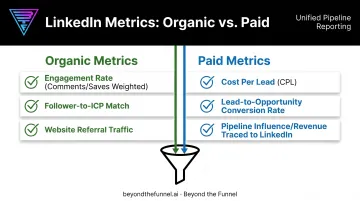
The last one is where most reporting falls apart. Impressions and click-through rates feel good but don't prove anything to a CFO.
What matters is whether CPL and conversion data connect to actual pipeline movement in your CRM. Transparent reporting that ties performance and learnings to next steps—not a spreadsheet of clicks—turns ad spend into a defensible growth channel. That is the standard Beyond the Funnel builds into every client engagement.
Frequently Asked Questions
What is the 3-2-1 rule on LinkedIn?
It's a weekly content mix: three pieces of industry-related content, two culture or company-pride posts, and one promotional post. The ratio keeps your feed useful instead of salesy.
What is the 3-3-3 rule on LinkedIn?
It means blocking daily time for three activities: posting, commenting on others' content, and outreach or networking. The exact breakdown varies by who's teaching it.
What is the 5-3-2 rule on LinkedIn?
Out of every ten posts, five are curated or informational, three are original thought leadership, and two are personal or promotional. It's a broader social media guideline, not LinkedIn-specific, but it applies well.
How often should B2B brands post on LinkedIn?
Two to four high-quality posts per week tends to be the practical sweet spot for most B2B brands. Consistency matters far more than hitting an exact number or perfect posting time.
Should B2B brands focus on the company page or personal profiles?
Both matter, but personal profiles typically drive more organic reach and trust than company pages. The strongest strategies run both in parallel, with employees amplifying company messaging in their own voice.
How do you measure ROI from LinkedIn B2B marketing?
Track Cost Per Lead and conversion rate, then connect those numbers to real pipeline and revenue through your CRM. Impressions and likes are not proof of ROI. Closed-won deals are.