The answer isn't as clean as most platform comparisons suggest. It depends on what you're optimizing for — lead volume, lead quality, cost per qualified opportunity, or all three. Getting this wrong doesn't just waste budget; it affects lead quality, sales cycle length, and ultimately how much revenue your ad spend generates.
This post breaks down both platforms across targeting, cost, lead quality, and real-world outcomes — and gives you a clear framework for deciding where to invest.
Key Takeaways
- LinkedIn's professional targeting — job title, seniority, company size — is purpose-built for reaching B2B decision-makers with precision
- Facebook's CPC is roughly 4x lower than LinkedIn's, making it valuable for top-of-funnel reach and retargeting on a tighter budget
- A lower CPL on Facebook doesn't guarantee better ROI; lead quality and downstream conversion rates matter more than acquisition cost alone
- The strongest B2B strategies use both: LinkedIn to acquire and qualify, Facebook to re-engage at lower cost
- Platform choice should be driven by deal size, sales cycle length, and audience specificity
LinkedIn vs Facebook: Quick Comparison
| Factor | ||
|---|---|---|
| Audience Size | 1B+ professionals | 2.11B DAU / 3.07B MAU |
| Primary User Mindset | Business-first, career-focused | Personal, social, entertainment |
| Targeting Precision | Job title, seniority, company size, industry, skills | Interests, behaviors, demographics |
| Average CPC (B2B) | $7.26 | $1.84 |
| Average CPM (B2B) | $69.49 | $12.18 |
| Average CPL (B2B) | $201.03 | $101.54 |
| CTR (B2B) | 0.96% | 0.66% |
| Best B2B Use Case | Decision-maker targeting, ABM, enterprise lead gen | Retargeting, awareness, lookalike audiences |
| Min. Retargeting Audience | 300 matched members | Varies / not disclosed |
Source: Metadata B2B Paid Social Benchmarks
These benchmarks only go so far — the right platform depends on where your buyer sits in the funnel and whether you're optimizing for pipeline quality or cost efficiency.
What Makes LinkedIn the B2B Default
Audience and Professional Mindset
LinkedIn's structural advantage isn't just its audience size — it's context. Users log in with a business-first mindset: researching solutions, evaluating vendors, consuming industry content. That context makes B2B advertising feel relevant rather than intrusive.
Compare that to Facebook, where the same decision-maker is scrolling past family photos and viral videos. The person is identical; their receptivity to a B2B pitch is not.
Third-party sources citing LinkedIn's own data suggest that 4 out of 5 LinkedIn members drive business decisions — a concentration of buying authority that Facebook's general audience simply can't replicate at the same density.
Targeting Built for B2B
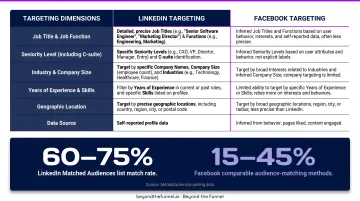
LinkedIn's targeting operates on self-reported professional data, not inferred interests. The dimensions available include:
- Job title and job function
- Seniority level (including C-suite)
- Industry and company size
- Years of experience and skills
- Geographic location
Facebook's interest-based targeting is a proxy. It infers professional identity from behavior — pages liked, content engaged with, demographic signals. LinkedIn's data comes directly from the user's own profile, making it far more accurate for B2B targeting.
For Account-Based Marketing (ABM), LinkedIn's Matched Audiences feature allows advertisers to upload company lists and target decision-makers at named accounts directly. According to Metadata's benchmarking data, LinkedIn achieves 60–75% match rates on uploaded lists, compared to 15–45% on Facebook using comparable audience-matching methods. This capability is a meaningful advantage for enterprise sellers running account-specific campaigns.
Ad Formats Designed for B2B Conversion
LinkedIn Lead Gen Forms auto-populate with a prospect's profile data — name, job title, company, email — removing the friction of manual form entry. Secondary sources report Lead Gen Forms convert at approximately 13%, compared to roughly 4% for standard landing pages, though this figure hasn't been independently verified from primary LinkedIn data.
Across more than 1,000 managed accounts, Joshua Stout at Beyond the Funnel identifies five formats as most effective for B2B lead generation:
- Single-Image Ads — high reach, straightforward CTA delivery
- Document Ads — gated or ungated content that drives downloads
- Video Ads — strong for awareness and explaining complex solutions
- Thought Leader Ads — content delivered through a named executive or founder's profile
- Text Ads — low-cost, sidebar placements that work for retargeting
Thought Leader Ads in particular have emerged as a trust-building mechanism. B2B decision-makers have grown skeptical of polished corporate creative, but respond when a recognizable founder or executive delivers genuinely useful content. This format complements direct conversion campaigns rather than replacing them.
Matching format to campaign objective matters. Using a conversion-focused format for an awareness goal — or vice versa — is one of the most common sources of wasted LinkedIn ad spend.
When Facebook Works for B2B Marketing
Reach, Cost Efficiency, and Retargeting Strength
Dismissing Facebook as a B2C-only channel is a mistake. The same decision-makers on LinkedIn have Facebook accounts. They're just in a different headspace, which means Facebook works best when the goal is reach and brand familiarity rather than immediate lead capture.
The cost difference is real and significant:
- CPC: $1.84 on Facebook vs. $7.26 on LinkedIn
- CPM: $12.18 on Facebook vs. $69.49 on LinkedIn
- CPL: $101.54 on Facebook vs. $201.03 on LinkedIn
On the same $10,000 budget, Facebook generates roughly 4x more clicks and far more impressions. For top-of-funnel campaigns where volume and visibility matter, those economics make Facebook a serious option for awareness and reach.
Facebook's retargeting infrastructure is well-developed and practical for B2B use. The Meta Pixel enables cross-device tracking, and Custom Audiences let advertisers retarget website visitors, video viewers, and engagement-based audiences. That makes Facebook a smart, lower-cost channel for re-engaging prospects who first encountered a brand via LinkedIn.
Where Facebook Fits in the B2B Funnel
Those cost and retargeting advantages translate most clearly in specific B2B scenarios where LinkedIn's premium pricing isn't justified:
- Retargeting warm audiences — site visitors, LinkedIn ad clickers, video viewers
- Lookalike audience campaigns built from existing customer lists
- Lower-ticket B2B products with shorter sales cycles where cost-per-acquisition is the primary optimization metric
- Small business owner targeting, where the audience is broader and less role-specific
Facebook's algorithm rewards visual and story-driven content. B2B brands that translate their value proposition into short-form video or sharp creative can build meaningful brand recall at a fraction of LinkedIn's CPM.
LinkedIn vs Facebook for B2B: Which One Wins?
Lead Quality and Cost Per Qualified Opportunity
Raw CPL is a misleading comparison point. The more relevant question is what happens downstream.
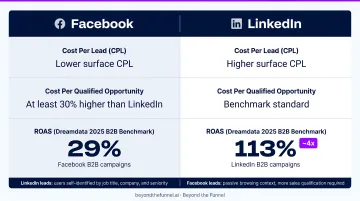
Metadata's analysis of B2B paid social spend found that while Facebook's surface-level CPL appeared lower, Facebook's cost per qualified opportunity was at least 30% higher than LinkedIn's in their dataset. This aligns with what most experienced B2B marketers observe: Facebook leads are cheaper to acquire but require more sales qualification work before they're pipeline-ready.
LinkedIn leads arrive in a business context — users have already self-identified by job title, company, and seniority. Facebook leads, while cheaper, often come from users who were passively browsing, and that passive engagement doesn't translate to the same buyer intent. Dreamdata's 2025 B2B benchmark data reinforces this: LinkedIn generated 113% ROAS versus 29% ROAS for Facebook across B2B campaigns — nearly a 4x difference in return.
That gap is why the platform decision matters more than most budget conversations. Here's how to make it.
How to Choose Based on Your Goal
Use this situational framework:
Choose LinkedIn as your primary channel when:
- You need to reach specific job titles at specific companies
- You're running ABM campaigns targeting named accounts
- Your deal value is high and your sales cycle is long
- Lead quality directly impacts revenue (enterprise, SaaS, financial services)
Lean on Facebook when:
- Budget is limited and top-of-funnel reach is the priority
- You're retargeting audiences who already know your brand
- Your audience is broader (small business owners, general professionals)
- Your product has a shorter sales cycle and lower deal value
Think of it as the cost of precision: LinkedIn's higher CPC isn't inefficiency. It's the price of reaching the right person in the right frame of mind — and for high-value B2B deals, that precision pays for itself in pipeline quality.
Real-World B2B Campaign Results
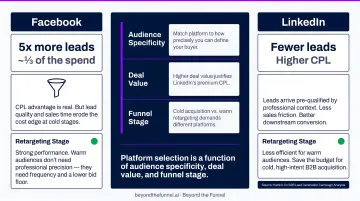
Published case data illustrates the nuance well. A Katté & Co analysis of a B2B lead generation campaign found Facebook generated 5x more leads at roughly one-third of the spend compared to LinkedIn. On CPL alone, Facebook won decisively.
But lead volume at low cost didn't tell the whole story. When qualification rates and downstream conversion were factored in, the higher-volume Facebook leads required significantly more sales time to move through the funnel — eroding the cost advantage. The LinkedIn leads, though fewer and more expensive to acquire, arrived already pre-qualified by professional context.
That dynamic flips at the retargeting stage. For campaigns reaching warm prospects — people who had already engaged with content or visited a website — Facebook consistently delivers strong results at lower cost. Someone who already knows your brand doesn't need LinkedIn's professional precision. They need frequency and a lower bid floor.
The pattern that holds across real campaign data: platform selection is a function of audience specificity, deal value, and funnel stage. Brands that choose based on habit or benchmark CPCs — without testing against actual pipeline outcomes — consistently misread where their budget should go. The campaigns that perform are the ones built around audience validation, creative testing, and deliberate funnel alignment.
Conclusion
There's no universal winner here. LinkedIn is the stronger default for B2B precision — reaching decision-makers in a professional context with targeting depth that no other platform matches. Facebook earns its place as a cost-efficient amplifier, particularly for retargeting warm audiences and generating top-of-funnel awareness at scale.
The most effective B2B advertisers treat these platforms as complementary: LinkedIn to acquire and qualify, Facebook to re-engage at lower cost as prospects move down the funnel.
If you're ready to build a LinkedIn strategy that turns the platform into a predictable revenue channel, Beyond the Funnel can help. Founded by Joshua Stout — one of 80 LinkedIn Certified Marketing Experts worldwide and 1 of 16 in the U.S. — the agency brings a testing framework developed across 1,000+ managed accounts. That means faster audience validation, smarter creative decisions, and a clear path from LinkedIn spend to pipeline.
Frequently Asked Questions
Which platform is the best for B2B marketing?
LinkedIn is the stronger choice for most B2B teams for B2B due to its professional audience and precise targeting by job title, seniority, and company size. Your specific goals still matter — LinkedIn excels for lead quality and decision-maker reach, while Facebook adds value for retargeting and broad awareness.
Is LinkedIn good for B2B marketing?
Yes — LinkedIn is the leading platform for B2B lead generation. Its ability to target by job title, company, and seniority makes it uniquely effective for reaching decision-makers, and Dreamdata's benchmarks show LinkedIn delivering 113% ROAS compared to 29% for Facebook in B2B campaigns.
What is the 5-3-2 rule on LinkedIn?
The 5-3-2 rule is a content balance framework: for every 10 posts, 5 should be curated content from others relevant to your audience, 3 should be original educational content from your brand, and 2 should be personal or humanizing posts. It's designed to build credibility without being overly promotional.
Is Facebook advertising worth it for B2B companies?
Yes, for the right use cases. Facebook works well for B2B retargeting, top-of-funnel brand awareness, and reaching broader audiences like small business owners. It's most valuable as a complement to LinkedIn rather than a replacement, especially when budget efficiency is a priority.
Should B2B marketers use LinkedIn and Facebook together?
The most effective dual-platform approach uses LinkedIn for top-of-funnel prospecting and precise targeting of new decision-makers, then uses Facebook to retarget those same audiences at a lower cost as they move further down the funnel.