But uploading a target account list and hitting launch isn't a strategy. Results swing wildly depending on list quality, budget allocation, ad format mix, and whether your creative actually speaks to each account's problems or just slaps a logo on a template.
This guide covers whether LinkedIn ABM ads are the right move for your brand, the exact steps to launch a campaign, the variables that determine performance, and the mistakes that sink most programs. It's written from the perspective of a LinkedIn Certified Marketing Expert who has managed over 1,000 LinkedIn ad accounts.
Key Takeaways
- Account Targeting reaches named companies and their decision-makers—not a broad demographic bucket.
- Start with warm accounts (closed-lost deals, churned customers, stalled opportunities) before layering in a cold ICP list.
- Build segments around LinkedIn's 300 matched-member minimum so every audience stays large enough to serve.
- Most campaigns fail from budget dilution, generic creative, or tracking clicks instead of account progression.
How to Run LinkedIn ABM Ads That Land: A Step-By-Step Framework
Running ABM ads on LinkedIn is a five-step process. Skip a step, and the whole thing tends to wobble.
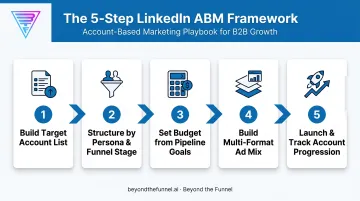
Step 1: Build and Upload Your Target Account List
Most teams default to a cold ICP list because it's the obvious starting point. That's backwards.
Warm accounts already know who you are, which shortens the path from impression to pipeline. A Demand Gen Report analysis of enterprise buying behavior found that 86% of enterprise buyers shortlisted a vendor they already knew before research even began, and 71% went on to buy their top pick. Familiarity does the heavy lifting.
Before building a cold list, mine these sources first:
- Closed-lost deals from the past 12-18 months
- Churned customers who left for reasons you've since fixed
- Stalled opportunities sitting in your CRM
- Unconverted MQLs
- Identified website visitors who never filled out a form
Once your list is ready, upload it through LinkedIn's Account Targeting feature, which matches company names against LinkedIn's database of 13 million-plus Company Pages. You can upload up to 300,000 companies, though matching can take up to 48 hours.
One catch: LinkedIn requires a minimum of 300 matched members before an audience can go live. If your niche account list doesn't clear that bar, widen it or combine segments. Tighter, more niche audiences also tend to cost more as competition for those members increases.
Step 2: Structure Campaigns by Persona and Funnel Stage
Blending your marketing-leader messaging with your sales-leader messaging into one campaign waters both down. Each persona has different pain points, different objections, and different reasons to care about your product.
Build separate campaigns for each persona first (for example, marketing leaders vs. sales leaders). Then split each persona group by funnel stage:
- Cold segment: accounts that are identified but haven't engaged yet
- Warm segment: accounts that have clicked, watched, or otherwise shown engagement and are ready for retargeting
This separation matters because it lets you track account movement independently instead of guessing which message actually moved someone from aware to interested.
Step 3: Set a Realistic Budget Based on Pipeline Goals
Don't pick a monthly ad spend out of thin air. Reverse-engineer it from your pipeline target.
Start with your revenue goal, then work backward:
- Determine your average contract value (ACV) to figure out how many closed deals you need.
- Apply your close rate to calculate how many qualified opportunities you need.
- Apply your qualification rate to determine how many total leads or engaged accounts must enter the funnel.
- Size your account list and budget to realistically produce that volume within LinkedIn's ad platform.
The biggest budget mistake is spreading spend across too many personas or ad variations at once. Each ad needs a minimum daily volume of clicks and engagements to produce data you can actually act on. Split $3,000 a month across six ad variations and none of them will tell you anything reliable.
Step 4: Build a Multi-Format, Personalized Ad Mix
Different formats do different jobs. Single-image ads and Sponsored Content work well for top-of-funnel awareness. Thought Leader Ads build credibility by amplifying content from your executives. Message ads and carousels tend to fit better once an account has already engaged.
Format performance does vary. In Huble's 2025 analysis of client campaigns, Single Image ads averaged a 0.39% CTR and roughly $3.75 CPC, while Carousel ads outperformed on both metrics at a 0.49% CTR and roughly $2.15 CPC. That's not a universal rule for every industry, but it's a strong signal that format choice isn't a minor detail.
Personalization is where most ABM programs get lazy. Dropping {{Company Name}} into a template is just a mail-merge trick. Real personalization means:
- Addressing the specific pain point that segment faces
- Using authentic imagery, not stock photos of people pointing at whiteboards
- Referencing the actual stage that account is at in their buying journey
Step 5: Launch With Precision Settings and Track Account Progression
Two settings decisions make or break account-level visibility.
First, choose Website Visits as your objective instead of Lead Gen Forms in most cases. Lead Gen Forms optimize for form fills inside LinkedIn's native experience, obscuring which accounts are actually engaging with your site and content. Website Visits, paired with proper conversion tracking, ties activity back to specific accounts more clearly.
Second, disable audience expansion and set frequency caps. Without caps, LinkedIn's algorithm tends to consolidate impressions on your largest, most active accounts, starving the smaller ones in your list of any visibility at all.
Then measure success the right way: track accounts moving from aware → engaged → considering, and tie that progression to pipeline influenced. Clicks and impressions tell you almost nothing about whether a $50,000 account is actually warming up.
When Should You Use LinkedIn ABM Ads?
Account-based advertising isn't the right fit for every B2B company. The decision comes down to deal size and how complicated the buying process is.
Forrester's 2024 State of Business Buying report found that the average B2B purchase decision involves 13 people, and 89% of purchases touch at least two departments. That kind of complexity is exactly what ABM was built for. It lets you reach multiple stakeholders inside the same account with tailored messaging.
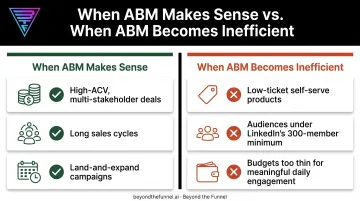
ABM makes sense for:
- High-ACV deals with multi-stakeholder buying committees (SaaS, finance, healthcare, enterprise tech)
- Long sales cycles where you nurture multiple contacts over months
- "Land and expand" campaigns targeting existing customers for upsell or cross-sell
ABM becomes inefficient when:
- Your product is low-ticket or self-serve, where broad reach beats precision
- Your total addressable market can't clear LinkedIn's 300-member minimum
- Your budget is too thin to give even one persona's ad set meaningful daily engagement
If those constraints sound familiar, start with broader demand generation instead.
Key Variables That Affect LinkedIn ABM Ad Performance
Two companies can run nearly identical ABM campaigns and get wildly different results. The gap usually comes down to a handful of controllable variables.
Five variables drive most of that gap:
- Target account list quality and size: Warm, pre-qualified accounts convert faster and cheaper than cold ICP-matched lists because trust-building is already partially done. Cold lists need larger budgets and longer nurture cycles before pipeline moves.
- Ad format mix: Formats carry different cost-per-click profiles and perform differently by funnel stage. The wrong format for where an account sits in the journey wastes spend that could generate real engagement.
- Budget allocation per persona or campaign: Each ad needs enough daily clicks and engagements to produce usable data. Under-funded campaigns create noise that leads to premature optimization before results stabilize.
- Creative personalization and messaging relevance: Messaging built around a segment's actual pain points outperforms generic corporate copy or superficial name-dropping, driving higher engagement and lower cost per landing page visit.
- Campaign settings: Wrong objectives or enabled audience expansion pull spend and impressions off your target list. Correct settings improve tracking and keep smaller accounts from being starved while the biggest names soak up budget.
These factors compound. A strong list with weak creative still underperforms, and strong creative aimed at the wrong accounts burns budget without moving pipeline.
Common Mistakes That Sink LinkedIn ABM Campaigns
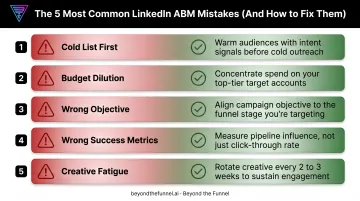
Most failed ABM programs trace back to one of these five issues.
- Starting with a cold ICP list instead of warm accounts. Fix: mine closed-lost deals, churned customers, and stalled opportunities before you touch a cold list.
- Spreading budget across too many ads or personas (budget dilution). Fix: calculate the minimum viable daily spend per ad before adding new formats or segments.
- Choosing an objective, like Lead Gen Forms, that hides account-level engagement. Fix: use Website Visits paired with proper tracking so activity ties back to specific accounts.
- Judging campaigns on CTR or impressions instead of account progression. Fix: track which accounts move from aware to engaged to considering—not CTR or impressions.
- Letting the same ads run for months against a small account pool. Fix: rotate in a few new creative concepts per persona each month before fatigue sets in.
Fix these before you scale spend. Most ABM waste comes from one of the five, not from LinkedIn itself.
Alternatives and Complements to LinkedIn ABM Ads
Paid LinkedIn ABM ads work best as one piece of a broader account-based approach, not a standalone tactic.
Organic Social Selling and Thought Leadership Content
Organic content fits smaller budgets and helps build trust before paid spend starts. Sales can engage target accounts through posts and outreach while marketing publishes thought leadership.
You gain authenticity, but reach grows slowly—and you can't guarantee specific accounts will see the content the way paid targeting can.
Multi-Channel 1:1 ABM
Pair email, direct mail, and personalized landing pages with LinkedIn when your list is very small and highly strategic. Deep individualization matters more than reach if you're pursuing a handful of high-value logos.
This path is resource-intensive. It only works when sales and marketing stay aligned on messaging, timing, and follow-up.
Broader Demand Generation on LinkedIn
Choose broader LinkedIn demand gen for lower-ACV products, a larger addressable market, or an ICP that isn't defined enough to justify narrow ABM. Personalization and per-account conversion drop, but campaigns scale far more easily.
Frequently Asked Questions
What is a LinkedIn ABM strategy?
A LinkedIn ABM strategy uses account targeting to focus ad spend on a curated list of high-value companies and their decision-makers, not a broad demographic audience.
Do organic posting rules like 3/2/1 or 95-5 apply to LinkedIn ABM ads?
No. Cadences like 3/2/1 and the 95-5 rule apply to organic content, not paid targeting. A steady organic presence builds trust alongside ABM ads, but it doesn't replace account-level precision.
How much budget do I need to start LinkedIn ABM ads?
Reverse-engineer budget from pipeline goals and account list size. As a practical floor, fund each persona ad set with enough daily spend to exit LinkedIn's learning phase and collect usable engagement data.
How long does it take to see results from LinkedIn ABM campaigns?
The first 1–2 months usually build account awareness and engagement, not closed deals. With typical B2B sales cycles, pipeline impact often shows in the 3–6 month range.
What's the minimum audience size for LinkedIn account targeting?
LinkedIn requires at least 300 matched members per targeted audience. Below that, you'll need to broaden segments—by combining personas or industries—until the audience qualifies.
How is LinkedIn ABM different from regular LinkedIn demand generation ads?
ABM prioritizes depth: tailored messaging to specific named accounts. Demand generation prioritizes breadth, reaching as many qualified leads as possible across a wider audience.