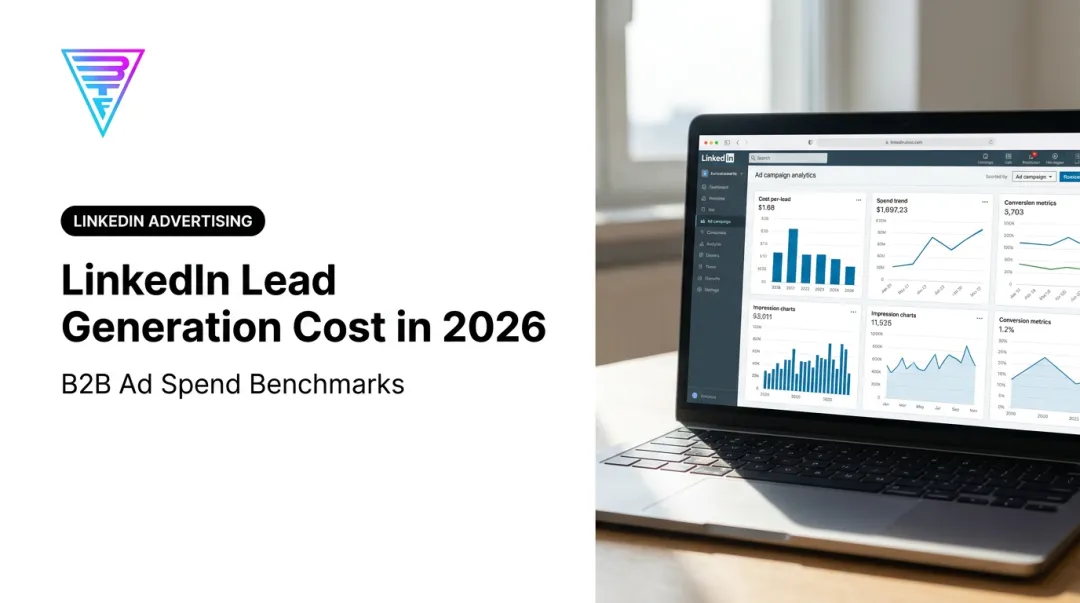
Here's the catch: there's no single "average" LinkedIn cost per lead. Your CPL depends on your industry, how tightly you target, which ad format you run, and whether you're using a native form or sending traffic to a landing page.
This article breaks down current 2026 CPL benchmarks, the factors pushing your costs up or down, the full expense picture beyond ad spend, and practical ways to bring your CPL under control.
Key Takeaways
- LinkedIn CPL in 2026 averages $202-$276, though it ranges from under $150 to over $2,500 by industry
- Targeting precision, ad format, and lead capture method drive most of your cost swings
- Native Lead Gen Forms beat landing pages on cost, but yield shallower lead qualification
- Cost per lead matters less than cost per qualified meeting or closed deal
How Much Does LinkedIn Cost Per Lead Cost in 2026? (Pricing Overview)
LinkedIn doesn't publish a fixed CPL, and for good reason: it fluctuates with your industry, campaign objective, audience size, and how you're capturing leads. A SaaS company running a content offer and an enterprise FinTech brand running direct lead generation could see costs that differ by 10x or more.
Most businesses get their CPL expectations wrong in three predictable ways:
- Benchmarking against Google or Meta without accounting for LinkedIn's premium, high-intent professional audience
- Underbudgeting for testing before scaling, then panicking when early results look expensive
- Chasing lead volume instead of tracking which leads actually turn into pipeline
Typical LinkedIn CPL Ranges (2026)
According to Metadata's 2026 B2B Paid Media Benchmark Report, which analyzed $57.6 million in 2025 B2B ad spend across 150+ advertisers, prospecting campaigns averaged $194 CPL, while retargeting campaigns ran about 21% higher at $234 CPL.
Separately, 42 Agency's 2026 benchmarks, drawn from 87 B2B clients across 14 industries, found that content-offer campaigns typically cost 2-4x less than direct lead generation campaigns. Their data also pegged an average CPL of $276, with narrow enterprise targeting (like FinTech) running $1,500-$1,800.
These figures reflect ad spend only. They exclude agency management fees, creative production, and the tools you'll need to track results, which we'll cover shortly.
CPL by Industry Snapshot
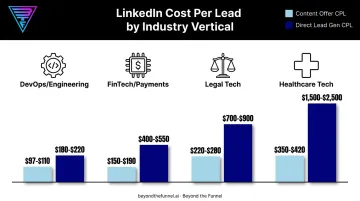
Industry and offer type move CPL more than almost any other factor. Here's how 42 Agency's dataset breaks down by subcategory:
| Industry Subcategory | Content Offer CPL | Direct Lead Gen CPL |
|---|---|---|
| DevOps/Engineering (SaaS/Tech) | $400-$600 | $1,500-$2,500 |
| FinTech/Payments (Finance) | $200-$400 | $1,500-$1,800 |
| Legal Tech | $97-$110 | $300-$350 |
| Healthcare Tech | $400-$600 | $800-$1,000 |
A $1,500 CPL sounds alarming in isolation. But if your average deal size is $50,000, that same number is a rounding error. Judge your CPL against your deal size and customer lifetime value, not against a benchmark table from a different industry.
Key Factors That Affect LinkedIn Cost Per Lead
Budget size matters less than most advertisers assume. What actually shapes your CPL comes down to targeting choices, bidding strategy, ad format, and how LinkedIn's algorithm scores your ad's relevance.
Targeting Depth & Audience Size
Broad audiences lower your CPC but dilute intent. Narrow audiences raise your CPC but typically convert at a higher rate.
- Broad example: Targeting all "Marketing Managers" in the United States (1M+ members): cheap clicks, low relevance
- Narrow example: Targeting "VP of Marketing" at companies with 500-1,000 employees in SaaS (under 100K members): pricier clicks, sharper intent
LinkedIn's own guidance recommends 300,000+ members for Sponsored Content and at least 50,000 for reliable delivery. But size isn't the only lever that matters. 42 Agency found that excluding companies above 500 employees cut CPL by 60-70% in many B2B campaigns, since smaller companies often move faster through the buying process.
For most B2B campaigns, a medium-sized, role-and-industry-based audience is the sweet spot: specific enough to filter for real buyers, broad enough that LinkedIn's delivery engine isn't starved for impressions.
Bid Strategy & Ad Format
Your bidding approach affects predictability more than raw cost:
- Maximum delivery (automated): LinkedIn spends your full daily budget automatically, offering predictable spend but less predictable cost per result
- Cost cap: You set a target average cost; LinkedIn manages bids around it, though individual conversions can still exceed that target
- Manual bidding: You set the ceiling yourself, gaining control at the risk of limited delivery
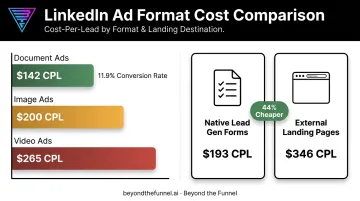
Ad format matters just as much. Metadata's 2026 data found Document Ads averaged $142 CPL with an 11.9% conversion rate, while Image Ads ran $200 and Video Ads ran $265. Video often drives stronger engagement per impression, but it doesn't automatically translate into a cheaper lead.
Ad Quality Score & Lead Capture Method
LinkedIn's auction rewards ads that people actually engage with. Higher CTR and relevance signals lower your cost over time, while stale or poorly targeted creative gets penalized with higher CPCs.
Lead capture method makes an even bigger dent. Metadata measured $193 CPL for native Lead Gen Forms versus $346 for external landing pages, a 44% reduction for staying on-platform. The trade-off: landing pages typically capture more qualifying detail before a lead reaches sales. On form completion rate specifically, 42 Agency classifies under 10% as poor and above 25% as excellent for native forms.
Cost Breakdown of LinkedIn Lead Generation
The number in your Campaign Manager dashboard is only part of what LinkedIn lead generation costs. A realistic budget accounts for four categories:
- Ad spend (recurring): The auction cost reflected in the CPL ranges above, governed by LinkedIn's minimum daily and campaign budget requirements.
- Campaign management or agency fees (recurring): Industry-wide, this typically runs 10-20% of ad spend, or roughly $500-$10,000 monthly for an average account.
- Beyond the Funnel's LinkedIn-specific retainers range from $1,045/month (up to $5,000 in ad spend) to $8,775/month (up to $80,000 in ad spend), built around structured testing rather than general PPC oversight.
- Creative production & testing (periodic): Developing and iterating ad variations for A/B testing, often bundled into the management fee or offered as a $500/month add-on.
- Tools & tracking (recurring): Sales Navigator, Campaign Manager, and attribution or analytics platforms that connect ad spend to actual pipeline.
Skip any one of these four, and your "true" CPL calculation ends up understated.
LinkedIn Ads vs. Other Channels: Is the Higher CPL Worth It?
LinkedIn's CPL almost always runs higher than Meta's or Google's. That comparison alone, though, ignores what happens after the click.
| Channel | Cost | Conversion Rate | Source |
|---|---|---|---|
| $202 CPL | 5.9% | Metadata 2026 | |
| $145 CPL | 2.6% | Metadata 2026 | |
| Google B2B Search | $606 per conversion | 0.31% | 42 Agency 2026 |
Metadata's data also showed LinkedIn's CPC running 3.1x higher than Facebook's, but converting at 2.3x the rate. That's the trade B2B advertisers are making: paying more per click to land on a platform where people are in a professional headspace, filtering by job title and seniority. They're not scrolling past ads between vacation photos.
The real question is which channel produces the cheapest closed deal, not which one has the cheapest lead. A $250 LinkedIn lead that converts to a $40,000 contract outperforms a $50 Meta lead that never gets past the first sales call — every time.
How to Lower Your LinkedIn Cost Per Lead in 2026
CPL rarely drops from one big change. It drops from small, systematic adjustments that compound over a few months.
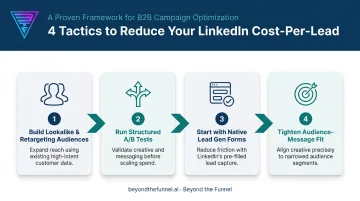
- **Build lookalike and retargeting audiences** from your best-converting segments to preserve relevance while trimming CPC compared to cold, broad targeting
- Run structured A/B tests across ad formats, creative angles, and messaging instead of launching one campaign and letting it ride
- Start with native Lead Gen Forms for volume, then layer in landing pages once you have the budget to prioritize deeper qualification
- Tighten the fit between your audience and your message. A sharper match boosts your relevance score, which lowers auction costs across the life of the campaign
Many B2B brands find they hit these improvements faster with a dedicated partner running the testing in the background. That's the core of how Beyond the Funnel approaches client accounts:
- Audience validation before scaling
- Continuous creative testing
- Full-funnel structure instead of isolated campaign tweaks
One client, Evidation, saw pipeline grow from a few dozen opportunities to over 100 in a single year after this kind of structured approach replaced ad-hoc campaign management. The bigger win is a repeatable system that keeps lowering CPL month after month, not just a single low number.
Frequently Asked Questions
What is the average cost per lead on LinkedIn in 2026?
Current benchmarks put LinkedIn CPL between $202 and $276 on average, but individual campaigns range from under $150 to over $2,500. The right benchmark depends on your industry, offer type, and deal size, not a single universal figure.
Why is LinkedIn's cost per lead higher than Meta or Google Ads?
LinkedIn's professional-context audience and precise B2B targeting (job title, seniority, industry) command a premium price per click. In exchange, those leads typically arrive with higher intent and shorter sales cycles than leads from cheaper, less-targeted channels.
How much should I budget monthly for LinkedIn lead generation in 2026?
Beyond ad spend, expect management fees of roughly 10-20% of that spend, or a flat retainer, commonly $1,000-$9,000/month depending on account size and service depth. Add creative production costs if that's not bundled into your fee.
Does using LinkedIn Lead Gen Forms actually reduce cost per lead?
Yes. Benchmark data shows native forms averaging $193 CPL versus $346 for external landing pages, nearly a 44% reduction. The trade-off is that landing pages typically capture more qualifying information upfront.
What's considered a "good" cost per lead on LinkedIn?
Under $150 is generally rated excellent and over $400 poor, but "good" really depends on your industry, deal size, and close rate. Your own historical account data is a more reliable benchmark than any industry-wide number.
Is LinkedIn worth the higher cost per lead for B2B companies?
For high-ticket B2B sales with strong lifetime value, yes — LinkedIn's premium CPL is usually justified by better lead quality, higher close rates, and larger deal sizes compared to cheaper, lower-intent channels.