The gap isn't the platform. It's the lack of structure behind most campaigns.
This guide breaks down why LinkedIn Ads work for B2B lead gen, which formats and targeting tactics actually move the needle, what you should realistically budget, and how to measure results so campaigns compound instead of resetting every quarter. Get the audience validation and funnel structure right, and LinkedIn stops being a gamble. It becomes a channel you can forecast.
Key Takeaways
- Layered targeting + Matched Audiences beats broad, single-filter campaigns on lead quality
- Lead Gen Forms cut friction when limited to 3–4 pre-filled fields
- Cost-per-lead varies widely by industry and targeting—budget for testing first
- Buying committees average 13 people, so executive-only targeting leaves pipeline untapped
- Weekly optimization and A/B testing turn one-off campaigns into a repeatable revenue channel
Why LinkedIn Ads Work for B2B Lead Generation
People show up to LinkedIn in a different headspace than they do on Instagram or Facebook. They're thinking about their job, their industry, their next move. That context changes how they respond to B2B messaging.
According to Sprout Social's 2026 research, a large majority of B2B marketers already include LinkedIn in their lead generation mix. Three advantages explain the pull.
Three Advantages No Other Platform Matches
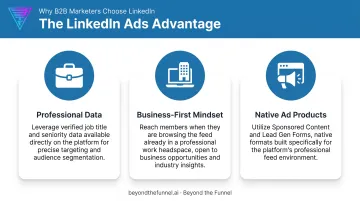
- Professional data: Job title, seniority, industry, and company size are self-reported and verified, not inferred from browsing behavior
- Business-first mindset: Members are actively thinking about work, budgets, and vendors, not vacation photos
- Native ad products: Formats built specifically for the feed context, from Sponsored Content to Lead Gen Forms
The Buying Journey Has Gotten More Complicated
Nobody buys B2B software or services alone anymore. Forrester's 2024 State of Business Buying research found that the average purchase decision involves 13 people inside the buying organization, and 89% of purchases span two or more departments.
That's a direct challenge to any campaign targeting a single title or department. If IT, finance, and operations are all in the room, your ads need to reach more than the VP whose name is on the budget.
Reaching that many stakeholders also changes how you should read cost-per-lead.
How LinkedIn Stacks Up on Cost
Cost comparisons across platforms vary by dataset, but one useful reference point comes from Metadata's analysis of B2B customer campaigns from January through September 2024:
| Platform | Cost-Per-Lead |
|---|---|
| $190.04 | |
| $160.48 | |
| Google Ads | $580.61 |
| $112.60 |
LinkedIn's CPL sits higher than Facebook and Instagram but well below Google Ads in this dataset. Raw CPL alone doesn't tell the full story. Lead quality and pipeline value belong in the comparison, not just sticker price.
That quality gap is why campaign structure matters as much as the channel. Joshua Stout, founder of Beyond the Funnel and one of only 16 LinkedIn Certified Marketing Experts in the U.S., has managed and optimized more than 1,000 LinkedIn ad accounts. The pattern he sees repeatedly is clear: tested strategy is what unlocks LinkedIn's potential.
LinkedIn Ad Formats & Lead Gen Forms for B2B Campaigns
Running one ad format in isolation limits what you can learn. Pairing formats, like Sponsored Content for top-of-funnel awareness with Message Ads for direct follow-up, gives prospects multiple touchpoints instead of a single impression they scroll past.
Sponsored Content, Message Ads & Text Ads
Each format has a distinct job:
- Sponsored Content: Native in-feed ads that work well for thought leadership pieces, gated offers, and case studies
- Message Ads: Land directly in the inbox, making them especially effective for webinar invites and time-sensitive offers
- Text Ads: Low-cost, self-serve options useful for early testing before committing a bigger budget
Beyond these three, Carousel Ads and Dynamic Ads add visual storytelling and personalized creative at scale. They pull in profile data like name or company logo to grab attention.
Whichever formats you run, Lead Gen Forms help you capture interest without sending prospects to an external landing page.
LinkedIn Lead Gen Forms Best Practices
Lead Gen Forms auto-populate with a member's LinkedIn profile data, meaning fields like name, job title, and company fill in automatically. On mobile, where typing is a hassle, this removes a major conversion barrier.
LinkedIn reports that 90% of Lead Gen Forms pilot customers beat their cost-per-lead goals, often outperforming their own standard Sponsored Content campaigns. To get that kind of result, keep forms tight:
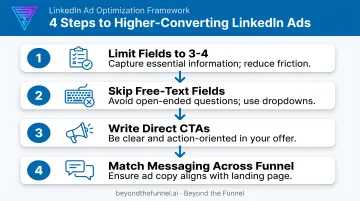
- Limit fields to 3-4 - every additional field adds drop-off
- Skip free-text fields - manual typing kills mobile conversion
- Write direct CTAs - "Download the Guide" beats "Submit"
- Match messaging across the funnel - the ad, form, and thank-you page should feel like one continuous conversation
Targeting Strategies to Reach the Right B2B Buyers
Good targeting layers the right filters so you reach decision-makers without shrinking your pool so far that delivery stalls.
Building Personas That Actually Convert
Start broad, then layer:
- Job function (marketing, IT, finance)
- Seniority (director and above, or manager-plus depending on the deal size)
- Skills (specific tools or expertise relevant to your offer)
Each layer narrows the audience. Stack too many, and you risk an audience so small LinkedIn can't deliver efficiently.
Matched Audiences: Your Retargeting and ABM Engine
LinkedIn's Matched Audiences feature gives you three ways to get precise:
- Website retargeting: Serve ads to people who already visited your site
- Account targeting: Upload a list of target companies for account-based marketing
- Contact targeting: Upload email lists to reach known prospects or existing customers directly
Don't Target Executives Only
Forrester puts most B2B purchases at roughly 13 people across multiple departments. If your targeting only reaches VPs and C-suite, you miss the managers and specialists who influence the decision even when they don't sign the contract.
Gartner's 2025 research found buying groups range from 5 to 16 people across as many as four functions. Content relevant to the whole group improved consensus by 20%. Content aimed at just one individual hurt consensus by 59%.
Practical move: Test 2-3 targeting combinations early and measure cost-per-qualified-lead by segment, then double down on winners. Pair account-based targeting with a clear ideal customer profile so spend stays on accounts that fit, not everyone who might.
How Much Do LinkedIn Ads Cost?
LinkedIn charges advertisers through a few different models, and understanding which one fits your goal matters more than chasing a "good" CPC number in isolation.
Bidding Models Explained
- CPC (cost-per-click): You pay when someone clicks your ad
- CPM (cost-per-impression): You pay based on how many times your ad is shown
- Cost-per-send: Used for Message Ads, charging based on delivered messages
Once you pick a model, maximum delivery bidding lets LinkedIn's algorithm optimize automatically, while manual bidding gives you direct control over what you're willing to pay per result.
What Drives Cost Up or Down
Several factors push CPC and CPL higher or lower:
- Industry competitiveness: Crowded verticals like SaaS or finance often see higher bids
- Targeting specificity: Narrower audiences can cost more per impression
- Ad format: Message Ads and video typically price differently than static Sponsored Content
- Time of year: Budgets and competition shift seasonally
A 2025 HockeyStack study covering more than 70 B2B SaaS companies and $28 million in ad spend found CPC climbing from $10.48 in Q1 to $15.72 in Q3, largely from rising competition as campaigns ramped through the year.
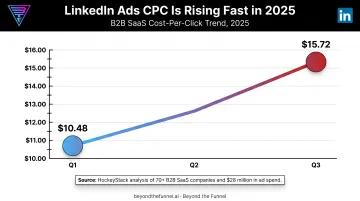
That's one cohort, not a universal benchmark—but it shows how much costs can shift within a single year.
Setting a Realistic Budget
Start with a testing budget before scaling. Run smaller spend across multiple audience and creative combinations, then reallocate toward what's actually converting. Only once you've validated a winning combination should you push into higher-spend campaigns.
Beyond the Funnel structures client plans around this progression—foundational testing first, then higher ad spend caps as performance data comes in.
Measuring, Optimizing & Scaling Your Campaigns
None of the targeting or format work matters if you are not tracking what happens after the click or the view.
Set Up Conversion Tracking Correctly
The LinkedIn Insight Tag connects website conversions back to specific ads, capturing data like button clicks, page visits, and visitor job titles. Pair it with CRM integration, and you can trace a lead all the way from first impression to closed deal.
LinkedIn's conversion windows can be set to 1, 7, 30, or 90 days, covering both:
- Post-click conversions: Someone clicked, then converted
- Post-view conversions: Someone saw the ad without clicking, then converted later
Test Continuously, Not Occasionally
Run 3-4 ad variants at once and review performance weekly. LinkedIn's own A/B testing tool requires a minimum two-week window, so give tests enough runway before declaring a winner.
Prioritize lead quality over volume. A campaign generating 200 form fills that never turn into sales conversations is not winning, even if cost-per-lead looks great on a dashboard. Define KPIs around qualified leads or sales-accepted leads, not raw form submissions.
Scale What the Data Validates
Once audiences and creatives prove out, raise budget on winners in controlled steps rather than spreading spend across untested variants. Watch frequency, CPL, and lead quality as budget climbs—if quality slips, pause and retest before adding more spend.
That quality-first loop is what moved the needle for Evidation. Michael Arbini, the company's former Head of Commercial Marketing, worked with Beyond the Funnel on a full LinkedIn strategy:
"Josh helped us map out and execute a full LinkedIn strategy that took our pipeline from a few dozen to over 100 opportunities in one year."
Gains like that come from continuous testing, transparent reporting, and cutting what underperforms while you scale what works.
Frequently Asked Questions
Do LinkedIn ads work for lead generation?
Yes. LinkedIn's professional targeting data and native ad formats make it highly effective for B2B lead gen, provided campaigns use tested audiences and creative rather than a single untested launch.
How much do LinkedIn ads cost?
Cost varies by bidding model, industry, and targeting specificity. CPC and CPL often run higher than platforms like Facebook, but the tradeoff is typically stronger lead quality and more precise professional targeting.
What is a good conversion rate for LinkedIn Lead Gen Forms?
There’s no single “good” rate—conversion depends on offer, audience, and form length. Shorter forms (3–4 fields) usually convert best. LinkedIn reports that 90% of Lead Gen Forms pilot customers beat their prior cost-per-lead goals versus standard campaigns.
What's the difference between LinkedIn Ads and LinkedIn Sales Navigator?
LinkedIn Ads (managed through Campaign Manager) runs paid lead generation campaigns at scale. Sales Navigator is a prospecting tool for manual outreach and relationship building. Many teams use both together.
How long does it take to see results from LinkedIn ads?
Initial data usually appears within 2–4 weeks of active testing. LinkedIn’s A/B testing tool needs at least a two-week run, and stronger optimization insights come with more spend and impressions behind them.
What targeting options work best for B2B lead generation on LinkedIn?
Layered targeting—job function plus seniority—paired with Matched Audiences for retargeting or account-based lists tends to beat single-filter or executive-only setups.