That shift breaks single-stage marketing. Brands that only chase bottom-funnel conversions end up bidding against rising ad costs while ignoring the buyers who aren't ready to purchase today, but will be in three months.
This guide breaks down what a full-funnel marketing strategy actually means, the stages that make it work, how to build one, and the mistakes that quietly derail most B2B marketing teams.
Key Takeaways
- Full-funnel marketing connects awareness, consideration, conversion, and loyalty into one connected system
- B2B buying journeys loop and skip stages, requiring messaging at every touchpoint
- Skipping upper-funnel investment inflates acquisition costs and stalls long-term growth
- The right metrics at each stage separate strategies that scale from ones that plateau
What Is a Full-Funnel Marketing Strategy?
A full-funnel marketing strategy aligns messaging, content, and channels across every stage of the buyer's journey so each stage reinforces the next. Instead of running awareness, consideration, and conversion as separate campaigns with different owners and goals, everything works as one connected system.
The "funnel" metaphor comes from a simple visual: a wide pool of prospects enters at the top, and a narrower group of committed buyers exits at the bottom. It's a useful shorthand, but it's easy to confuse the model with the strategy.
- Marketing funnel: a conceptual model showing how prospects theoretically move from awareness to purchase
- Full-funnel strategy: the operational system of tactics, content, and measurement built around that model
That distinction matters more in B2B than almost anywhere else. Longer sales cycles, multiple decision-makers, and extended consideration periods mean prospects move in and out of stages unpredictably. A buyer might see a LinkedIn ad, forget about you for six weeks, then return through a Google search after a colleague mentions your name.
Full-Funnel vs. Single-Stage Marketing
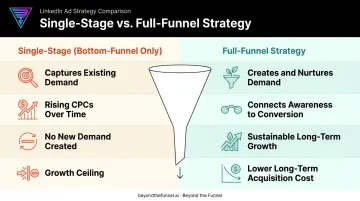
A bottom-funnel-only strategy captures demand that already exists. Someone searches for your product category, clicks a conversion-focused ad, and converts. That works, but it has a ceiling: it does nothing to create new demand for tomorrow.
Six months later, that well of demand starts to dry up, and cost-per-click climbs as more competitors chase the same handful of searches.
Full-funnel marketing requires deliberately designing how demand gets created, nurtured, and converted into a unified system, rather than simply adding more campaigns across more channels. An awareness impression today can feed a conversion six weeks from now.
Why B2B Brands Need a Full-Funnel Marketing Strategy
Marketing leaders aren't just being asked to generate leads anymore. McKinsey reports that 83% of CEOs look to marketing as a growth engine for the business, which means brand-building and performance marketing need to work together, not compete for budget.
McKinsey's research points to a common failure mode: separating brand teams from performance teams, each with different KPIs, creates friction instead of growth. Full-funnel thinking closes that gap.
LinkedIn is uniquely suited for this. It's one of the only platforms where a B2B brand can:
- Build awareness with decision-makers through organic reach and thought leadership content
- Nurture consideration with case studies, document ads, and retargeting
- Convert with precise targeting by job title, industry, and company size
All within the same ecosystem, without switching platforms or losing continuity between stages.
This is the exact philosophy Beyond the Funnel builds campaigns around. Rather than treating awareness spend as separate from conversion spend, the agency validates audiences with real data first, then tests creative against that validated audience.
The agency structures campaigns so upper-funnel efforts directly feed the consideration and conversion stages that follow. It's a big part of why the agency's work with Evidation grew the company's LinkedIn-driven pipeline from a few dozen opportunities to over 100 in a single year.
The Stages of a Full-Funnel Marketing Strategy
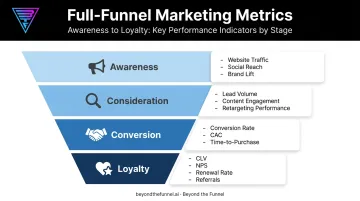
Most full-funnel frameworks boil down to four core stages: Awareness, Consideration, Conversion, and Loyalty. You'll often see these referenced by the TOFU/MOFU/BOFU shorthand (top, middle, and bottom of funnel) across the industry.
At Beyond the Funnel, we map LinkedIn campaigns to these four stages for our clients.
Awareness (Top of Funnel)
The goal here is simple: introduce your brand to a relevant audience before they're actively searching for a solution. This is content, social presence, and paid reach doing the work of familiarity, not conversion.
Metrics to track:
- Website traffic
- Social reach and impressions
- Keyword and branded search visibility
- Ad recall and brand lift
Consideration (Middle of Funnel)
Once a prospect knows you exist, they start comparing options. This stage needs content that builds trust and proves authority through real evidence and expertise.
Content that works:
- Case studies
- Webinars
- Comparison guides
Metrics to track:
- Lead generation volume
- Content engagement rates
- Email and retargeting performance
Conversion (Bottom of Funnel)
This is where friction gets removed. Prospects need final proof points to make a purchase decision, since they've already done their research.
Proof points that close deals:
- Product demos
- Customer testimonials
- Clear, transparent pricing
Metrics to track:
- Conversion rate
- Customer acquisition cost (CAC)
- Time-to-purchase
Loyalty (Retention & Advocacy)
Full-funnel strategies don't stop at the sale. Onboarding, customer experience, and advocacy programs drive repeat business and referrals, which is often cheaper growth than acquiring net-new customers.
Metrics to track:
- Customer lifetime value (CLV)
- Net promoter score (NPS)
- Repeat purchase or renewal rate
- Referral and advocacy participation rate
How to Build a Full-Funnel Marketing Strategy
Building a full-funnel strategy means sequencing campaigns deliberately, not running them everywhere at once.
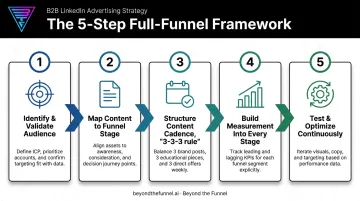
Identify and validate your target audience. Skip assumptions. Use buyer personas and firmographic data instead. LinkedIn lets B2B brands target by job title, industry, and company size, which makes audience validation far more precise than broad demographic guessing.
Map content and messaging to each funnel stage. Awareness content should educate. Consideration content should prove value. Conversion content should remove final objections. Reusing the same message at every stage is one of the fastest ways to lose a prospect's attention.
Structure your content cadence. Some marketers apply a "3-3-3" framework as a practical rule of thumb: testing three messages, across three channels, over three defined timeframes. It's not a rigid industry standard, but it's a useful way to structure a content calendar without overcomplicating early testing.
Build measurement into every stage from day one. Last-click reporting gives all the credit to the final touchpoint, erasing the awareness and nurturing work that got the buyer there in the first place. Multi-touch attribution, while imperfect, gives upper-funnel efforts the credit they've earned.
Test and optimize continuously. This is where most strategies either compound or stall. Beyond the Funnel's own framework, built across more than 1,000 managed LinkedIn ad accounts, validates audiences first, refines creative based on real performance data, and scales only what's already proven to work.
You don't need this fully built from the start. Start with a modified version, two or three stages, and expand as your measurement matures. Beyond the Funnel's own tiered retainer structure reflects this: a Foundation-level engagement (starting around $1,045/month) focuses on campaign build and strategy, while higher tiers add funnel testing and multi-vertical complexity as data accumulates.
Common Full-Funnel Marketing Mistakes to Avoid
Even teams that understand full-funnel theory stumble on execution. Three mistakes show up more than any others.
Siloed teams and budgets. When brand marketing and performance marketing report to different KPIs, continuity breaks. Brand teams struggle to prove near-term value while performance teams get credit for demand someone else created.
MarketingWeek's 2025 survey of 450 B2B marketers found that 50.7% didn't consider brand building a budget priority, with 58.3% citing perceived lack of ROI as the main obstacle.
Over-indexing on bottom-funnel conversion. It feels efficient in the short term, but it makes a brand dependent on demand it didn't create. Eventually, that well runs dry, and acquisition costs climb because there's no fresh pipeline of aware prospects entering behind it.
Treating the funnel as strictly linear. Real buyer journeys loop, skip stages, and double back. A rigid, one-path campaign structure misses how prospects actually behave, and it leaves money on the table at every stage where a buyer doesn't follow the script.
Frequently Asked Questions
What are the 5 stages of the marketing funnel?
Common frameworks reference Awareness, Interest, Consideration, Conversion, and Loyalty. These map to the TOFU/MOFU/BOFU shorthand used across the industry, though many marketers condense it to four core stages.
What is the 3-3-3 rule in marketing?
It's a practical framework some marketers use to structure content cadence, typically three messages, across three channels, over three timeframes. It's not a formal industry standard, but a useful starting structure for campaign testing.
What is full-funnel marketing according to McKinsey?
McKinsey describes it as combining brand building and performance marketing through linked teams, shared measurement systems, and unified KPIs, rather than running them as two separate, competing disciplines.
What is the difference between full-funnel marketing and multi-channel marketing?
Multi-channel means having a presence across several platforms. Full-funnel means those channels are deliberately connected so each one reinforces the buyer's journey across every stage, not just channel breadth for its own sake.
What is an example of full-funnel marketing for a B2B brand?
A prospect discovers a brand through LinkedIn thought leadership content, later engages with a case study during their research phase, and converts weeks later through a precisely targeted retargeting ad. Each stage reinforces the next.
Is full-funnel marketing only for large companies with big budgets?
No. A modified version covering two or three stages can start small and expand as measurement and budget mature. Many B2B brands begin with awareness and conversion, then layer in consideration content later.