But here's the frustration most SaaS marketers hit: they run LinkedIn like Google Search, expect someone to click an ad and book a demo in the same session, then declare the platform doesn't work. LinkedIn isn't a demand-capture channel. It's a demand-creation channel — and SaaS conversions happen across lifecycle stages, not in a single touch.
This guide walks through exactly how to run LinkedIn ads for B2B SaaS: what to set up before you spend a dollar, how to structure campaigns around the SaaS buying journey, which variables most determine performance, and the mistakes that drain budgets fastest.
Key Takeaways
- Structure campaigns around SaaS lifecycle stages — not a simplified three-step funnel
- Segment executives and end users from day one; identical messaging to both wastes budget on both
- Prioritize demo and trial campaigns before brand awareness
- Give campaigns 60–90 days minimum before drawing conclusions
- Connect CAPI to push in-app events back to LinkedIn — it's what turns campaign data into a repeatable growth signal
What You Need Before Running LinkedIn Ads for B2B SaaS
Preparation quality directly determines what the first 60 days look like. Underprepared SaaS teams consistently overspend and underperform early — not because of the platform, but because of what was (and wasn't) built before launch.
Technical Setup Requirements
Before a single campaign goes live, confirm these are in place:
- LinkedIn Campaign Manager with billing configured
- LinkedIn Insight Tag installed and verified on all key pages — pricing, sign-up, demo request, and confirmation pages
- At least one conversion event tracked and confirmed firing in Campaign Manager
- LinkedIn CAPI (Conversions API) configured to send in-app events — trial starts, account activations, demo bookings — back to LinkedIn as custom conversion events
The Insight Tag alone only tells LinkedIn what happened on your website. CAPI goes further, streaming server-side conversion data so the algorithm can optimize toward what actually matters for your business — not just page visits and form opens.
Strategic Readiness Checklist
With the technical foundation confirmed, the next layer is strategic. These inputs need to be locked in before you build a single campaign:
- ICP defined with at least two distinct persona segments — typically an executive/decision-maker and an end-user persona
- SaaS buyer journey mapped from first touch through trial, demo, and paid subscription
- At least one high-converting landing page or LinkedIn Lead Gen Form ready for each offer
- Realistic budget — based on managing 1,000+ LinkedIn ad accounts, around $5,000/month as a meaningful starting point for SaaS campaigns to gather actionable data; smaller test budgets in the $500 range produce limited signal
Skipping any of these creates expensive ambiguity. It's far harder to correct mid-campaign than it is to build correctly from the start.
How to Run LinkedIn Ads for B2B SaaS: Step-by-Step
Step 1: Define Campaign Objectives Around SaaS Lifecycle Stages
The first decision is campaign objective — and it should be driven by where in the SaaS lifecycle you're trying to move prospects.
The full SaaS lifecycle funnel campaigns should map to:
- TOFU awareness by persona — cold audience education, segmented by executive vs. end user
- MOFU education and problem framing — content that frames the problem your software solves
- Free trial or gated resource — first conversion event with low commitment
- Demo or booked call — high-intent conversion for mid-market and enterprise buyers
- Paid subscription — handoff from marketing to product and CS
- Expansion or upsell — existing customers seeing upgrade messaging
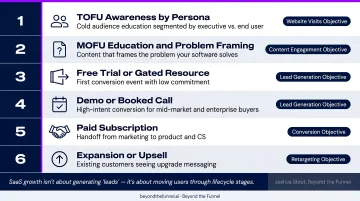
Each stage represents a different conversion event and needs its own messaging. Website Visits objectives drive traffic for TOFU education; Lead Generation objectives capture intent directly in-platform at MOFU and BOFU. Most SaaS brands should start with demo requests and trial sign-ups — not brand awareness — because those stages produce revenue signal faster.
Practitioner note: SaaS growth isn't about generating "leads" — it's about moving users through lifecycle stages. That requires event-level tracking and a funnel built around behavior, not assumptions. — Joshua Stout, Beyond the Funnel
Step 2: Build Your Audience Targeting Strategy
Cold audiences: Layer job title targeting by persona (end users vs. decision-makers), company size, and industry. Avoid targeting a single job title in isolation — titles vary wildly across companies. Combining Job Function + Seniority alongside Job Title creates a larger, more stable audience without sacrificing ICP fit. As Factors.ai notes, function + seniority preserves relevance at greater scale than job title alone.
Warm retargeting audiences: Build segments from high-intent pages — pricing, demo, sign-up — plus LinkedIn video viewers and Lead Gen Form openers. The most common audit error here is incorrect AND/OR filter logic: using OR when AND is needed lets unqualified visitors contaminate retargeting pools and inflates CPL without improving pipeline quality.
ABM targeting: Use LinkedIn's Matched Audiences to upload named account lists, then layer persona filters on top. This reaches the right contacts within target accounts rather than broadcasting to entire companies.
Step 3: Choose Ad Formats and Write Persona-Specific Creative
Format logic by funnel stage:
| Stage | Recommended Format | Rationale |
|---|---|---|
| Cold TOFU | Single Image Ads | Clarity and directness outperform complexity |
| MOFU education | Document Ads | Ungated or lightly gated content builds trust |
| Retargeting / BOFU | Video Ads | Product walkthroughs and social proof build conversion confidence |
| Brand recall | Thought Leader Ads | Amplifying founder posts generates authentic engagement |
Secondary sources report that Thought Leader Ads produce 1.7x higher CTR and 1.6x higher engagement than standard single-image ads — making them especially effective for SaaS brands where founder credibility accelerates trust.
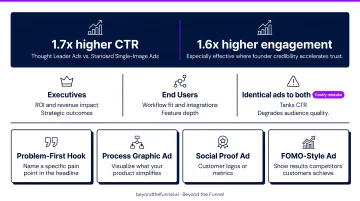
The persona-messaging rule: Executives care about ROI, revenue impact, and strategic outcomes. End users care about workflow fit, integrations, and feature depth.
Running identical ads to both personas is one of the most common and most expensive mistakes in SaaS LinkedIn ad management. Misaligned creative tanks CTR, which signals LinkedIn's algorithm to serve the ad less frequently and to a lower-quality audience slice.
Proven creative patterns for SaaS:
- Problem-first hooks that name a specific pain point in the headline
- Process graphic ads that visualize what your product simplifies
- Social proof ads featuring recognizable customer logos or metrics
- FOMO-style ads showing results competitors' customers achieve with your software
Step 4: Configure Budget, Bidding, and Campaign Structure
Budget guidance: For meaningful learning, plan around $5,000/month for a focused SaaS campaign. Allocate the majority toward cold prospecting (further split across education and direct conversion objectives), with a meaningful portion reserved for retargeting. Shift that ratio as retargeting pools grow — larger warm audiences justify heavier retargeting investment.
Bidding strategy:
- Manual CPC during the testing phase — gives budget control before campaigns have enough data for LinkedIn's algorithm to optimize effectively
- Maximum Delivery (automated) once campaigns have established performance baselines and the algorithm has sufficient conversion signal to work with
Campaign structure: Separate campaigns by funnel stage, persona type, and audience temperature. Do not mix cold and warm audiences in the same campaign. Each audience temperature requires its own bid level, creative approach, and success metrics. Mixing them creates misleading reporting and prevents the algorithm from optimizing correctly for either segment.
Step 5: Launch, Track, and Iterate Based on Lifecycle Data
Post-launch tracking: Before scaling spend, confirm conversion events are firing correctly in Campaign Manager. For SaaS, push downstream events via CAPI — trial activations, onboarding completions, demo attendances — so LinkedIn's algorithm can optimize toward quality signals, not just raw form fills.
Dynamic audience building: Use behavioral data to build segments that reflect where prospects actually are:
- Free trial users who haven't converted → different ads than cold prospects
- Demo bookers → value-reinforcement content
- Paid subscribers → exclude from acquisition campaigns, move to expansion messaging
Timeline expectations:
| Timeframe | What You Should See |
|---|---|
| 30 days | Early engagement signal — which creative and targeting combinations are gaining traction |
| 60–90 days | Meaningful performance trends — what's working vs. what should be cut |
| 180+ days | True pipeline impact — especially relevant for SaaS deals with 3–6 month sales cycles at mid-market and enterprise ACV |
Key Parameters That Determine LinkedIn Ad Performance for SaaS
HockeyStack's analysis of 70+ B2B SaaS companies and $28M in LinkedIn ad spend found CTRs ranging from 0.82% in Q1 to 0.96% in Q3, with CPC between $10.48 and $15.72. Those ranges are wide — and four controllable variables explain most of the variance.
Audience Size and Segmentation Quality
Audience size determines how quickly fatigue sets in — and how efficiently your budget works. Common pitfalls include:
- Too narrow (under 50,000): The same users see the same ads repeatedly, building fatigue before trust
- Too broad: Spend dilutes across unqualified users who will never convert
- Wrong expansion method: Adding unrelated job titles inflates reach without improving relevance
The right fix is layering Job Function with Seniority to expand reach while keeping qualification intact.
Creative-to-Persona Alignment
Misaligned creative — executive messaging shown to end users, or feature-heavy copy shown to C-suite — produces low engagement that signals LinkedIn's algorithm to deprioritize the ad. Persona-first creative briefs prevent this. Start with the persona brief — then write the ad.
Conversion Tracking Depth
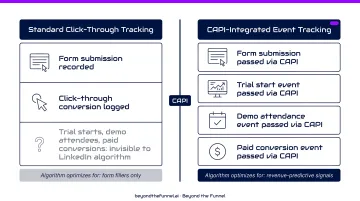
Most SaaS teams track only click-through form submissions. LinkedIn's algorithm then optimizes for form fillers — not for users who start trials, attend demos, or convert to paid. CAPI integration changes this by passing in-app behavioral events back to LinkedIn, enabling optimization toward the signals that actually predict revenue.
Budget-to-Audience Ratio
A large budget deployed against a small audience drives frequency up faster than trust can be established. LinkedIn's frequency-cap controls for brand awareness campaigns (3–30 impressions per member per seven-day period) help, but the principle applies across all campaign types.
Match budget scale to audience size. Expand the audience before dramatically increasing spend.
Common Mistakes B2B SaaS Brands Make with LinkedIn Ads
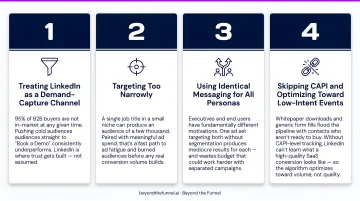
Most LinkedIn ad programs don't fail because of bad creative — they fail because of avoidable structural mistakes. Here are the four most common ones:
Treating LinkedIn as a demand-capture channel. Research from the Ehrenberg-Bass Institute and LinkedIn B2B Institute shows 95% of B2B buyers are not in-market at any given time. Campaigns that skip education and push cold audiences straight to "Book a Demo" consistently underperform. LinkedIn is where trust gets built — not assumed.
Targeting too narrowly. A single job title in a small niche can produce an audience of a few thousand. Paired with meaningful ad spend, that's a fast path to ad fatigue and burned audiences before any real conversion volume builds.
Using identical messaging for all personas. Executives and end users have fundamentally different motivations. One ad set targeting both without segmentation produces mediocre results for each — and wastes budget that could work harder with separated campaigns.
Skipping CAPI and optimizing toward low-intent events. Whitepaper downloads and generic form fills flood the pipeline with contacts who aren't ready to buy. Without CAPI-level tracking, LinkedIn can't learn what a high-quality SaaS conversion looks like — so the algorithm optimizes toward volume, not quality.
Frequently Asked Questions
How much budget does a B2B SaaS company need to run LinkedIn ads effectively?
$5,000/month is a meaningful starting point for SaaS campaigns to generate enough data to optimize effectively. Budgets in the $300–500 range produce limited signal and are especially vulnerable to ad fatigue when audience sizes are modest.
What LinkedIn ad format works best for SaaS lead generation?
Single image ads typically perform best for cold audiences due to clarity and directness. Video ads and document ads excel in retargeting and mid-funnel education stages, where prospects already have some awareness and need more context before converting.
How long does it take to see ROI from LinkedIn ads for B2B SaaS?
Early engagement signals appear around 30 days, meaningful performance trends at 60–90 days, and true pipeline influence — particularly for mid-market and enterprise deals — at 180+ days. Shorter SaaS sales cycles at lower ACV will see results faster.
Should B2B SaaS companies use LinkedIn Lead Gen Forms or landing pages?
Lead Gen Forms reduce friction and typically lower cost per lead. Landing pages tend to produce higher-intent leads who've read more before converting. The best approach is testing both and selecting the winner based on lead-to-pipeline conversion rate, not raw lead volume.
How is running LinkedIn ads for SaaS different from other B2B industries?
SaaS requires more conversion events — trial starts, activations, demo attendance, subscription upgrades — and more dynamic audience segmentation than most B2B services. The need for CAPI integration to push in-app behavioral signals back to LinkedIn is unique to software products and is what enables lifecycle-stage optimization.
What metrics should SaaS marketers prioritize when tracking LinkedIn ad performance?
Surface-level CPL is often misleading without CRM-connected attribution. Prioritize cost per trial start, cost per demo attended, pipeline influenced, and CAC by campaign. Impressions and clicks are useful for diagnosing creative issues — but they don't tell you whether campaigns are generating revenue.
Most LinkedIn ad failures for SaaS brands come down to setup, not the platform. Undersized budgets, incorrect audience logic, misaligned creative, and shallow conversion tracking all compound quickly. Beyond the Funnel, led by Joshua Stout (1 of 80 LinkedIn Certified Marketing Experts worldwide), gives SaaS brands a proven framework for moving from early testing to consistent, measurable pipeline growth.