This matters most for B2B marketers and demand gen leaders at SaaS, finance, tech, and healthcare companies running LinkedIn ads. Disconnected, single-stage campaigns burn budget on cold leads and stall pipeline before sales ever gets a real shot at closing them.
"Full-funnel" gets thrown around a lot on LinkedIn, often without a real system linking ad stages to CRM data and revenue. This article breaks down how the framework actually works stage by stage, what factors affect performance, and when a narrower approach makes more sense.
TL;DR
- Full-funnel LinkedIn strategy links TOFU, MOFU, and BOFU to sales handoff and revenue attribution, not just lead volume.
- Each stage needs its own audience temperature, content type, and budget—not one generic lead-gen push.
- Results hinge on audience quality, creative testing, tracking setup, and marketing-sales alignment.
- Skipping upper-funnel stages inflates cost-per-lead and hands sales cold, context-free names.
- Smaller budgets or missing CRM infrastructure may warrant a single-stage approach before full-funnel scale.
What Is a LinkedIn Full-Funnel Strategy (and Why It Matters for B2B)?
A LinkedIn full-funnel strategy is a structured system of connected campaigns that moves a buyer from first brand exposure through consideration to a sales-qualified, closed-won deal. Every stage feeds data into the next.
The goal is predictable, repeatable pipeline — not sporadic lead spikes with zero visibility into what actually turned into revenue. That's the core difference from single-stage lead-gen campaigns, which only chase bottom-funnel, "ready-to-buy" audiences and ignore everyone still forming an opinion about your brand.
Why This Matters More on LinkedIn Than Almost Anywhere Else
B2B buying decisions rarely involve one person clicking "request a demo" in isolation. Forrester's State of Business Buying research found the average B2B purchase now involves 13 people across two or more departments, and 86% of purchases stall somewhere in the process.
That's a long sales cycle with multiple stakeholders who each need their own path into your brand. A single bottom-funnel campaign targeting one job title misses the other 12 people in the room.
Without a full-funnel structure, the pattern is predictable:
- Cost-per-lead climbs as you exhaust the small pool of already-warm prospects
- Brand recall never builds, so buyers don't recognize you when they finally start researching
- Cold outreach lacks context, so sales reps call names with no signal on why that person engaged
How the LinkedIn Full-Funnel Strategy Works: TOFU to Closed-Won
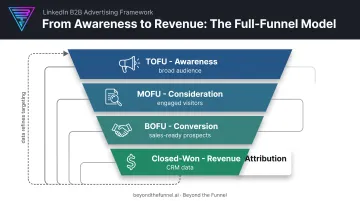
The system works end-to-end: audiences are segmented by funnel stage, content matches buyer intent at that stage, and data flows back from your CRM to refine targeting over time.
What feeds this system:
- ICP and firmographic data that defines who belongs in each audience tier
- Creative assets built specifically for each stage (not one ad recycled everywhere)
- Website and CRM signals (visits, form fills, opportunity stage) that show buyer readiness
Audience exclusions, retargeting rules, and budget shifts by stage keep spend off people who've already converted or aren't ready yet. A visitor can move from anonymous impression to MQL, SQL, and closed-won customer, with data at every checkpoint.
TOFU: Building Awareness
TOFU campaigns use broad targeting based on job title and industry — the largest audience pool in your funnel. The goal here isn't conversion. It's making sure the right people recognize your brand before they're ready to buy.
Content that works at this stage:
- Thought leadership posts from founders or executives
- Educational video content addressing industry pain points
- Industry insight and trend commentary
Metrics to track: impressions, video view rate, and engagement rate. If nobody's watching or engaging, nobody's remembering you three months from now.
MOFU: Building Consideration
MOFU targets website visitors and engagers from your TOFU campaigns with more specific, educational content. This is where you start capturing intent signals and building trust rather than just visibility.
Content that fits here:
- Gated guides addressing a specific problem
- Webinars that go deeper than a blog post can
- Case studies showing how similar companies solved the same issue
Metrics to track: content downloads, form fills, and engagement depth (time spent, pages viewed, return visits).
BOFU: Driving Conversion
BOFU campaigns use hyper-targeted retargeting or ABM lists: your smallest, most sales-ready audience segment. LinkedIn's Matched Audiences require a minimum of 300 matched members to run, so this stage depends on enough engaged prospects from TOFU and MOFU feeding it.
Content built to remove final objections:
- Product demos
- Competitor comparisons
- Customer testimonials and proof points
Metrics to track: demo requests, cost-per-lead, and conversion rate. This stage also needs tight conversion tracking — without it, you can't tell which creative or audience actually drove the result.
Closed-Won: Sales Handoff and Revenue Attribution
This is where most LinkedIn strategies fall apart. Integrating CRM and offline conversion data (including LinkedIn's own Revenue Attribution Report) lets you trace ad spend to actual closed revenue instead of stopping at "lead generated."
A defined sales follow-up cadence matters here too. Momentum from a form-fill dies fast if a rep doesn't follow up within a day or two.
The feedback loop closes when closed-won data decides which audiences, creatives, and offers earn more budget next quarter.
When Beyond the Funnel worked with health data company Evidation, this connected approach took their pipeline from a few dozen opportunities to over 100 in a single year, according to their former Head of Commercial Marketing. With transparent reporting, you can see which funnel stage is driving pipeline and which is only generating activity.
Key Factors That Affect LinkedIn Full-Funnel Performance
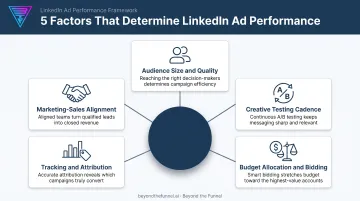
Five variables determine whether this system produces pipeline or just burns budget:
- Audience size and quality: Prospecting audiences need significant scale to sustain delivery. Retargeting works best well above the 300-member minimum; ABM lists can run smaller but usually cost more per click.
- Creative testing cadence: Run 3–5 ad variations per campaign and refresh them regularly. That stops frequency fatigue, where the same few people see your ad twenty times and tune it out.
- Budget allocation and bidding: BOFU and retargeting almost always cost more than broad TOFU pools. You're bidding on a smaller, more competitive slice of the audience.
- Tracking and attribution: Insight Tag setup and CRM integration decide whether upper-funnel impact is visible at all. No tracking means no proof TOFU spend mattered.
- Marketing-sales alignment: Forrester found companies with strong cross-functional alignment see 2.4x higher revenue growth than those without it. The system breaks down fast if sales ignores MOFU and BOFU signals.
Common Mistakes & When a Full-Funnel Approach May Not Fit
The biggest misconception: full-funnel means running more campaigns. It doesn't. It means building one connected system of audience, content, and attribution. Three disjointed campaigns with no shared data isn't full-funnel. It's just three campaigns.
Other recurring mistakes:
- Mismatched messaging by stage: A hard sales pitch to a cold TOFU audience (or a brand awareness ad to someone who already requested a demo) wastes spend and hurts brand perception.
- Chasing lead volume over pipeline quality: Forrester reports that fewer than 1% of leads ever convert to a closed deal. Optimizing for form fills alone hides whether those leads become revenue.
- Running stages in silos: Without shared audiences and retargeting across TOFU, MOFU, and BOFU, each stage starts from zero and the funnel never compounds.
Full-funnel isn't always the right starting point. Skip it, at least for now, if:
- Your budget is too limited to fund meaningful spend at each stage
- Your ICP is still undefined
- You have no CRM or attribution system in place to close the loop
In these cases, start with one focused stage (usually BOFU or MOFU) and expand once you have data.
Conclusion
A LinkedIn full-funnel strategy connects TOFU, MOFU, BOFU, and closed-won into one system instead of isolated campaigns running in parallel. Aligning those stages with sales handoff turns LinkedIn from a guessing game into a predictable B2B revenue channel.
Correct sequencing and disciplined testing matter more than checking a "full-funnel" box. Partnering with LinkedIn Certified experts like Beyond the Funnel helps validate audiences at each stage and connect ad spend to real pipeline, not just activity.
Frequently Asked Questions
What is a full-funnel strategy?
A full-funnel strategy is a marketing approach that engages buyers at every stage of their decision-making journey: awareness, consideration, and decision, rather than only targeting people who are already ready to buy.
What are TOFU, MOFU, and BOFU in LinkedIn marketing?
TOFU (top-of-funnel) targets broad audiences with brand and educational content. MOFU (middle-of-funnel) retargets engaged visitors with guides and webinars. BOFU (bottom-of-funnel) targets sales-ready prospects with demos and testimonials.
How long does it take to see results from a LinkedIn full-funnel strategy?
Awareness metrics like impressions and video views typically show up within weeks. Pipeline and closed-won impact usually take a full B2B sales cycle to materialize, which can run several months to nearly a year.
What metrics should I track at each funnel stage on LinkedIn?
Track impressions and engagement rate for TOFU, content downloads and form fills for MOFU, conversion rate and cost-per-lead for BOFU, and pipeline created plus revenue won at the closed-won stage.
How much budget should I allocate to each funnel stage?
TOFU typically needs the largest budget since it reaches the widest audience, while BOFU and retargeting need smaller but higher-CPC budgets due to audience size and competition. One campaign per stage is often enough at lower budgets.
Can small B2B companies run full-funnel campaigns on LinkedIn?
Yes, with a leaner structure: one campaign per funnel stage and disciplined tracking. Very small budgets may still benefit from starting with a single stage first before expanding into a full-funnel setup.