Many marketers still search for it, hoping to recreate the retargeting, nurturing, and full-funnel tracking it once promised. The good news: those capabilities didn't disappear. They just moved.
This guide breaks down what Lead Accelerator actually was, why LinkedIn shut it down, and exactly which tools inside Campaign Manager now do the job in 2026, often better.
Key Takeaways
- Lead Accelerator launched in 2015 via LinkedIn's Bizo acquisition and was phased out by 2016
- Its functions now live in Campaign Manager: Insight Tag, Matched Audiences, Lead Gen Forms, and Conversion Tracking
- Today's tools skip the traffic minimums and annual contracts the original product required
- Setting up equivalent retargeting today takes five clear steps, detailed below
What Was LinkedIn Lead Accelerator?
LinkedIn launched Lead Accelerator on February 19, 2015, positioning it as a full-funnel B2B marketing product. Most of its underlying technology came from Bizo, a B2B ad platform LinkedIn acquired for roughly $175 million in 2014, according to AdExchanger's coverage of the deal. Bizo had already built Multi-Channel Nurturing technology that sequenced content across email, display, and social.
How the Cookie-Drop Retargeting Worked
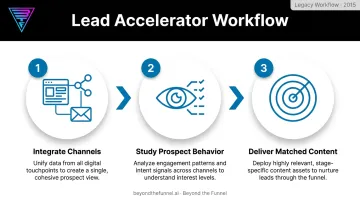
Lead Accelerator dropped a tracking cookie on website visitors, then served sequenced ads across LinkedIn itself and the LinkedIn Network Display, a group of partner business publisher sites. The workflow broke down into three connected steps:
- Integrate channels: Connect display, social, and email into one system
- Study prospect behavior: Track opens, clicks, and website visits to gauge engagement level
- Deliver matched content: Serve ads and messaging based on where each prospect sat in the funnel
Who Could Actually Use It
This wasn't built for small budgets. Advertisers reportedly needed at least 20,000 monthly website visitors or leads just to qualify, according to Business Insider's reporting on LinkedIn's ad network launch. Combined with an annual or quarterly subscription requirement, this made Lead Accelerator accessible mainly to larger B2B brands with existing traffic volume.
LinkedIn's own marketing materials named companies like eCornell and Cetera Financial Group as early customers of the platform. Neither company's original case study data is publicly available anymore, but their inclusion signaled that Lead Accelerator was aimed squarely at established B2B organizations with sizable marketing budgets, not startups testing their first campaign.
Is LinkedIn Lead Accelerator Still Available in 2026?
No. LinkedIn announced it would phase out sales of Lead Accelerator starting in early 2016. CEO Jeff Weiner explained that scaling the product required more capital and resources than LinkedIn intended to commit. As a result, the company took a $50 million write-down, per AdExchanger's report on the shutdown.
Rather than kill the underlying technology entirely, LinkedIn folded key components into Sponsored Content and, over time, into the broader Campaign Manager platform.
Here's the confusion this creates: most people searching "how to set up Lead Accelerator" aren't actually looking for a discontinued product. They're looking for retargeting and lead nurturing capabilities, which is exactly what modern Campaign Manager delivers. That's the focus for the rest of this guide.
The Modern LinkedIn Toolkit: Features That Replaced Lead Accelerator
Instead of one bundled product, LinkedIn now spreads full-funnel capability across four native features inside Campaign Manager. Here's how each one maps to what Lead Accelerator used to do:
| Lead Accelerator Function | Modern Replacement |
|---|---|
| Website cookie-drop retargeting | LinkedIn Insight Tag |
| Conversion assist / form pre-fill | Lead Gen Forms |
| Funnel reporting dashboard | Conversion Tracking & Analytics |
| Network Display off-platform reach | CRM sync + Conversions API |
Website Retargeting (Matched Audiences)
The LinkedIn Insight Tag now performs the cookie-drop function Lead Accelerator relied on. Once installed site-wide, it tracks visitors and lets advertisers build Matched Audiences segments for retargeting, according to LinkedIn's official Insight Tag product page. You can retarget anyone who visited a specific page, without needing a minimum traffic threshold.
Lead Gen Forms
Native Lead Gen Forms auto-populate a member's LinkedIn profile data, name, company, job title, contact info, directly into the form. That reduces friction the same way Lead Accelerator's old "conversion assist" feature did, but it's now built natively into the ad unit instead of bolted on separately.
Conversion Tracking & Analytics
Campaign Manager's built-in Conversion Tracking now delivers the funnel visibility Lead Accelerator's dashboard once provided. You can track post-click and post-view actions, measure cost per lead, and review engagement data by campaign, without a separate reporting layer.
CRM & Multi-Channel Integration
Modern CRM sync and the Conversions API extend nurturing beyond LinkedIn itself, echoing what Network Display accomplished with off-platform reach. Server-side events from your CRM can feed directly back into campaign optimization. Beyond the Funnel builds these integrations for clients across SaaS, finance, and healthcare, ensuring CRM data sharpens targeting instead of sitting unused.
How to Set Up LinkedIn Retargeting & Lead Nurturing Today
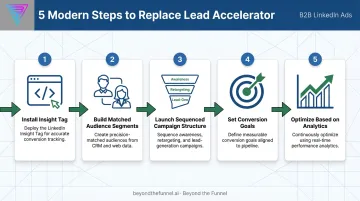
Recreating Lead Accelerator's workflow today takes five steps inside Campaign Manager. None of them require a special subscription tier.
Step 1: Install and Verify the LinkedIn Insight Tag
Add the Insight Tag's JavaScript snippet to your site's global footer so it loads on every page. Check its status under Analyze > Insight Tag in Campaign Manager. Verification can take up to 24 hours depending on your site's traffic volume.
Step 2: Build Matched Audience Segments
Create website retargeting audiences based on specific pages visitors landed on, then layer in contact-based lists uploaded from your CRM. This mirrors Lead Accelerator's old "known vs. anonymous" visitor split, letting you message each group differently.
Step 3: Launch a Sequenced Campaign Structure
Build a multi-stage flow across three ad types:
- An awareness ad for cold audiences who haven't engaged yet
- A retargeting ad for site visitors already familiar with your brand
- A Lead Gen Form ad for warm prospects ready to convert
This sequence recreates the nurture-stream logic Lead Accelerator automated years ago.
Step 4: Set Conversion Goals and Track Performance
Configure conversion events under Analyze > Conversion Tracking so you can measure leads, cost per lead, and engagement in one place. This replaces the reporting dashboard Lead Accelerator used to provide.
Step 5: Optimize Based on Funnel Analytics
Review campaign demographics and engagement reports on a weekly basis. Costs vary widely by industry, bidding strategy, and ad format, so treat any published "average" LinkedIn cost-per-lead figure with caution and benchmark against your own historical data instead.
Running this cycle weekly takes real bandwidth—exactly the ongoing optimization work Beyond the Funnel manages for clients through continuous testing and reporting.
Why Work With a LinkedIn Certified Expert Instead of Going It Alone
Setting up the individual pieces above isn't hard. Building a testing framework that actually validates which audiences convert, and which creative earns attention, is the part that took LinkedIn years to bake into Lead Accelerator in the first place.
That's where a certified expert changes the equation.
Joshua Stout, founder of Beyond the Funnel, is one of just 80 LinkedIn Certified Marketing Experts worldwide and one of only 16 in the U.S. Across more than 1,000 managed LinkedIn ad accounts, he's built full-funnel systems for B2B brands in SaaS, finance, and healthcare.
One example: Michael Arbini, former Head of Commercial Marketing at health tech company Evidation, credited Josh with helping "map out and execute a full LinkedIn strategy that took our pipeline from a few dozen to over 100 opportunities in one year."

That kind of pipeline growth doesn't happen by chance. Beyond the Funnel's approach centers on three principles:
- Audience validation over assumption — using real performance data before scaling spend
- Creative built from insights, not guesses, refined through structured testing cycles
- Transparent reporting that connects awareness, consideration, and conversion into one measurable system
If you're trying to rebuild what Lead Accelerator once promised without the multi-year learning curve, reaching out for a strategy call is a faster path than reinventing the framework solo.
Frequently Asked Questions
What was LinkedIn Lead Accelerator used for?
It was a retargeting and lead-nurturing tool that sequenced ads across LinkedIn and partner sites based on prospect behavior, such as page visits and email opens. Launched in 2015, it targeted larger B2B advertisers.
Is LinkedIn Lead Accelerator still available?
No. LinkedIn phased out sales starting in 2016 and folded the underlying technology into Sponsored Content and, eventually, Campaign Manager. It hasn't been sold as a standalone product since.
What replaced LinkedIn Lead Accelerator?
Four native Campaign Manager features cover the same ground: Insight Tag for retargeting, Matched Audiences for segmentation, Lead Gen Forms for capture, and Conversion Tracking for reporting.
How do I retarget website visitors on LinkedIn today?
Install the LinkedIn Insight Tag, confirm it's firing in Campaign Manager, then build a Matched Audience from the pages you want to retarget. No minimum traffic threshold applies.
How much does LinkedIn lead generation cost?
Cost per lead varies by industry, ad format, and bidding strategy, so there's no reliable average to quote. Track your own account's cost-per-lead trend instead of benchmarking against generic industry figures.
Do I need a minimum ad spend to use LinkedIn's lead generation features today?
No. Unlike Lead Accelerator's traffic and spend requirements, today's Campaign Manager tools, including Insight Tag, Matched Audiences, and Lead Gen Forms, are accessible to businesses of nearly any budget size.