US LinkedIn B2B display ad revenue is projected to reach $4.73 billion by end of 2025, and competition for attention is intensifying. Knowing which campaigns are actually driving pipeline is no longer optional.
This guide covers the 12 best LinkedIn Ads analytics tools for 2026, what to look for when choosing one, and how to match the right platform to your specific B2B goals.
Key Takeaways
- LinkedIn Campaign Manager tracks clicks and impressions but can't show company-level engagement, CRM pipeline, or revenue attribution
- The right tool depends on your primary gap: attribution, creative optimization, competitive benchmarking, or multi-channel reporting
- Top picks: Fibbler for B2B attribution and CRM sync, Factors.ai for multi-channel ABM, Rival IQ for competitive intelligence, Superads for creative optimization
- CRM integration depth and attribution modeling matter more than dashboard aesthetics
- Most tools offer free trials; prioritize revenue visibility over vanity metrics before committing
Why LinkedIn's Native Analytics Leave B2B Advertisers Flying Blind
LinkedIn Campaign Manager is a solid starting point. It surfaces impressions, clicks, CTR, demographic breakdowns, and cost-per-click at the campaign and creative level. That is where its usefulness ends.
Three gaps stand out immediately:
- No account-level visibility into which companies are actually seeing your ads
- No connection between ad activity and CRM pipeline or closed revenue
- No way to distinguish a decision-maker at a target account from an intern you'd never sell to
That limitation is particularly painful in B2B. According to Forrester's 2024 State of Business Buying report, the average buying decision involves 13 people, with 89% of purchases crossing two or more departments. "Someone clicked" is nearly useless information in that context. What you need to know is whether Acme Corp has seen your ads 14 times this month, which contacts are engaging, and whether they have entered your pipeline yet.
The tools below are built to close exactly that gap.
What to Look For in a LinkedIn Ads Analytics Tool
Attribution Modeling and CRM Integration
This is the most important capability for B2B teams. The three core models each tell a different story:
- Last-touch: Credits the touchpoint immediately before conversion — useful for direct response, misleading for long sales cycles
- First-touch: Credits the first interaction a buyer had with your brand
- Multi-touch: Distributes credit across every touchpoint in the journey, which is far more accurate for B2B campaigns where a buyer might see your LinkedIn ad, attend a webinar, and respond to a sales email months later
Company-level attribution takes a different approach entirely: rather than tracking individual clicks, it maps account-level engagement (impressions, clicks, content interactions) against CRM pipeline stages. For ABM and enterprise B2B, this is the data that actually informs budget decisions.
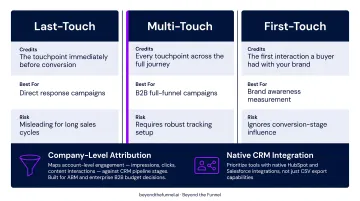
Prioritize tools with native HubSpot and Salesforce integrations — not just CSV export capabilities.
Reporting Depth and Demographic Insights
The best tools surface engagement by job title, seniority, company size, and industry — not just aggregate click counts. At Beyond the Funnel, the team uses these demographic breakdowns to validate whether LinkedIn campaigns are reaching the right decision-makers before scaling spend. Seeing that 60% of your clicks come from individual contributors when your target is VP-level means something different than seeing a 0.8% CTR in isolation.
Those same breakdowns feed into creative decisions. Cross-campaign creative analysis shows which ad formats, headlines, and visuals drive qualified engagement — not just raw clicks.
Fit for Team Size, Use Case, and Budget
Different tools serve different roles:
| Use Case | Tools to Evaluate |
|---|---|
| LinkedIn-first B2B attribution | Fibbler, Factors.ai |
| Agencies managing multiple clients | Superads, SocialPilot |
| Enterprise social media teams | Sprout Social, Oktopost |
| Competitive intelligence | Rival IQ, Socialinsider |
| Budget-conscious multi-channel teams | Zoho Analytics, Hootsuite |
Match the tool to your primary question, not to the longest feature list.
The 12 Best LinkedIn Ads Analytics Tools for 2026
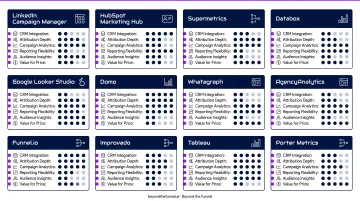
These tools were evaluated on CRM integration, attribution depth, campaign analytics, reporting flexibility, audience insights, and value for price.
| Tool | Best For | Key Strength | Starting Price |
|---|---|---|---|
| Fibbler | B2B attribution & CRM pipeline | Company-level revenue attribution | $89/mo |
| Factors.ai | Multi-channel ABM attribution | Multi-touch account journey mapping | $199/mo (Lite) |
| Superads | Agency creative optimization | AI-powered creative recommendations | $150/mo (Pro) |
| Zoho Analytics | Budget multi-channel BI | Data blending across ad + CRM sources | $30/mo |
| Hootsuite | Unified paid + organic reporting | Single dashboard across social networks | $99/mo |
| Shield Analytics | LinkedIn organic analytics | Lifetime content data for creators | $25/mo/profile |
| SocialPilot | Agency multi-client reporting | White-label PDF reporting | $30/mo |
| Rival IQ | Competitive benchmarking | Named competitor LinkedIn analysis | $239/mo |
| Socialinsider | Competitive intelligence + AI | AI content pattern analysis | $99/mo |
| Oktopost | Enterprise CRM attribution | Organic + paid pipeline attribution | Custom |
| Sprout Social | Enterprise social management | Custom reporting + BI integrations | $199/mo |
| Keyhole | Social listening + ad tracking | Real-time hashtag + brand monitoring | Custom |
1. Fibbler
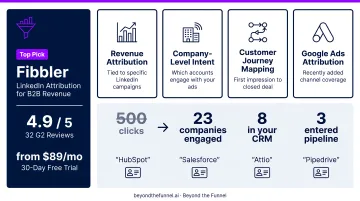
Fibbler is purpose-built for B2B teams that need to connect LinkedIn ad activity directly to revenue. It integrates natively with HubSpot, Salesforce, Attio, and Pipedrive, syncing campaign data at the company level — not just the individual click level.
Key features:
- Revenue attribution tied to specific LinkedIn campaigns
- Company-level intent signals showing which accounts are engaging
- Customer journey mapping from first impression to closed deal
- Google Ads attribution (recently added)
- 30-day free trial
What makes Fibbler stand out is the specificity of its data. Rather than showing that your campaign received 500 clicks, it shows that 23 companies engaged with your ads, 8 of them are in your CRM, and 3 entered pipeline this month. Rated 4.9/5 across 32 G2 reviews, it is the top pick for LinkedIn-first B2B teams with a serious attribution problem to solve. Pricing starts at $89/month.
2. Factors.ai
Factors.ai is a multi-channel demand generation and account identification platform built for complexity. It offers multi-touch attribution modeling, intent data integration, and account journey mapping across LinkedIn and other paid channels.
Best suited for: B2B teams running complex ABM strategies who need to understand how LinkedIn ads interact with Google, content, and email across a 90-day buying cycle.
Its LinkedIn AdPilot feature enables audience sync and view-through attribution — useful for measuring the impact of campaigns that drive awareness rather than direct conversions. The platform rates 4.5/5 across roughly 183 G2 reviews.
Fair warning: setup complexity can be a barrier for smaller teams. Pricing ranges from a free plan to $199/month (Lite) up to enterprise tiers starting at $30K/year.
3. Superads
Superads focuses on what Campaign Manager overlooks: creative performance. Its AI-driven analytics identify which ad formats, visuals, and copy combinations are driving results — and which are dragging down campaign efficiency.
Key features:
- AI-powered creative recommendations
- Budget management and forecasting
- A/B testing across campaigns
- Multi-account management for agencies
Rated 4.7/5 on G2, Superads is particularly strong for agencies managing multiple LinkedIn Ads accounts who need structured creative analysis at scale. The Pro plan starts at $150/month, with pricing scaling based on ad spend. A free version exists but has limited functionality.
4. Zoho Analytics
Zoho Analytics is a broad BI platform with a solid LinkedIn Ads connector. Its standout feature is data blending — combining LinkedIn campaign data with CRM records, sales data, and other ad channels in one environment.
Best for: Teams already embedded in the Zoho ecosystem or those running multi-channel campaigns who want cross-source reporting without building custom integrations.
The Zia AI assistant adds a conversational layer for querying data without SQL knowledge. LinkedIn-specific attribution depth is limited compared to dedicated tools, but for budget-conscious teams, the value-to-cost ratio is strong. Paid plans start at $30/month.
5. Hootsuite
Hootsuite's LinkedIn Ads module sits within its broader social management platform, offering side-by-side paid and organic reporting, customizable dashboards, and industry benchmarking across LinkedIn and other networks.
Best for: Marketing teams managing paid and organic LinkedIn activity alongside Facebook, Instagram, and X, who want one central reporting hub.
LinkedIn ad analytics depth is limited — Hootsuite is not the right choice if attribution or company-level identification is your priority. But if channel consolidation is the goal, it handles that well. Pricing starts at $99/month.
6. Shield Analytics
Important note: Shield Analytics announced it is winding down operations. If you are currently using Shield or evaluating it, verify current availability directly with the company before committing.
Shield was a LinkedIn-exclusive organic analytics platform tracking post performance, follower growth, and content history with lifetime data retention. It was purpose-built for B2B thought leaders and brands using organic LinkedIn as a demand generation channel alongside paid campaigns. Pricing started at $25/month per profile. It covered organic content only — no paid ads attribution.
7. SocialPilot
Built with agencies and SMBs in mind, SocialPilot covers LinkedIn alongside other networks with white-label PDF reporting, bulk scheduling, and multi-client management.
Best for: Agencies reporting LinkedIn performance to multiple clients on a constrained budget.
It tracks follower growth, post reach, and engagement trends, and generates exportable reports clients can receive directly. LinkedIn-specific depth lags premium tools — SocialPilot is a reporting and management solution, not an attribution platform. Pricing starts at $30/month.
8. Rival IQ
Rival IQ is the strongest competitive benchmarking tool on this list. It tracks your LinkedIn performance against named competitors, surfacing engagement rates, posting frequency, follower growth trends, and boosted post detection across platforms.
Key differentiator: You can monitor exactly how competitors are performing on LinkedIn — not just your own metrics — and spot strategic gaps in their approach before those gaps close.
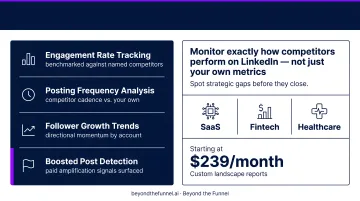
Custom landscape reports make it particularly useful for in-house teams and agencies in competitive industries like SaaS, fintech, and healthcare. Pricing starts at $239/month.
9. Socialinsider
Socialinsider covers competitive intelligence similar to Rival IQ at a more accessible price point. An added AI layer surfaces content patterns and strategic insights from competitor LinkedIn activity.
Key features:
- LinkedIn content analytics and competitor benchmarking
- AI-powered content insights and a conversational dashboard
- Cross-platform analytics including Instagram, Facebook, and TikTok
Rated 4.7/5 across 140 G2 reviews, Socialinsider is a strong mid-range option for teams that want competitive intelligence without paying Rival IQ pricing. Note that it does not cover LinkedIn Ads attribution. Pricing starts at $99/month ($83/month billed annually).
10. Oktopost
Oktopost is the only tool on this list that connects LinkedIn organic activity — not just paid ads — to CRM pipeline. That distinction matters for enterprise B2B teams where employee advocacy, social selling, and executive content are core to the demand generation strategy.
Key differentiator: Native Salesforce and HubSpot connections tie employee post engagement and social selling activity to pipeline stages — giving you a complete picture of how LinkedIn drives revenue across both paid and organic channels.
Purpose-built for enterprise B2B. Pricing is custom-quoted, reflecting its enterprise positioning.
11. Sprout Social
Sprout Social is a full-featured social media management platform with LinkedIn Ads analytics, sentiment analysis, team collaboration features, and a custom report builder that can pipe data into external BI tools.
Best for: Large enterprise teams managing many social channels who need structured collaboration workflows, approval processes, and the ability to share LinkedIn data with finance or leadership through BI integrations.
The premium pricing ($199/month starting, per seat) reflects its broad scope. If LinkedIn analytics is your primary need, Sprout's cost-to-depth ratio may not justify the investment — but for teams where LinkedIn is one of many managed channels, it consolidates effectively.
12. Keyhole
Keyhole (acquired by Muck Rack in September 2024) combines social listening, hashtag monitoring, influencer analytics, and competitor benchmarking across platforms including LinkedIn.
Best for: B2B teams running LinkedIn campaigns where brand monitoring and real-time campaign tracking matter alongside ad metrics. It's particularly useful during product launches or event campaigns, where hashtag performance and brand mention volume signal how far a campaign is actually reaching.
Pricing is custom. Given the Muck Rack acquisition, confirm current product roadmap and LinkedIn-specific capabilities directly before evaluating.
How We Selected These 12 Tools
Tools were assessed across six criteria:
- CRM integration and attribution depth — can it connect LinkedIn to pipeline and revenue?
- Campaign analytics and reporting granularity — does it go beyond impressions and clicks?
- Audience insight quality — can it surface engagement by job title, seniority, and company?
- Ease of use and onboarding — how quickly can a B2B team get actionable data?
- Pricing relative to typical LinkedIn ad budgets — is the cost proportional to the value?
- User ratings from verified platforms like G2 — what do real users say?
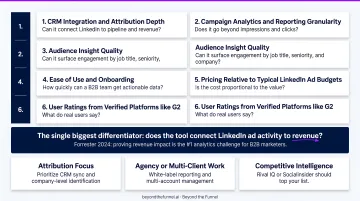
The single biggest differentiator between these tools is whether they connect LinkedIn ad activity to revenue. Forrester's 2024 B2B Marketing research found that proving revenue impact remains the top analytics challenge for B2B marketers — driven by data quality and accessibility gaps. A tool that replicates Campaign Manager data in a cleaner interface moves the needle on aesthetics, not attribution.
The right tool depends entirely on your team's biggest gap:
- Attribution focus: Prioritize CRM sync and company-level identification
- Agency or multi-client work: White-label reporting and multi-account management matter most
- Competitive intelligence: Rival IQ or Socialinsider should top your list
Conclusion
LinkedIn is too expensive a channel to fly blind on. Knowing which companies are in your pipeline — and why — is what separates campaigns that scale from ones that just spend.
Start with your primary question: is it attribution, creative optimization, or competitive benchmarking? Choose the tool that answers that question — not the platform with the most features you will never use.
If you are running LinkedIn Ads and need more than a platform — a clear framework for validating audiences, refining creative, and turning campaign data into pipeline clarity — that is exactly what Beyond the Funnel was built for.
Joshua Stout is 1 of 16 LinkedIn Certified Marketing Experts in the United States, with experience managing and optimizing over 1,000 LinkedIn ad accounts across SaaS, finance, technology, and healthcare. The team helps B2B brands move from surface-level metrics to decisions that actually scale.
Frequently Asked Questions
How do you analyze LinkedIn ads?
Start by aligning your metrics to your campaign objective — impressions and CTR for awareness campaigns, cost per lead and lead form completion for conversion campaigns. Then use demographic breakdowns to verify you are reaching the right audience, and connect ad activity to CRM pipeline to evaluate whether that activity is actually driving revenue.
What are the 3-2-1, 4-1-1, and 95-5 rules on LinkedIn?
The 4-1-1 rule recommends four educational posts, one soft promotion, and one direct sell per six posts. The 3-2-1 rule is a similar content mix (three industry posts, two curated, one promotional). The 95-5 rule from LinkedIn's B2B Institute holds that only 5% of your audience is in-market at any given time — so most impressions should build future demand, not chase immediate conversions.
Is LinkedIn Campaign Manager enough for analytics?
For basic performance monitoring — impressions, clicks, CTR, spend, and demographic breakdowns — yes. For anything more advanced (which companies are engaging, how ads connect to pipeline, how your performance compares to competitors), no. Those capabilities require third-party tools.
What metrics should I track to measure LinkedIn Ads ROI?
Go beyond CTR and CPC — track cost per lead, lead form completion rate, cost per pipeline opportunity, and revenue attributed to LinkedIn. Connecting that last metric requires CRM integration or a dedicated attribution tool like Fibbler or Factors.ai.
How do LinkedIn analytics tools integrate with CRMs like HubSpot or Salesforce?
Tools like Fibbler, Factors.ai, and Oktopost offer native CRM integrations that sync campaign and company-level engagement data directly into HubSpot or Salesforce, tying LinkedIn activity to pipeline stages automatically. No manual exports required.
What is the best LinkedIn ads analytics tool for B2B companies?
For most B2B teams focused on pipeline attribution, Fibbler is the top pick — Factors.ai works better for enterprise teams running multi-channel ABM, and Superads leads for agencies that prioritize creative optimization. The right choice depends on whether your primary gap is attribution, optimization, or competitive intelligence.