Introduction
Most B2B cold emails never get a reply. According to Woodpecker's 2025 cold email analysis, reply rates typically fall between 1% and 8.5% — and stricter studies of net-new outreach put the average even lower. At those numbers, generic templates sent at volume aren't just ineffective. They actively damage your sender reputation.
The difference between campaigns that book meetings and ones that get ignored isn't the volume of emails sent. It's the quality of targeting, personalization, and structure behind each one.
This guide covers 14 cold email templates organized by use case, the anatomy of what makes each one work, and the outreach practices that consistently generate replies.
Key Takeaways
- Cold email reply rates range from 1% to 8.5% — templates are frameworks to adapt, not scripts to copy-paste
- Emails under 125 words consistently outperform longer ones in reply and booking rates
- Short subject lines (2–7 words) drive the highest open rates across B2B datasets
- At least one follow-up raises average reply rates from 9% to 13% — 2–3 follow-ups is the supported sweet spot
- Pairing LinkedIn advertising with cold email builds the multi-touchpoint presence decision-makers need to see before they respond
What Makes a B2B Cold Email Template Actually Work
Templates vs. Frameworks
The best cold email templates are structural frameworks — they define what to include and in what order, but the actual content must be written for a specific person. Every prospect should feel the email was written for them, not blasted at a list.
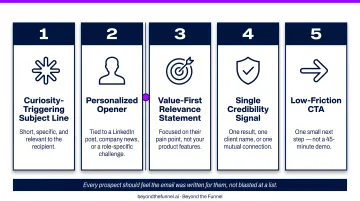
Every high-converting B2B cold email shares five structural elements:
- Curiosity-triggering subject line — short, specific, and relevant to the recipient
- Personalized opener — tied to something real: a LinkedIn post, company news, or a role-specific challenge
- Value-first relevance statement — focused on their pain point, not your product features
- Single credibility signal — one result, one client name, or one mutual connection
- Low-friction CTA — asking for one small next step, not a 45-minute demo
Personalization Depth
Swapping in a first name is mail merge, not personalization.
What actually moves reply rates is context-specific relevance: referencing a prospect's recent LinkedIn post, a funding announcement, a company hire, or a shared industry challenge. A Belkins study of 5.5 million emails found personalized subject lines achieved 46% open rates vs. 35% for non-personalized — and 7% reply rates vs. 3%. That gap widens when personalization extends into the email body.
Best sources for prospect research: LinkedIn activity, company news pages, podcast appearances, and job postings (which reveal internal priorities and pain points).
Email Length
Keep it under 125 words. Mailmeteor's analysis of 10,000+ campaigns found emails around 120 words produced a 52% booking rate — and Lemlist's data puts the same 75–125 word range at 5–15% higher reply rates than longer emails.
B2B decision-makers scan, they don't read. A concise email signals respect for their time; a long one signals a heavy ask.
Cut: product features, company history, lengthy intros, and any sentence that doesn't directly serve the prospect's interest.
ICP First
No template works if sent to the wrong audience. Before selecting any template, define:
- Industry — who specifically you're targeting
- Role and seniority — job title, decision-making authority
- Company size — revenue range or headcount
- Pain point — the specific friction they're most likely experiencing
- Buying stage — cold prospect vs. warm re-engagement
14 Cold Email Templates for B2B Lead Generation
The 14 templates below are organized into five groups based on their primary mechanism. Match the template type to the prospect's context — the right structure matters as much as the copy.
Formula-Based Templates
These use proven copywriting formulas to structure the message. Each formula is most effective in specific situations.
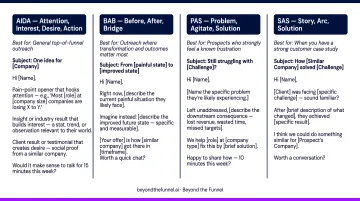
Template 1 — AIDA (Attention, Interest, Desire, Action)
Best for: General top-of-funnel outreach
Subject: One idea for [Company]
Hi [Name],
[Pain-point opener that hooks attention — e.g., "Most [role] at [company size] companies are losing X to Y."]
[Insight or industry result that builds interest — a stat, trend, or observation relevant to their world.]
[Client result or testimonial that creates desire — social proof from a similar company.]
Would it make sense to talk for 15 minutes this week?
Template 2 — BAB (Before, After, Bridge)
Best for: Outreach where transformation and outcomes matter most
Subject: From [painful state] to [improved state]
Hi [Name],
Right now, [describe the current painful situation they likely face].
Imagine instead: [describe the improved future state — specific and measurable].
[Your offer] is how [similar company] got there in [timeframe]. Worth a quick chat?
Template 3 — PAS (Problem, Agitate, Solution)
Best for: Prospects who strongly feel a known frustration
Subject: Still struggling with [Challenge]?
Hi [Name],
[Name the specific problem they're likely experiencing.]
Left unaddressed, [describe the downstream consequence — lost revenue, wasted time, missed targets].
We help [role] at [company type] fix this by [brief solution]. Happy to share how — 10 minutes this week?
Template 4 — SAS (Story, Arc, Solution)
Best for: When you have a strong customer case study
Subject: How [Similar Company] solved [Challenge]
Hi [Name],
[Client] was facing [specific challenge] — sound familiar?
After [brief description of what changed], they achieved [specific result].
I think we could do something similar for [Prospect's Company]. Worth a conversation?
Personalization & Research-Driven Templates
These three templates require genuine research — generic compliments backfire, while specific, verifiable references build instant rapport.
Template 5 — The Relevant Question
Best for: Opening with immediate value, no pitch required
Subject: Quick question about [their goal]
Hi [Name],
Working with [role] teams, the most common challenge I see is [pain point]. Are you running into this too?
A couple of things that tend to help: [Tip 1]. [Tip 2].
Happy to go deeper on any of these — would a short call be useful?
Template 6 — The Recent News
Best for: Funding rounds, awards, new hires, or press mentions
Subject: Congrats on [specific news]
Hi [Name],
Just saw [specific announcement] — congratulations. [One genuine, relevant observation about it.]
We work with [similar companies] on [relevant challenge] — often at exactly this stage of growth. Open to a quick conversation?
Template 7 — The "Love Your X"
Best for: Prospects who publish content — articles, podcasts, posts
Subject: Your [post/article] on [topic]
Hi [Name],
Read your piece on [specific topic] — [one specific, genuine observation about it, not generic praise].
It actually connects to something we've been working on with [similar company type]. Would it be useful to share what we've seen?
Best sources for this research: LinkedIn posts, company blog content, podcast appearances, and conference talks.
Social Proof Templates
Social proof reduces friction. Decision-makers are risk-averse — they use peer results as credibility shortcuts. The proof cited should come from a company similar in size and industry to the prospect for maximum relevance.
Template 8 — The "We Help Famous X"
Best for: Prospects who recognize your reference clients
Subject: How we helped [Known Client] with [Challenge]
Hi [Name],
We recently helped [Well-Known Company] achieve [specific result] — and [Prospect's Company] looks like a strong parallel.
[One sentence on why the situations are similar.]
Worth 5 minutes to see if there's a fit?
Template 9 — The Competitor Satisfaction
Best for: Prospects actively using a competing tool or provider
Subject: A quick thought on [Competitor]
Hi [Name],
[Competitor] is a solid tool — a lot of our clients used it before working with us.
Where we tend to make the biggest difference is [specific differentiator relevant to their situation]. Could be worth 5 minutes to find out.
Value-First & Nurture Templates
These are best used early in the buyer journey, when trust hasn't been established yet. They prime the prospect for a warmer second or third touchpoint.
Template 10 — The Valuable Resource
Best for: Early-stage prospects who haven't heard of you
Subject: Thought this might be useful for [Company]
Hi [Name],
Saw your [content/post/topic] — thought this [resource/guide/framework] might be relevant given where you're focused.
No ask here — just something that's helped similar teams. If it's useful and you want to explore further, I'm easy to reach.
Template 11 — The "Better Way To"
Best for: Prospects with a specific, identifiable bottleneck
Subject: A faster way to [achieve specific goal]
Hi [Name],
Most [role] at [company type] are still [describing the current friction].
[Client] cut that process from [X] to [Y] using our approach. I think we could show you something similar in a 15-minute call — interested?
Situational & Tactical Templates
These four templates address specific circumstances. Match the template to the trigger, not just the industry.
Template 12 — The "You've Been on Our Site"
*Best for: Converting warm intent signals from site visitors*
Subject: Saw you checking out [page/topic]
Hi [Name],
Noticed you visited our [specific page] — wanted to reach out in case you had questions.
[One relevant resource or case study tied to that page topic.]
Happy to walk you through anything — worth a quick call?
Keep the tone curious, not surveillance-y. Reference the content category, not behavioral tracking details.
Template 13 — The Gatekeeper Bypass
Best for: Large organizations where the right contact is unclear
Subject: Checking I've reached the right person
Hi [Name],
I've been trying to connect with the person who handles [specific function] at [Company] — I've also reached out to [colleague name/team].
If that's not you, would you be able to point me in the right direction? Appreciate any help.
Template 14 — The Follow-Up Reminder
Best for: Reactivating a stalled thread
Subject: Re: [original subject]
Hi [Name],
Wanted to follow up in case timing was off when I reached out last week.
[One new angle, data point, or option not mentioned in the original email.]
Still worth a quick conversation?
Bonus — The "Up to You"
Hi [Name],
Didn't want to leave you hanging. Here are two quick ideas for [challenge]:
- [Tip 1]
- [Tip 2]
If you'd like a third, just reply and I'll send it over. No pressure either way.
This template works because it hands control back to the prospect. Giving them a clear, low-stakes next step disarms skepticism without dropping the conversation.
Subject Lines That Improve Cold Email Open Rates
The subject line is the first filter — before your prospect reads a single word of your email, they decide whether it's worth opening.
Belkins' study of 5.5 million B2B emails found 2–4 word subject lines achieved the highest open rates at 46%. Autobound's analysis of 130M+ B2B emails supports a slightly wider range of 4–7 words. Either way, the target is the same: stay between 2–7 words (or 36–50 characters), short enough to read in a single glance.
Five Subject Line Formulas That Work
| Formula | Example | Why It Works |
|---|---|---|
| Curiosity gap | "One idea for [Company]" | Creates intrigue without revealing everything |
| Specificity | "Saw your post on [topic]" | Signals genuine research, not mass outreach |
| Value-forward | "How [Similar Co] grew pipeline by 40%" | Leads with outcome, not product |
| Pain-point direct | "Still struggling with [Challenge]?" | Speaks directly to a frustration they already feel |
| Low-friction question | "Quick question about [goal]" | Feels conversational, not sales-y |
What to Avoid
- Clickbait phrases — inflate opens, destroy trust, and tank reply rates
- Spam-trigger words — terms like "free," "guaranteed," "urgent," and "exclusive deal" damage deliverability
- Subject lines over 60 characters — they get truncated on mobile, where most emails are first seen
B2B Cold Email Best Practices to Boost Reply Rates
Timing and Follow-Up Cadence
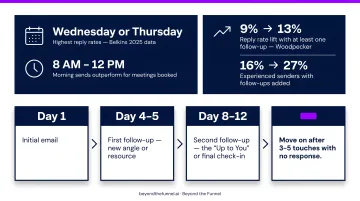
Send on Wednesday or Thursday — Belkins' 2025 data found these days produced the highest reply rates. Morning sends (8 AM–12 PM) outperform other windows in meeting booked rates.
Woodpecker's follow-up analysis found that adding at least one follow-up raised average reply rates from 9% to 13% — and for experienced senders, from 16% to 27%.
A practical cadence:
- Day 1 — Initial email
- Day 4–5 — First follow-up (new angle or resource)
- Day 8–12 — Second follow-up (the "Up to You" or final check-in)
- Move on after 3–5 touches with no response
Deliverability and Domain Hygiene
- Send from a custom company domain — shared or free domains kill deliverability
- Warm new domains over 14–21 days at low volume (20–50 emails/day) before scaling
- Set up SPF, DKIM, and DMARC — Google requires these for bulk senders of 5,000+ messages/day
- Keep bounce rates below 2% — above that threshold, sender reputation degrades
Personalization at Scale
You don't need to write fully custom emails for every prospect. You need one genuinely personalized sentence: a specific reference to something real about that person or company. Even one tailored line outperforms complete automation with zero context.
A practical approach:
- Pull a dynamic first line from prospect research (recent news, job change, shared connection)
- Let the template carry the rest of the structure
- Avoid generic openers like "I came across your profile" — they signal automation immediately
A/B Testing Discipline
Test one variable at a time:
- Subject line vs. subject line
- Opener A vs. opener B
- CTA phrasing variation
Use meaningful sample sizes (minimum 100 sends per variant) before calling a winner. Document every test and apply winning variants across the full sequence.
Compliance Basics
Cold B2B email is legal — but must follow the rules:
- CAN-SPAM (US): Use accurate headers, non-deceptive subject lines, and include an opt-out mechanism. Per the FTC's compliance guide, opt-out requests must be honored within 10 business days
- GDPR (EU): Legitimate interest may apply to B2B outreach, but requires balancing against the individual's rights — automatic qualification is not guaranteed
- PECR (UK): B2B marketing must identify the sender and provide a clear opt-out
Source prospect data legitimately. Never send to unsegmented bulk lists.
When Cold Email Alone Isn't Enough: Scaling B2B Lead Gen with LinkedIn
Cold email starts conversations. It doesn't do much beyond that.
Reply rates have declined year-over-year as inboxes get noisier. Woodpecker's platform data shows reply rates fell from 5.1% in 2024 to 3.43% — a trend projected to continue through 2026 — a trend that shows no sign of reversing. Cold email also requires constant list building, sequence management, and offers no mechanism for building brand awareness with prospects who aren't ready to reply yet.
Why LinkedIn Changes the Equation
LinkedIn advertising reaches 1 billion+ professionals with targeting precision cold email can't match — filtering by job title, company size, industry, and seniority means your message lands in front of verified buyers, not just email addresses that may no longer be accurate.
For B2B brands in SaaS, finance, technology, and healthcare — where buying cycles are long and multiple stakeholders are involved — this matters. LinkedIn's audience data updates continuously (90 new roles added every minute), while cold email lists decay the moment someone changes jobs.
That's the gap a structured LinkedIn advertising strategy fills. Beyond the Funnel pairs cold email's reach with LinkedIn's targeting precision — building brand familiarity with prospects before they're ready to respond, and validating audiences through real campaign data rather than assumptions. The Evidation result illustrates it clearly: a pipeline that grew from a few dozen to over 100 qualified opportunities in a single year through a full-funnel LinkedIn strategy built by founder Joshua Stout.
The Multichannel Approach
Top B2B teams don't choose between cold email and LinkedIn. They sequence them:
- Connect on LinkedIn before the cold email lands — prospects who recognize your brand are far more likely to reply
- Retarget email non-responders with LinkedIn ads — stay visible to buyers who weren't ready the first time
- Run Thought Leader content from founders and executives — personal posts build credibility that makes your cold outreach feel familiar, not cold
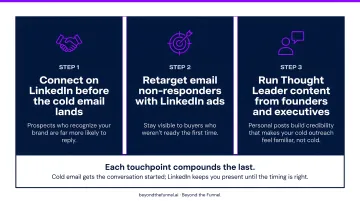
Each touchpoint compounds the last. Cold email gets the conversation started; LinkedIn keeps you present until the timing is right.
Conclusion
Cold email templates are tools, not shortcuts. Their effectiveness depends entirely on targeting precision, personalization depth, and follow-up discipline. The 14 templates in this guide give B2B sales teams a proven starting point — but sustained pipeline growth requires testing, refinement, and multi-channel execution.
For B2B teams looking to go beyond cold email, LinkedIn advertising adds a dimension outbound can't replicate: direct access to decision-makers who are already in a professional buying context, with the targeting granularity to reach the right job titles, industries, and company sizes at scale.
Talk strategy with Beyond the Funnel and find out how LinkedIn advertising fits into your B2B pipeline.
Frequently Asked Questions
What do you mean by lead generation?
Lead generation is the process of identifying and attracting potential buyers with the goal of moving them into a sales pipeline. It covers both inbound methods (content, SEO) and outbound methods like cold email and LinkedIn advertising.
Is lead generation illegal?
Lead generation is legal, but how you collect, store, and use prospect data must comply with CAN-SPAM (US), GDPR (EU), and PECR (UK). Prospects must be able to opt out, data must be sourced legitimately, and emails cannot use deceptive subject lines or headers.
Does lead generation make money?
Effective lead generation directly drives revenue by filling the sales pipeline with qualified prospects. Channels like cold email and LinkedIn advertising deliver strong ROI when backed by precise targeting and consistent follow-up.
What is a good cold email open rate for B2B?
Well-targeted B2B cold email campaigns typically see open rates between 27–44%, based on Woodpecker's platform benchmarks. Subject line quality and list hygiene are the two biggest levers — poor subject lines and outdated lists are the most common reasons rates fall below that range.
How many follow-up emails should I send in a B2B cold outreach sequence?
Two to three follow-ups after the initial email is the supported sweet spot. Woodpecker's data shows even one follow-up raises reply rates from 9% to 13%. Beyond five touches on the same thread with no response, diminishing returns set in sharply.
How is cold email different from spam?
Cold email targets specific, researched prospects with personalized, relevant messaging and a legitimate business purpose. Spam is unsolicited bulk email with no targeting, no personalization, and no compliance framework.