Introduction
B2B marketers, SaaS founders, CMOs, and growth teams are all running into the same problem: traditional LinkedIn ads aren't cutting through anymore. Decision-makers scroll past polished company banners without a second glance.
LinkedIn Thought Leader Ads (TLAs) exist precisely because of this reality. By sponsoring organic posts from real individuals — founders, executives, subject matter experts — brands can reach targeted paid audiences with content that reads like a real conversation, not an ad.
Most advertisers already know TLAs exist. The friction is execution: which content to promote, whose voice to use, how to set campaigns up correctly, and how to connect TLA spend to pipeline.
This guide breaks down what TLAs are, why they outperform other formats, the step-by-step setup sequence, and the creative disciplines that separate strong campaigns from wasted budget.
Key Takeaways
- TLAs sponsor posts from individual profiles, not company pages — making them feel native and driving higher engagement
- LinkedIn's own data shows TLAs deliver 1.7x higher CTR than standard single-image ads
- Write in first-person, open with a specific pain point, and keep CTA links at the bottom — not buried mid-post
- Run 4–6 post variants per campaign, not one
- The Engagement objective outperforms Brand Awareness for TLAs on cost-per-click
What Are LinkedIn Thought Leader Ads?
LinkedIn Thought Leader Ads are a sponsored ad format that promotes organic posts from individual LinkedIn member profiles — not company pages. Launched in 2023 and expanded in 2024, the format lets businesses amplify authentic personal voices to a paid, targeted audience — appearing in the LinkedIn feed exactly as a native post would. The 2024 expansion extended promotion eligibility beyond a company's own employees to include external creators.
Two Types of Thought Leader Ads
| Type | Who It Promotes | Label Required? |
|---|---|---|
| Employee TLAs | Posts from people within your company | No |
| Third-Party TLAs | Posts from customers, partners, or external experts | Yes, if compensated |
Third-party TLAs require explicit permission from the creator and a partnership disclosure label when the person receives compensation. Authors can revoke permission at any time — which immediately deactivates the ad.
Supported and Unsupported Content Formats
Not every post type is eligible — and this trips up a lot of advertisers during setup.
Eligible for TLA promotion:
- Text-only posts
- Single image posts
- Native video posts
- Articles and newsletters
- Posts with third-party links
Not eligible:
- Documents
- Polls
- Multi-image posts
- Reshared content
- Celebration posts
If you attempt to promote an ineligible format, Campaign Manager won't surface it during the content browsing step — which causes unnecessary delays if you don't know why.
Why LinkedIn Thought Leader Ads Outperform Other Formats
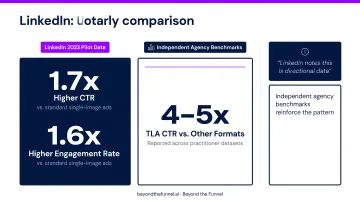
Performance data across multiple practitioner datasets consistently shows TLAs outperforming standard LinkedIn ad formats. LinkedIn's 2023 pilot data showed 1.7x higher CTR and 1.6x higher engagement rate versus standard single-image ads. LinkedIn notes this is directional data, but independent agency benchmarks reinforce the pattern — with some practitioners reporting TLA CTRs of 4–5x compared to other formats.
The Trust Dynamic
The underlying reason is straightforward. The 2024 Edelman-LinkedIn B2B Thought Leadership Impact Report found that 73% of B2B decision-makers consider thought leadership a more trustworthy basis for assessing a vendor's capabilities than standard marketing materials or product sheets.
B2B buyers engage with people, not logos. When a founder or executive shows up in someone's feed with something useful to say, engagement rates reflect it — which is exactly why the format's native appearance matters as much as the message itself.
Why TLAs Don't Look Like Ads
The only visible difference between a TLA and an organic post is a small "Promoted" label. There's no branded header, no company logo dominating the creative, no obvious ad structure. That native appearance sidesteps the ad blindness that undermines most sponsored content — users scroll past polished ad formats on instinct, but a real person's post stops them.
Intent Signals Beyond the Click
When target accounts engage with TLAs — clicks, comments, reactions — those interactions surface buying intent at the account level. LinkedIn Campaign Manager's Companies tab lets you see which organizations are engaging, not just anonymous individual clicks. That data is useful for triggering warm outbound sequences. A contact who clicked on your CEO's post about a specific pain point is a warmer conversation than a cold list pull.
When TLAs Are the Right Fit
TLAs work best for:
- Building trust with mid-funnel ICP audiences
- Nurturing decision-makers through longer sales cycles
- Converting high-intent prospects in tightly defined segments
They're misused when:
- Boosting generic company messaging through an individual's name
- Running against audiences too broad to sustain meaningful frequency
- Treating them as a mass awareness tool rather than a precision trust-builder
Used with the right audience and genuine content, TLAs close the gap between paid reach and earned trust — which is what makes them worth the strategic investment.
How to Set Up LinkedIn Thought Leader Ads Step by Step
Setting up TLAs correctly follows a defined sequence in LinkedIn Campaign Manager. Skipping steps — particularly around objective selection and permission requests — leads to preventable performance problems.
Select Your Campaign Objective
TLAs are only compatible with three objectives:
- Brand Awareness
- Engagement (recommended for most TLA campaigns)
- Video Views (for video-format TLAs)
The Engagement objective typically delivers lower cost-per-click to landing pages than Brand Awareness. For most B2B campaigns where the goal is driving content interaction and downstream traffic, Engagement is the right default.
Choose Your Ad Format and Browse Content
- Select Single Image Ad or Video Ad as your format
- Use the "Browse existing content" function to search posts by LinkedIn member name
- You can promote posts from employees, or from 1st, 2nd, and 3rd-degree+ connections (broader connections via LinkedIn's Creator Marketplace)
Request and Manage Permissions
- Send a sponsorship request through Campaign Manager
- The author receives a notification to approve or reject
- Authors can enable auto-approval or review each request individually
- Critical risk: Authors can revoke permission at any time, which immediately deactivates the ad with no grace period
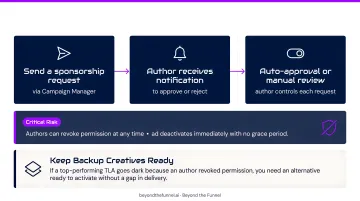
Keep backup creatives ready. If a top-performing TLA goes dark because an author revoked permission, you need an alternative ready to activate without a gap in delivery.
Configure Audience Targeting
Use LinkedIn's B2B targeting to define a tight ICP segment:
- Job title or function
- Seniority level
- Company size
- Industry
Match budget to audience size. A $500/month budget spread across a 500,000-person audience means nearly no one sees the ad with enough frequency to build any recognition. Tighter audiences with focused budget allocation consistently produce better cost-per-outcome.
Set Budget and Launch
LinkedIn doesn't publish an official TLA budget minimum, but based on experience across 1,000+ managed accounts, $5,000+ per month is the practical floor for a multi-stage LinkedIn funnel to generate meaningful data. Smaller budgets work but require longer ramp-up periods before drawing conclusions.
Run 4–6 post variants per campaign — not one. Multiple variants allow comparison across angles and offers, and provide a richer nurturing experience for accounts that see the campaign more than once.
Monitor Performance and Engagement
Track results in Campaign Manager, with particular attention to:
- CTR to gauge creative-audience fit early in a campaign
- The Companies tab to identify which accounts are engaging at scale
- Downstream pipeline — the metric that actually validates campaign value
CTR alone doesn't prove business impact. Connect Campaign Manager engagement data to your CRM or attribution workflow so account-level interactions can be traced back to real pipeline conversations.
Creative Best Practices for High-Performing Thought Leader Ads
The Anatomy of a Strong TLA Post
Top-performing TLA posts follow a recognizable structure:
- Hook (50–100 characters) — a specific, relatable pain point, not a generic opener
- Personal backstory — brief context that establishes why the author understands the problem
- Problem detail — one or two sentences that deepen the pain point
- Solution framing — what changed, what worked, what the insight is
- Social proof — a concrete metric or outcome, not a vague claim
- CTA with link — placed at the bottom, never mid-post
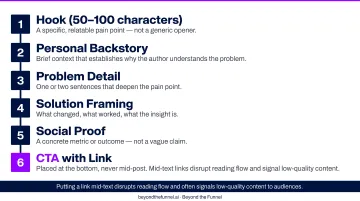
Putting a link mid-text disrupts reading flow and often signals low-quality content to audiences.
Voice and Length
- Write in first-person ("I") throughout
- Target 1,000–1,500 characters — long enough to develop a point, short enough to hold attention
- Read like a human sharing an experience, not a brand announcement
What underperforms: corporate "we" voice, vague social proof ("we helped our clients grow"), generic statements that could apply to any company.
Who Should Deliver the Message
Prioritize founders, senior executives, or subject matter experts who:
- Have an active LinkedIn presence
- Post content that aligns with what your ideal customer profile (ICP) actually cares about
- Carry genuine credibility in their field
The credibility of the voice matters as much as the quality of the copy. A well-written post from a low-credibility profile will underperform the same content from someone your ICP recognizes and respects.
Test Organically Before Spending
Before committing ad budget, post concepts organically to validate resonance. But organic reach alone doesn't qualify a post for TLA promotion. Viral posts often spread through relatability or entertainment — TLAs need to directly address audience pain points and drive a specific next step.
What to Avoid
- Skip hashtags — audience targeting handles definition; hashtags add clutter
- Avoid AI-generated copy — readers detect it, and it kills the authenticity TLAs depend on
- Drop webinar CTAs — they consistently underperform compared to specific resource offers or demo requests
- Resist polished visuals — overproduced imagery breaks the native feel that drives TLA performance
Common Mistakes That Kill TLA Performance
Running a Single Post Variant
One post per campaign gives you no comparison data, no multi-angle nurturing, and no fallback if the creative underperforms. Run 4–6 variants with different hooks, angles, or offers. This is the single most correctable structural error in most first-time TLA campaigns.
Budget Dilution Across Too Large an Audience
Spreading a small budget across a large audience means individual target accounts see the ad too infrequently to build any familiarity. Frequency matters for trust. Concentrate budget on a tighter, well-defined audience rather than chasing scale with insufficient spend.
Measuring Only CTR
Teams that can't prove TLAs influenced pipeline often lose budget to bottom-funnel channels with more obvious attribution. CTR is directional — it tells you whether creative is resonating, not whether TLAs are generating business value.
To build a defensible case for TLA investment:
- Open LinkedIn's Companies tab to identify which target accounts are actively engaging
- Cross-reference those accounts against open CRM pipeline conversations
- Present account-level engagement alongside downstream pipeline data to internal stakeholders
Account engagement plus pipeline correlation is what transforms TLA reporting from a vanity metric exercise into a budget-justifying business case.
Campaign Structure and Budget for LinkedIn Thought Leader Ads
A three-tier structure maps TLAs to funnel stage and gives each campaign a distinct purpose:
| Tier | Audience | Goal | Creative Approach |
|---|---|---|---|
| Prospecting | Cold ICP segments | Build retargeting pools | Educational, no hard CTA |
| Nurture | Mid-funnel, prior engagers | Build credibility | Insight-driven, founder voice |
| Convert | TLA engagers, retargeting | Drive direct response | Specific offer, clear CTA |
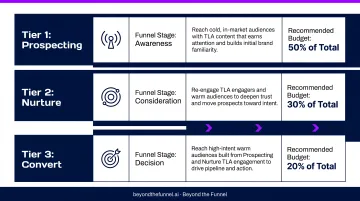
At Beyond the Funnel, this full-funnel structure is the foundation of every LinkedIn ad program — each tier feeds the next, and TLA engagement from Prospecting and Nurture stages creates the warm audiences that Convert campaigns can reach efficiently.
Budget and Scaling
Concentrate budget on well-defined audiences rather than spreading thin across broad segments. A meaningful full-funnel program typically starts at $5,000/month — smaller budgets can work, but require longer testing timelines.
Once a TLA shows consistent performance, scale deliberately:
- Expand reach by increasing budget or broadening the audience slightly
- Don't change creative that's working — introduce new variants in parallel
- Use strong CTR, engaged accounts, and downstream pipeline signals as your scaling triggers
Conclusion
LinkedIn Thought Leader Ads aren't complicated, but they do require discipline. Authentic voice, the right setup sequence, and a full-funnel structure are what determine whether a campaign builds real pipeline or just fills a reporting deck.
Treat TLAs as a long-term trust channel. The accounts you're reaching in January won't all convert by February — consistent, credible presence from real individuals builds the familiarity that makes conversion ads more effective downstream.
If you want to move faster than trial-and-error allows, working with a LinkedIn Certified Marketing Expert shortens the learning curve considerably. Beyond the Funnel, led by Joshua Stout — one of 80 LinkedIn Certified Marketing Experts worldwide and 1 of 16 in the U.S. — builds full-funnel LinkedIn programs for B2B brands that need predictable, data-driven results. Reach out here to start with a strategy discussion.
Frequently Asked Questions
What are LinkedIn Thought Leader Ads?
LinkedIn Thought Leader Ads sponsor organic posts from individual LinkedIn member profiles — not company pages — and distribute them to a targeted paid audience. Unlike standard sponsored content, TLAs appear as native feed posts from real people, with only a small "Promoted" label distinguishing them from organic content.
Are LinkedIn Thought Leader Ads worth it?
For B2B brands, yes — when set up correctly. LinkedIn's own data shows TLAs deliver 1.7x higher CTR than standard single-image ads, and independent benchmarks consistently show lower CPCs relative to other formats. The investment pays off when targeting is tight and the post addresses a real challenge your audience is actively trying to solve.
How much do LinkedIn Thought Leader Ads cost?
There's no single industry median. Practitioner benchmarks range from roughly $0.51 to $4.14 CPC depending on audience, objective, and creative quality. Plan for at least $5,000/month to collect meaningful data — smaller budgets can work but require longer ramp-up timelines.
Should I use Brand Awareness or Engagement objective for LinkedIn Thought Leader Ads?
Use the Engagement objective for most TLA campaigns. It consistently delivers lower cost-per-click to landing pages compared to Brand Awareness, making it the better option for driving content interaction and downstream traffic.
What content formats can be used for LinkedIn Thought Leader Ads?
Eligible formats include text-only posts, single image posts, native video, articles, and newsletters. Documents, polls, multi-image posts, reshared content, and celebration posts are not eligible — check format eligibility before building your campaign to avoid setup delays.
What is the difference between employee and third-party Thought Leader Ads?
Employee TLAs promote posts from people within your company and require no partnership label. Third-party TLAs promote posts from customers, partners, or external experts — these require explicit permission from the creator and a brand partnership disclosure label if the person is compensated for the promotion.