Introduction
Most LinkedIn ABM campaigns don't fail because LinkedIn is the wrong platform. They fail because the strategy running on it is broken.
LinkedIn's professional audience is uniquely built for reaching high-value accounts — yet campaigns routinely miss the mark. After auditing hundreds of underperforming accounts, the pattern is consistent: most companies don't have a LinkedIn Ads problem, they have a structure problem.
Campaigns target too broadly, sales and marketing aren't working from the same definition of success, and budget gets spread too thin across too many untested assumptions.
This guide covers how to fix that — drawing on insights from managing over 1,000 LinkedIn ad accounts. You'll find a practical framework covering:
- Building a target account list
- Structuring campaigns by funnel stage
- Choosing the right ad formats
- Aligning sales and marketing around shared KPIs
- Measuring what actually drives pipeline
Key Takeaways
- LinkedIn ABM targets specific accounts by company name, job title, and seniority — not broad demographics
- A strong ICP built from CRM win/loss data is the foundation before any campaign launches
- The "1-to-few" approach balances personalization with LinkedIn's 300-member audience minimum
- Sales and marketing must share a definition of qualified intent — not just lead volume
- Holdout testing is the most reliable way to prove ABM is actually driving pipeline
What Makes LinkedIn the Right Platform for ABM?
No other major advertising platform lets you target by company name, job title, seniority level, and industry simultaneously. On most platforms, B2B targeting is approximated — you infer professional attributes from demographics or interest signals. On LinkedIn, you reach the actual decision-maker at the actual company on your target list.
LinkedIn has more than 1 billion members across 200+ countries, and 89% of B2B marketers use it for lead generation — with 62% reporting it produces leads effectively. That concentration of professional intent is what makes it structurally different from other channels.
Why Precision Matters More Than Scale
The math on broad B2B campaigns is unforgiving: 95% of B2B buyers are not in-market at any given time. Only 5% are actively evaluating solutions in any given window. Campaigns that cast a wide net spend most of their budget reaching people with no near-term reason to buy.
ABM on LinkedIn concentrates spend on the accounts most likely to convert. That means:
- Companies that match your ICP, not just demographic proxies
- Roles that actually sign contracts, not just anyone with a business email
- Engagement signals that indicate real buying intent, not passive scrolling
- Measurable pipeline from a defined account universe, not lead volume metrics
For B2B companies with longer sales cycles and higher deal values, that precision is where campaigns stop burning budget and start building revenue.
Building Your Ideal Customer Profile and Target Account List
Effective LinkedIn ABM starts before any campaign is launched. The most common mistake is building campaigns before building an ICP — and then wondering why the targeting doesn't convert.
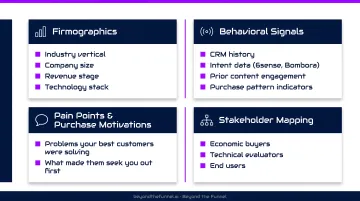
A strong ICP has four dimensions:
- Firmographics — industry vertical, company size, revenue stage, technology stack
- Behavioral signals — CRM history, intent data from tools like 6sense or Bombora, prior engagement with your content
- Pain points and purchase motivations — the specific problems your best customers were trying to solve when they first found you
- Stakeholder mapping — who's involved in the buying decision, including economic buyers, technical evaluators, and end users
Turning Your ICP Into an Account List
Start with your existing customers — specifically, the ones who generate the most revenue, renew consistently, and expand over time. Look for patterns: what industries do they cluster in? What size companies? What titles were involved in the original sale?
A CRM win/loss analysis is the most practical starting point for most B2B teams. Run it like this:
- Pull closed-won deals from the last 12–18 months and identify shared patterns
- Repeat the exercise for closed-lost deals — who didn't buy is often as instructive as who did
- Cross-reference both sets against firmographic and behavioral data to surface the clearest signals
According to the 2025 ABM Benchmark Survey by Demand Gen Report, 58% of organizations now use behavioral or intent signals to formulate their account lists — and 46% use dedicated intent monitoring tools. Starting with firmographics alone leaves a meaningful signal gap.
Segmentation Approaches That Work on LinkedIn
Three segmentation approaches work well for LinkedIn ABM:
- Vertical segmentation — group accounts by industry. Clean, manageable, and easy to match messaging to specific pain points.
- Regional + vertical — adds a geographic layer. Useful when territories differ or regional buying patterns affect your messaging.
- Intent-based segmentation — uses third-party data from platforms like Bombora or 6sense to identify accounts showing in-market signals. Highest precision, but requires additional tooling and data hygiene.
The practical advice: start with vertical segmentation. One vertical, one messaging angle, one test. Add complexity after you've validated the approach.
LinkedIn's technical minimum: You need at least 300 matched audience members to activate a campaign. Overly narrow account lists don't just limit reach — they slow data accumulation and make optimization decisions unreliable.
For list-building mechanics, LinkedIn supports CSV uploads of target companies or contacts, CRM integrations with HubSpot and Salesforce, and direct connections to intent platforms. Company list uploads (rather than contact lists) tend to be more scalable — LinkedIn matches at the organization level, which handles personnel changes and title variations automatically.
Structuring Your LinkedIn ABM Campaign
Mapping Campaigns to Funnel Stages
Rather than running one campaign at all target accounts, structure campaigns around where accounts are in their buying journey:
| Stage | Definition | Campaign Goal |
|---|---|---|
| Identified | All target accounts on your list | Establish baseline reach |
| Aware | Accounts reached by at least one ad impression | Build familiarity |
| Interested/Engaged | Accounts that clicked or engaged | Deepen relevance |
| Considering | Accounts that took a high-intent action (demo request, pricing page) | Drive commitment |
| Selecting | Accounts with open deals | Support sales conversations |
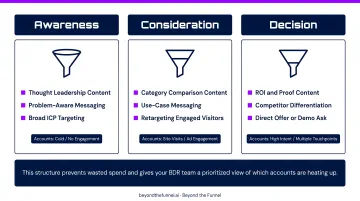
This structure prevents wasted spend and gives your BDR team a prioritized view of which accounts are heating up.
The 1-to-Few Sweet Spot
Three ABM targeting tiers exist in theory:
- 1-to-1: Individually tailored campaigns for individual accounts. The problem on LinkedIn? You almost certainly can't hit the 300-member minimum for a single company, and you won't accumulate meaningful data.
- 1-to-many: Broad segments that technically qualify as ABM but functionally behave like demand generation. Messaging becomes too generic to move specific accounts.
- 1-to-few: Small clusters of like-minded accounts grouped by industry, use case, or shared challenge. It's specific enough to resonate with a defined audience, yet large enough to generate statistically useful data.
With 1-to-few, you write messaging that speaks to a specific vertical's problems without needing to create individual assets per account. A SaaS company targeting mid-market manufacturing CFOs gets different creative than the same company targeting enterprise retail operations leaders.
The Budget Math Most Marketers Skip
Campaigns with too many ads and too little budget per ad produce no usable optimization data. Here's a simplified version of the math:
Example: $10,000/month budget
- Daily budget: $10,000 ÷ 30 = ~$333/day
- If average CPC is ~$10 (based on HockeyStack's 2025 B2B SaaS benchmark of $10.48 CPC across 70+ companies), that's roughly 33 clicks per day across all active ads
- To generate 3–5 clicks per ad per day (enough to start seeing patterns), you can realistically run 6–10 ads total
Running 20 ads on that same budget means each ad generates fewer than 2 clicks per day. You'd need months to make meaningful creative decisions. Keep your active ad count proportional to your budget.
Moving Accounts Between Stages Dynamically
As accounts hit engagement thresholds — for example, 5 or more ad clicks within a campaign window — remove them from awareness campaigns and enroll them in consideration-stage campaigns with more product-specific messaging. This ensures buyers at each stage see content matched to where they actually are in the decision process — not where you assumed they'd be.
This can be partially automated through CRM-LinkedIn integrations, though it requires clear rules for what constitutes a stage transition and someone owning that process.
The cleaner your stage definitions and transition rules, the faster you can act on account signals rather than letting warm prospects stagnate in the wrong campaign.
Ad Formats and Content Mix for LinkedIn ABM
Choosing the Right Format by Stage
| Format | Best Use | Notes |
|---|---|---|
| Single Image Ads | Direct traffic to landing pages | Most reliable for CTR; lowest CPC in practice |
| Thought Leader Ads | Awareness and credibility building | CTR can be inflated by profile clicks, not landing page visits — track destination clicks separately |
| Video Ads | Awareness-stage storytelling | Strong for brand familiarity; conversion attribution is harder |
| Carousel Ads | Multiple use cases or features | Good for showcasing a product across several angles |
| Sponsored Messaging | Warm accounts at consideration stage | Higher cost per conversion — use selectively, not as a default |
Matching Content to Campaign Stage
- Awareness: Third-party reports, industry insights, perspective pieces — educate without promoting
- Interest: Case studies, persona-specific challenges, vertical-focused content
- Consideration: Demos, ROI calculators, competitive comparisons, direct offers
The most common creative failure in LinkedIn ABM is running product-heavy messaging at the awareness stage. Accounts that don't know you yet aren't ready to evaluate your features. Lead with education first — your product story earns attention only after you've established relevance.
The Content Mix Rules: 5-3-2, 3-2-1, and 4-1-1
Three frameworks help maintain a non-promotional content balance across a campaign:
- 5-3-2 rule: For every 10 pieces, 5 are curated third-party content, 3 are original branded content, 2 are personal or humanizing content
- 3-2-1 rule: 3 educational pieces, 2 soft promotional pieces, 1 direct call-to-action
- 4-1-1 rule (attributed to Tippingpoint Labs and Joe Pulizzi, not LinkedIn): 4 educational or entertaining pieces, 1 soft promotion, 1 hard promotional piece
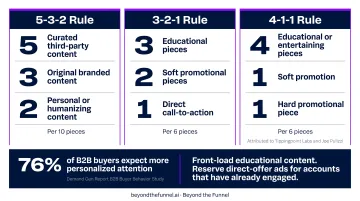
These frameworks originated for organic content strategy but they inform how paid ad creative should be weighted across a campaign. In a LinkedIn ABM context, that means front-loading educational content in your campaign mix and reserving direct-offer ads for accounts that have already engaged with earlier touchpoints.
Content weighting only matters if the content itself is relevant to the segment. Personalization here doesn't mean inserting a prospect's name into an ad — it means writing copy that speaks to the specific competitive pressures, use cases, and pain points of the accounts you're targeting.
According to Demand Gen Report's B2B Buyer Behavior Study, 76% of buyers expect more personalized attention from marketers. Generic messaging is the fastest way to get ignored in a crowded LinkedIn feed.
Aligning Sales and Marketing Around ABM
43% of ABM practitioners cite sales and marketing alignment as a major challenge, according to the 2025 DGR ABM Benchmark Survey. Forrester puts that broader misalignment figure at 65% of sales and marketing professionals. When two teams disagree on who to target, when to hand off, and what counts as success, ABM falls apart before a single ad runs.
What Alignment Actually Requires
Both teams need to agree on three things before a campaign launches:
- What constitutes a high-value account — specific ICP criteria, not vague descriptions
- What "qualified intent" looks like — concrete engagement thresholds that trigger BDR outreach
- What KPIs both teams are accountable for — pipeline influenced and closed-won revenue, not just MQL volume
The Bi-Weekly Feedback Loop
Alignment isn't a one-time conversation — it requires a recurring cadence. Bi-weekly reviews between sales and marketing should cover:
- Which target accounts are engaging and what content is resonating
- Where accounts are dropping off or going cold
- What objections the sales team is hearing that should inform ad messaging
Sales insights about why deals stall are some of the most valuable inputs for improving creative. If reps are consistently hearing "we're not ready to switch providers," your awareness-stage ads should address switching costs and risk reduction — not product features.
Intent Scoring as the Handoff Mechanism
Rather than handing off accounts arbitrarily, assign weighted scores to engagement signals:
- Passive signals (low weight): Ad impression, social media engagement, email open
- Active signals (medium weight): Content download, webinar attendance, ad click
- High-intent signals (high weight): Pricing page visit, demo request, case study download
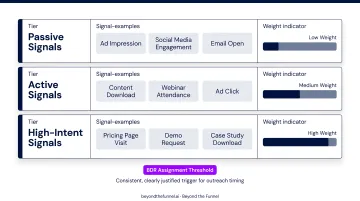
Define the threshold score that triggers a BDR assignment. This creates a consistent, clearly justified process for outreach timing and removes the friction of marketing calling an account "warm" while sales disagrees.
Measuring LinkedIn ABM Performance and Avoiding Common Pitfalls
Leading vs. Lagging Metrics
Leading metrics (early indicators of campaign health):
- Ad impressions among target accounts
- CTR relative to benchmark (HockeyStack's 2025 B2B SaaS data reports 0.82% average CTR — useful context, though results vary by industry and audience)
- Number of accounts moving from Aware to Interested per week
- Engagement rate by account segment
Lagging metrics (outcome indicators):
- Pipeline generated from target accounts
- Closed-won revenue influenced by ABM campaigns
- Pipeline per dollar spent
The shift from MQL-based reporting to pipeline-influenced reporting is often the hardest organizational change in ABM. It requires trust between sales and marketing — and patience, since lagging metrics take months to materialize.
The Holdout Test Methodology
The most rigorous way to prove ABM is working: split your target account list 50/50. Show ads to one group, withhold from the other, and compare pipeline generation and close rates over 3–4 months.
This removes attribution ambiguity. Instead of claiming an account closed because of your LinkedIn ads, you measure actual incremental impact: how much more likely accounts are to move through the funnel when exposed to your ABM campaign versus those who weren't.
Four Mistakes That Kill LinkedIn ABM Campaigns
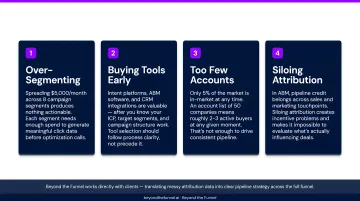
Over-segmenting with too little budget per segment — Each ad needs enough spend to generate meaningful click data before you make optimization calls. Spreading $5,000/month across 8 campaign segments produces nothing actionable.
Buying tools before validating strategy — Intent platforms, ABM software, and CRM integrations are valuable — after you know your ICP, target segments, and campaign structure work. Tool selection should follow process clarity, not precede it.
Targeting too few accounts — Given that only 5% of the market is in-market at any time, an account list of 50 companies means roughly 2–3 active buyers at any given moment. That's not enough to drive consistent pipeline.
Treating attribution as a marketing-only metric — In ABM, pipeline credit belongs across sales and marketing touchpoints. Siloing attribution creates incentive problems and makes it impossible to evaluate what's actually influencing deals.
Interpreting campaign data accurately and restructuring campaigns around these principles is where many B2B teams stall. Beyond the Funnel works directly with clients on exactly this — translating messy attribution data into clear pipeline strategy across the full funnel.
Frequently Asked Questions
What is account-based marketing on LinkedIn?
LinkedIn ABM is a B2B strategy where marketers target specific high-value companies — rather than broad audiences — using LinkedIn's precise targeting tools. By reaching decision-makers directly by company name, job title, and seniority, teams deliver personalized campaigns to the accounts most likely to convert into pipeline.
What are the 5-3-2, 3-2-1, and 4-1-1 content mix rules for LinkedIn ABM?
Each framework defines the right balance of promotional vs. educational content. The 5-3-2 rule mixes 5 curated, 3 original, and 2 personal posts per 10. The 3-2-1 rule is 3 educational, 2 soft promotional, 1 direct CTA. The 4-1-1 rule is 4 educational, 1 soft promotion, 1 direct offer — all built to earn trust before asking for action.
What ad formats work best for LinkedIn ABM campaigns?
Single Image Ads are the most reliable for driving landing page traffic at the lowest CPC. Thought Leader Ads work well for credibility-building at the awareness stage — track destination clicks separately to measure true engagement. The right format depends on campaign stage — awareness calls for different creative than consideration.
How do you build a target account list for LinkedIn ABM?
Start with your best existing customers, identify the firmographic patterns, and build outward. Upload the resulting company list to LinkedIn Campaign Manager — you need a minimum of 300 matched members to activate any campaign. CRM win/loss analysis is the most practical starting point for defining those patterns.
How do you measure the success of a LinkedIn ABM campaign?
Track leading metrics — account movement through funnel stages, CTR, and engagement rates — as early indicators. Lagging metrics — pipeline generated, closed-won revenue, and pipeline per dollar spent — are the real outcomes. Run a holdout test (50/50 split, 3–4 months) to isolate true campaign impact from other revenue activities.