But growth comes with a price. Competition in the auction is fiercer, costs are climbing, and the old playbook of "boost a post and hope" doesn't cut it anymore. B2B brands that don't understand where LinkedIn is headed risk overspending on tactics that already feel outdated.
This article breaks down the five trends defining LinkedIn Ads in 2026, what's driving them, how they're changing the way marketing teams operate, and what to watch for next.
Key Takeaways
- AI-assisted campaigns like Accelerate are cutting setup time, but strategists still need to override defaults for precision targeting
- Video and Connected TV are becoming the default way to reach professional audiences beyond the feed
- Buying-committee targeting is replacing single decision-maker campaigns as B2B deals involve more stakeholders
- Authentic, creator-style ad formats are outperforming polished, brand-first creative
- First-party data is now essential as third-party tracking keeps eroding
Key LinkedIn Ads Trends to Watch in 2026
LinkedIn's ad platform is evolving faster than most in-house teams can track. These five shifts will separate the brands that grow efficiently from the ones stuck overpaying for underperforming campaigns.
Trend 1: AI-Powered Campaign Management with Accelerate
LinkedIn's AI-powered campaign tool automatically generates targeting, creative, and bidding recommendations based on a campaign's objective. Instead of building every setting manually, advertisers get a starting framework in minutes.
LinkedIn's own reported early results show why adoption is climbing:
- 15% more efficient campaign creation compared to manual setup
- 52% lower cost per action compared to Classic campaigns
These figures come from LinkedIn's own platform announcement, not independent third-party testing, so treat them as directional rather than universal.
In practice, lean marketing teams and first-time LinkedIn advertisers increasingly default to this AI-driven setup before graduating to more manual, precision-controlled campaigns for retargeting and account-based work.
Here's the catch: automation lowers the barrier to entry, but it also raises the stakes for knowing when the AI's defaults are wrong. A strategist who understands LinkedIn's auction dynamics can spot an overly broad audience or a bidding strategy that's burning budget. A first-time advertiser running on autopilot might miss those signals entirely.
Trend 2: Video and Connected TV Ads Take Center Stage
Attention in the LinkedIn feed is harder to win than it used to be. Static image ads blend into a busy scroll, and richer storytelling formats are winning the share of voice that used to go to text posts.
Paid video on LinkedIn has grown substantially year over year. Connected TV ads moved from a 2024 beta to general availability across the US and Canada by mid-2025, and now let brands reach professionals while they're streaming, not just scrolling.
Real advertiser results are starting to back this up:
- Salesforce reported 4x as many on-target impressions compared to linear TV
- ServiceNow saw a 19% awareness lift among large-company audiences
- ServiceNow also reported a 45% improvement in lead-submission rates
CTV also opens up publisher partnerships with Paramount, Roku, Samsung Ads, and NBCUniversal, meaning B2B ads can now show up during a prospect's evening Peacock binge, not just their lunchtime LinkedIn scroll.
Trend 3: Full-Funnel Targeting of the Entire Buying Committee
The single decision-maker model is dying. Forrester's 2026 research on business buying finds that a typical purchase now involves 13 internal stakeholders and nine external influencers. That's not a small committee. It's practically a boardroom.
LinkedIn's native targeting and Matched Audiences make it possible to reach that whole group without leaving the platform. Instead of one campaign aimed at a VP, smart advertisers now build layered sequences:
- Awareness stage - thought leadership content reaches the full buying group, from practitioners to the C-suite
- Consideration stage - retargeting ads follow engaged viewers with sharper, role-specific messaging
- Conversion stage - lead form ads convert warmed audiences who've already seen two or three touchpoints
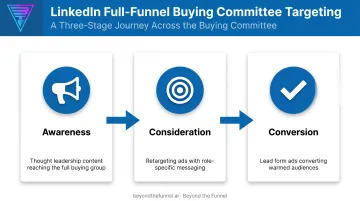
This sequencing replaces the old one-shot lead gen campaign, where a single ad tried to do everything at once.
At Beyond the Funnel, this full-funnel structure, paired with audience validation before scaling spend, is the backbone of how clients move from scattered impressions to a real, trackable pipeline. One client, Evidation, saw its opportunity pipeline grow from a few dozen to over 100 in a single year using this exact approach.
Trend 4: Authentic, Creator-Style Formats Outperform Polished Brand Ads
Studio-produced, brand-first creative is losing ground to something that looks less like an ad and more like a LinkedIn post. Thought Leader Ads let brands boost genuine posts from employees or executives, and Document Ads turn a simple PDF or slide deck into an in-feed, swipeable asset.
Edelman's CEO thought leadership program is a useful reference point here: it drove a 45% increase in LinkedIn engagement rate alongside 6x daily follower growth. That's one program's results, not a universal benchmark, but it illustrates the direction things are moving.
Why the shift? Audiences are fatigued by content that obviously came from a brand's marketing department. A post from an actual executive, sharing an actual opinion, reads as peer content rather than an advertisement, even when it's paid.
Beyond the Funnel builds this into client strategy directly, using Thought Leader Ads to establish trust through personal credibility, then layering paid media on top to convert that trust into pipeline.
Trend 5: First-Party Data and Privacy-Safe Retargeting Become Standard
Third-party cookie tracking hasn't disappeared entirely, but it's on shakier ground every year. Browser-level restrictions and a growing list of state privacy laws mean advertisers can no longer count on cross-site tracking to fuel their retargeting.
LinkedIn's answer is its own first-party toolkit:
- Insight Tag - supports both retargeting and conversion tracking directly on LinkedIn
- Matched Audiences - builds retargeting and lookalike pools from CRM lists and website visitors
- Conversions API - a server-to-server connection that doesn't depend on cookies at all
Brands that upload CRM lists and website visitor data to build lookalike audiences are keeping their spend efficient even as broader tracking options shrink. This isn't optional anymore. It's the difference between an ad account that keeps working and one that loses efficiency as browser restrictions tighten.
What's Driving These LinkedIn Ads Trends
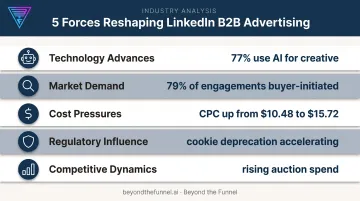
None of this happened by accident. Five forces are reshaping how B2B advertising works on LinkedIn.
- Technology advances: AI is now built into ad platforms—Gartner's 2025 survey of 418 marketing leaders found 77% of gen-AI users applied it to creative and 48% to strategy, cutting manual optimization time.
- Market demand: Buyers research vendors long before sales contact—6sense's 2025 study of nearly 4,000 buyers found they initiate 79% of engagements, and the first vendor contacted wins 77% of the time.
- Cost pressures: Rising CPCs push marketers toward sharper targeting over broad reach—HockeyStack's B2B SaaS benchmarks show average CPCs climbing from $10.48 to $15.72 in one year.
- Regulatory influence: Cookie deprecation and state privacy laws are accelerating reliance on platform-native, first-party targeting data.
- Competitive dynamics: More B2B budget enters LinkedIn's auction every quarter, rewarding sharper strategy and creative over volume alone.
How These Trends Are Impacting B2B Marketers
These shifts aren't staying theoretical. They're already changing how marketing teams plan, budget, and staff.
Operational Impact
Creative production cycles are shortening. A single static campaign no longer holds up against AI-driven optimization and rising ad fatigue.
Teams now need:
- Three to five rotating creative concepts running at any given time
- Testing frameworks that surface winners quickly instead of relying on guesswork
Business Impact
Budget allocation is shifting upstream. More spend is flowing into awareness and thought leadership content before lead gen even enters the picture. That requires realistic ROI expectations and longer attribution windows. A campaign built for pipeline six months out won't show its value in a first-month report.
Workforce Impact
This complexity is raising demand for specialized LinkedIn expertise. Validating audiences and building testing frameworks in-house through trial and error is slow and expensive. Partnering with a LinkedIn Certified Marketing Expert, such as Beyond the Funnel's founder Joshua Stout (one of only 16 in the U.S.), helps B2B brands reach validated results without the long in-house learning curve.
Future Signals for LinkedIn Ads Beyond 2026
LinkedIn's ad platform won't stand still after 2026. Watch these shifts over the next one to three years:
- AI-generated creative variants tailored automatically to each audience segment, not one-size-fits-all messaging
- Connected TV and cross-device retargeting as streaming claims more of the B2B buyer's day
- Native CRM and revenue integrations in Campaign Manager for true closed-loop pipeline reporting
Teams that build flexible testing habits now will adapt faster when these capabilities land.
Conclusion
AI-assisted campaigns, video and CTV growth, buying-committee targeting, authentic creative, and first-party data point to one shift: LinkedIn rewards advertisers who use its full-funnel capabilities over those still running static, single-format campaigns.
Brands that adapt early will outcompete the ones stuck in 2023-era playbooks. Strategy plus disciplined execution is what turns LinkedIn from an unpredictable cost center into a repeatable growth channel.
Beyond the Funnel's testing-driven, full-funnel approach is built for that work—the same approach that helped Evidation grow its pipeline from a few dozen to over 100 opportunities in a year.
Frequently Asked Questions
How much does a LinkedIn ad cost?
Pricing is auction-based and varies by audience, objective, and industry. B2B SaaS advertisers typically see CPC averages around $10–$16, depending on competition and targeting.
What do LinkedIn ads do?
LinkedIn ads let businesses target specific professional audiences by job title, industry, seniority, and company using sponsored content, messaging, and video. The goal can be brand awareness, website traffic, or direct lead generation.
Are LinkedIn ads worth it?
For B2B brands targeting professional decision-makers, yes. LinkedIn's precision targeting typically delivers higher-quality leads despite higher per-click costs than platforms like Facebook or Instagram.
What are the main LinkedIn ad formats in 2026?
Core formats include single image, video, carousel, document, event, Thought Leader, sponsored messaging, dynamic, and Connected TV ads. The right format depends entirely on your campaign objective and funnel stage.
Should I use Accelerate or Classic campaigns?
Accelerate suits fast, AI-guided launches, especially for teams without deep LinkedIn expertise. Classic suits advertisers who need precise account-based targeting or sequenced retargeting control.
How do I target the right audience on LinkedIn?
Combine professional attributes like job title, seniority, and industry with Matched Audiences built from CRM lists, website retargeting, and lookalikes. This is how you reach the entire buying committee, not just one contact.