Introduction
B2B sales reps spend 60% of their time on non-selling tasks — manual research, data entry, and chasing contacts who never reply. Meanwhile, cold email reply rates hover between 5% and 10%, and Gong's analysis of 25 million cold emails found that reps need an average of 344 cold emails to book a single meeting.
The math is brutal. On LinkedIn — where over 1 billion professionals are active and decision-makers are flooded with generic outreach — the volume problem compounds. More messages, same limited attention.
AI lead generation addresses this directly — scoring prospects, enriching contact data, and drafting personalized outreach without the hours of manual effort. This guide breaks down what AI lead gen actually means, the five best tools for B2B teams in 2025, and the practices that separate tools that generate activity from ones that generate pipeline.
Key Takeaways
- AI lead generation automates research, enrichment, scoring, and outreach — so reps spend time on conversations that close deals
- LinkedIn is the highest-value B2B prospecting channel, and purpose-built AI tools deliver measurably better targeting
- Evaluate tools on data accuracy, LinkedIn compatibility, personalization depth, and safety controls
- Clean ICP and intent-based triggers matter more than the tools themselves
- Measure replies, meetings, and pipeline — not emails sent
What Is AI Lead Generation?
AI lead generation uses artificial intelligence to automate and optimize the process of finding, qualifying, enriching, and engaging potential customers — cutting the manual research and guesswork that slow down most B2B sales teams.
It operates across four distinct stages:
| Stage | What AI Does | vs. Manual Approach |
|---|---|---|
| Lead Sourcing | Scans databases and signals to find matching companies and contacts | Hours of manual LinkedIn and Google research |
| Enrichment | Fills in missing contact and firmographic data in real time | Manually updating spreadsheets, often with stale data |
| Scoring & Qualification | Ranks leads by conversion likelihood using behavioral signals | Static scoring rules that don't adapt |
| Personalized Outreach | Drafts and sequences context-aware messages at scale | Copy-paste templates with token personalization |
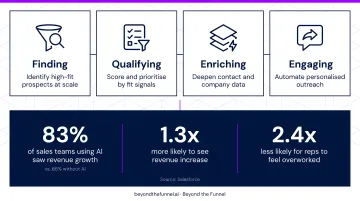
Salesforce research puts this in context: 83% of sales teams using AI saw revenue growth, compared to 66% for those without it. Teams using AI were also 1.3x more likely to see revenue increase and reps were 2.4x less likely to feel overworked.
The tools covered below address each of these stages, with particular attention to LinkedIn — where over a billion professionals make it the most concentrated platform for B2B prospecting.
Best AI Lead Generation Tools for B2B
Not every AI lead generation tool is built for B2B — and the wrong choice wastes both budget and outreach capacity. Each tool below was evaluated on data quality and freshness, AI personalization capability, native LinkedIn functionality, CRM integration, safety controls, and overall value for B2B use cases.
LinkedIn Sales Navigator
LinkedIn's native prospecting platform is purpose-built to surface the right decision-makers using advanced firmographic and behavioral filters that no external tool can fully replicate. As a first-party data source, it has a foundational advantage: the data is live, coming directly from the platform where your prospects actually spend time.
What makes it stand out:
- Real-time alerts on job changes, new posts, and company news — so outreach triggers off actual moments of relevance
- TeamLink surfaces warm introduction paths through your team's collective network
- Advanced filters by seniority, function, company size, growth signals, and more
- LinkedIn data shows Sales Navigator users make 5x more connections to Director+ leaders than non-users, and tailored outreach can improve response rates by up to 11.9x
| Best For | B2B sales teams relying on LinkedIn as their primary prospecting channel who need accurate, real-time decision-maker data before layering on outreach automation |
| Key AI Features | AI-assisted lead recommendations based on ICP, real-time alert triggers (job changes, mentions), smart filters to surface in-market buyers |
| Starting Price | Official pricing not published on LinkedIn's product page — contact LinkedIn directly or request a demo for current Core, Advanced, and Advanced Plus rates |
Apollo.io
Apollo combines one of the largest verified contact databases with multichannel outreach automation and AI-powered personalization — giving teams a single platform for data sourcing and outreach without stitching together separate tools.
What makes it stand out:
- 230M+ verified contacts across 30M companies, searchable with 65+ precision filters
- 91% email verification accuracy via a proprietary 7-step process — credits are refunded if a verified email bounces within 30 days
- AI-generated message snippets personalize first-touch outreach by referencing role, recent activity, or tech stack
- Intent data layer helps prioritize accounts actively researching relevant solutions
| Best For | SMBs to mid-market teams needing a large verified contact database paired with LinkedIn task sequences and AI-personalized email outreach |
| Key AI Features | AI-generated outreach snippets, intent signal filters, predictive lead scoring, email verification waterfall for clean contact data |
| Starting Price | Basic plan from $49/seat/month (billed annually); free plan available with 900 credits/seat/year |
Clay
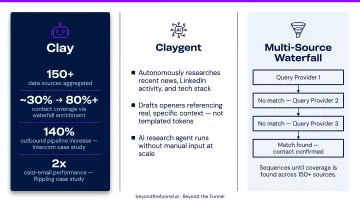
Clay is a lead research and enrichment platform that aggregates data from 150+ sources, runs AI agents to research prospects in depth, and generates context-aware outreach copy. It's the go-to tool for ops-savvy teams that want hyper-targeted personalization at scale.
What makes it stand out:
- Claygent — Clay's AI research agent — autonomously researches a company's recent news, LinkedIn activity, or tech stack, then drafts openers that reference real, specific context rather than templated tokens
- Multi-source data waterfall pushes contact coverage from ~30% to 80%+ by querying providers in sequence until a match is found
- Clay's own case studies report a 140% outbound pipeline increase (Intercom) and 2x cold-email performance (Rippling)
| Best For | Revenue operations and growth teams wanting AI-powered research and personalized outreach at scale, especially for high-value target account lists |
| Key AI Features | Claygent AI research agent, multi-source enrichment waterfall, AI-generated context-aware openers using live prospect data |
| Starting Price | Launch plan from $149/month (billed annually) or $185/month; free plan available |
Expandi
Expandi is a cloud-based LinkedIn outreach automation platform designed for B2B teams that need safe, consistent LinkedIn volume without risking account health. Its event-based sequences react to real-time triggers — post engagements, connection acceptances — to send outreach when relevance is highest.
What makes it stand out:
- Safety-first infrastructure: randomized timing, daily limits, and human-like behavioral patterns distinguish it from aggressive automation tools that trigger LinkedIn restrictions
- AI-generated openers and follow-ups are triggered off prospect activity, not static schedules
- Cloud-based operation with dedicated country-based IPs and profile auto warm-up
Important caveat: LinkedIn's User Agreement explicitly prohibits unauthorized automated methods for scraping, adding contacts, or sending messages. Any automation tool carries inherent policy risk — use Expandi within conservative limits and monitor account health consistently.
| Best For | LinkedIn-first B2B outreach teams that need safe, scalable connection and messaging automation with AI-personalized sequences |
| Key AI Features | Event-triggered AI message generation (post engagement, connection acceptance), smart inbox, campaign analytics for continuous sequence optimization |
| Starting Price | Business plan at $99/month or $79/month (billed annually); 7-day free trial available |
HubSpot (with Breeze AI)
HubSpot integrates Breeze AI across its hubs — bringing AI-assisted prospecting, lead scoring, email personalization, and pipeline forecasting into a single connected workspace most B2B teams can adopt quickly.
What makes it stand out:
- Breeze Prospecting Agent automates the research and outreach steps, enriching leads from multiple sources and drafting personalized outreach sequences without manual setup
- ICP-based configuration means the agent surfaces prospects that match your defined criteria from the start
- For B2B teams that need AI lead gen to flow directly into deal management and nurture sequences, HubSpot's unified data model keeps leads from falling between tools
| Best For | Growing B2B teams that want AI-assisted lead gen tightly integrated with CRM, email marketing, and pipeline management in one platform |
| Key AI Features | Breeze Prospecting Agent for automated research and outreach drafting, AI lead scoring, predictive deal insights, smart email personalization |
| Starting Price | Free CRM available; Sales Hub Starter from $20/seat/month (monthly) or $7/seat/month (billed annually) |
Best Practices for AI Lead Generation
Start with ICP and Data Hygiene
AI amplifies whatever inputs it receives. A poorly defined ideal customer profile or a dirty contact database produces faster results — just worse ones.
A clean ICP for AI lead gen includes:
- Firmographics: industry, company size, revenue range, geography
- Technographics: tools and platforms they already use
- Trigger signals: job changes, funding rounds, hiring surges, new executive hires
- Behavioral indicators: content engagement, pricing page visits, intent category activity
Get the ICP right before deploying any tool. This is the single biggest lever on AI-driven lead quality.
Use Trigger-Based Outreach, Not Batch-and-Blast
The most effective AI sequences react to real-time intent signals rather than blasting a static list. A prospect posting about a challenge they're facing, accepting a connection request, or visiting a pricing page is a fundamentally different outreach moment than a cold name in a spreadsheet.
Tools that enable this:
- Sales Navigator alerts — job changes, company news, post activity
- Clay enrichment — research a prospect's recent context before outreach fires
- Expandi event triggers — sequence messages react to connection acceptances and post engagements
Most teams optimize copy and ignore timing entirely — that's a mistake.
Test Messaging Before Scaling
AI can generate and send outreach at volume, but the message still has to earn a reply. Test at least two distinct opener angles per audience segment — measure positive reply rate, not open rate — and only scale what demonstrates genuine resonance.
Used well, AI removes repetitive tasks from your team's plate — so humans can focus on the conversations that actually close deals.
How We Chose These Tools
These tools were evaluated on six criteria:
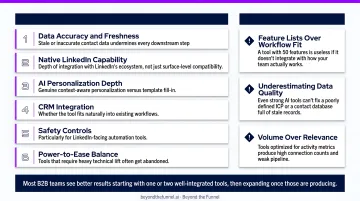
- Data accuracy and freshness — stale or inaccurate contact data undermines every downstream step
- Native LinkedIn capability — depth of integration with LinkedIn's ecosystem, not just surface-level compatibility
- AI personalization depth — genuine context-aware personalization versus template fill-in
- CRM integration — whether the tool fits naturally into existing workflows
- Safety controls — particularly for LinkedIn-facing automation tools
- Power-to-ease balance — tools that require heavy technical lift often get abandoned
The most common mistakes B2B teams make when choosing AI lead gen tools:
- Feature lists over workflow fit — a tool with 50 features is useless if it doesn't integrate with how your team actually works
- Underestimating data quality — even strong AI tools can't fix a poorly defined ICP or a contact database full of stale records
- Volume over relevance — tools optimized for activity metrics produce high connection counts and weak pipeline
Avoiding these mistakes narrows the field considerably. Most B2B teams see better results starting with one or two well-integrated tools, then expanding once those are producing. The right stack ultimately depends on team size, technical sophistication, and primary channel — not on which tool has the longest feature list.
Conclusion
AI lead generation works best when the strategy feeding it is already sound — clean ICPs, defined audiences, and tested messaging. The tools in this guide handle research, enrichment, and sequencing. The human advantage lies in the quality of strategy and targeting that feeds into them.
Start with a single bottleneck — lead sourcing, enrichment, or outreach personalization — and deploy one tool to solve it before expanding your stack.
For B2B brands using LinkedIn as a core channel, that outreach works harder when it's backed by a full-funnel advertising strategy that captures and converts the demand it creates. Beyond the Funnel builds LinkedIn campaigns purpose-built for this — audience validation, creative testing, and full-funnel structure that turns interest into measurable revenue. Connect with the team to explore what a full-funnel LinkedIn strategy looks like for your pipeline.
Frequently Asked Questions
What is AI lead generation and how does it work?
AI lead generation uses artificial intelligence to automate prospecting, data enrichment, lead scoring, and personalized outreach. Instead of manual research and copy-paste workflows, AI tools identify matching contacts, enrich profiles with fresh data, score leads by conversion likelihood, and draft context-aware messages at scale.
What are the best AI tools for B2B lead generation on LinkedIn?
LinkedIn Sales Navigator is the foundational data source — purpose-built for LinkedIn prospecting with first-party intent signals. Pair it with enrichment and outreach tools like Clay (for AI research depth), Apollo (for database scale), or Expandi (for LinkedIn automation) depending on your team's needs and budget.
How does AI improve lead quality compared to manual prospecting?
AI continuously enriches profiles with fresh data, scores leads on real-time intent signals rather than static filters, and enables personalization at scale that earns more qualified replies. The outcome is outreach that reaches the right people at the right moment — not a broad list with low relevance.
What are the biggest mistakes to avoid when using AI for lead generation?
The top pitfalls: deploying AI onto a poorly defined ICP or dirty database (AI amplifies bad inputs), scaling volume before validating message-market fit, and over-automating to the point where outreach feels robotic or triggers LinkedIn account restrictions.
Is LinkedIn automation safe to use for lead generation?
LinkedIn's User Agreement prohibits unauthorized automated methods, so any automation tool carries inherent policy risk. Tools like Expandi reduce that risk with randomized timing and built-in safety controls, but staying within conservative usage patterns and monitoring your account regularly remains essential.
What metrics should I track to measure AI lead generation performance?
Track connection acceptance rate, positive reply rate, meetings booked per week, opportunity rate, and pipeline generated. Review these weekly so the system can learn and improve. Vanity metrics like emails sent or connections made tell you nothing about lead quality.